
 Getty Images

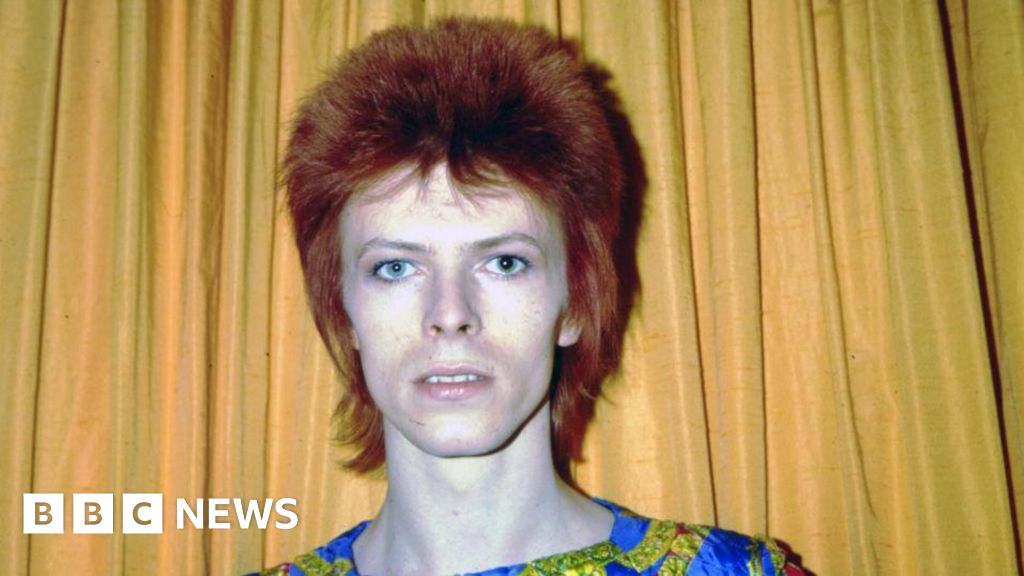
David Bowie helped to shape the sound of glam rock in the early 1970s
It’s been a decade since music legend David Bowie died from liver cancer in New York City.
But his story began in London, a city that shaped his artistry and still bears his imprint.
The BBC’s Nisha Patel reflects on the life of the Starman and explores some of the places that defined his extraordinary career.
Brixton: Where it all began
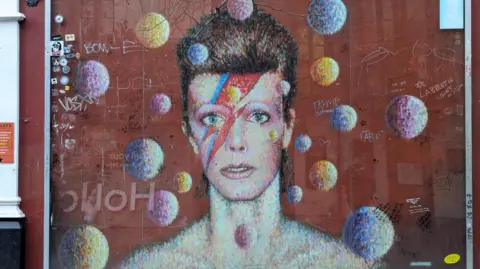
This vibrant mural was painted in 2013 by street artist Jimmy Cochrane
David Robert Jones was born on 8 January 1947 in Brixton, south London, to Haywood Stenton “John” Jones and Margaret Mary “Peggy” Jones.
Though he only lived there until the age of six, Brixton proudly celebrates its local legend.
Opposite Brixton station, on the side wall of Morley’s department store, stands a vibrant mural painted in 2013 by Australian street artist Jimmy Cochrane.
A burst of colour and Bowie’s iconic lightning bolt make it a site of pilgrimage for fans.
As I admired it, a passerby snapped a photo and said: “A local lad, one of us,” before walking away humming Starman.
Bromley: The formative years
 Heritage of London Trust
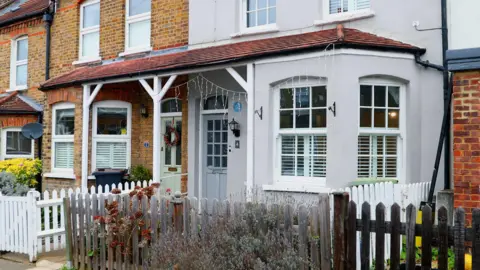
4 Plaistow Grove, Bromley, where Bowie lived from the age of eight to 20
Seven miles south-east of Brixton lies Bromley, where Bowie spent his teenage years. The Heritage of London Trust is restoring his childhood home at 4 Plaistow Grove, allowing fans to walk in his footsteps.
On Beckenham High Street, a pizza restaurant now occupies the site of the Three Tuns pub, where Bowie and his friend Mary Finnigan performed on Sundays.
These gigs evolved into the Beckenham Arts Lab, a creative hub that inspired the Free Festival of 1969 at Croydon Road Recreation Ground.
Today, the bandstand where Bowie played that summer is preserved behind a black gate, with a stone commemorating the event that inspired his track Memory of a Free Festival.
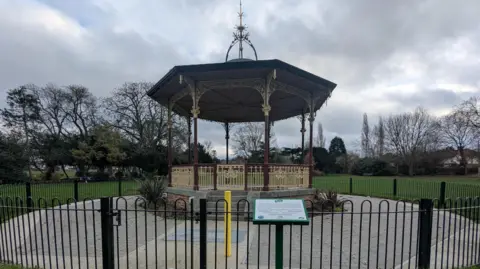
The bandstand where Bowie played in the summer of 1969 is preserved
Central London: Ziggy Stardust arrives
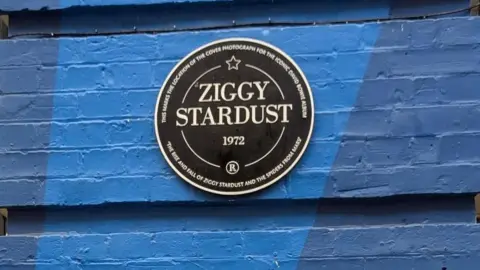
This plaque on Heddon Street marks the spot where Brian Ward photographed Bowie in 1972
In the mid-1960s, Bowie moved to central London in search of inspiration. On Heddon Street, just off Regent Street, a black plaque marks the spot where Brian Ward photographed Bowie in 1972 for the cover of The Rise and Fall of Ziggy Stardust and the Spiders from Mars.
“The concept was that Ziggy had just arrived from Mars,” says Adam Scott-Goulding, a Bowie enthusiast and music tour guide at London Walks.
“It was a misty, rainy night. Bowie wasn’t feeling well and almost cancelled, but that photoshoot became iconic. Until that record, he belonged to London. After this, he belonged to the world.”
Soho: The sound of Stardust
 Getty Images
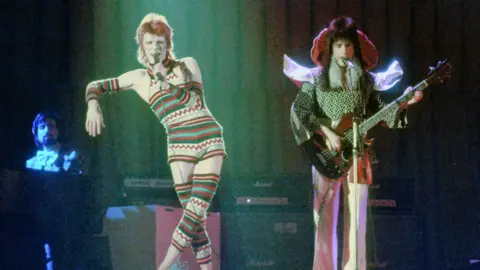
“Bowie’s space-themed track struck a chord and earned him his first hit,” Adam Scott-Goulding says
A short walk into Soho brings us to the former site of Trident Studios, marked by a blue plaque placed on BBC Music Day in June 2017.
Here, Bowie recorded the albums Hunky Dory, Ziggy Stardust and the ground-breaking single Space Oddity.
“Timing was everything,” says Adam. “In 1969, the world was captivated by the Moon landing. Bowie’s space-themed track struck a chord and earned him his first hit.”
Nearby, on Wardour Street, stood the Marquee Club. Bowie played here often, including his last appearance in 1973 for The 1980 Floor Show, a TV special featuring Marianne Faithfull.
Their unforgettable duet, a cover of Sonny & Cher’s iconic classic I Got You Babe – Bowie in a feather boa, Faithfull dressed as a nun – remains a glam rock milestone.
Global stardom and legacy
 Getty Images
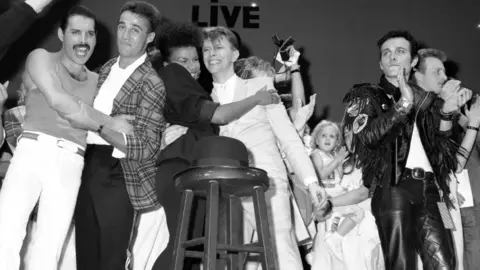
In 1985 David Bowie returned to London for Live Aid at Wembley
In the mid-to-late 1970s, after helping to shape the sound of glam rock, Bowie lived in Berlin, creating three monumental albums – Low, Heroes and Lodger.
In the summer of 1985, he returned to London for Live Aid at Wembley, where he performed the song Heroes, shortly after he had teamed up with Mick Jagger for Dancing in the Street, which was filmed in London’s Docklands.
“Bowie was the outsider,” says Adam. “He was rebellious, singular and inspirational. He did his own thing—and that drew people in.”
During his lifetime, Bowie sold more than 140 million albums, released 111 singles and produced 51 music videos.
His final album, Blackstar, was released just two days before his death at 69. It marked the end of an era, but Bowie’s influence remains woven into the fabric of music worldwide.