
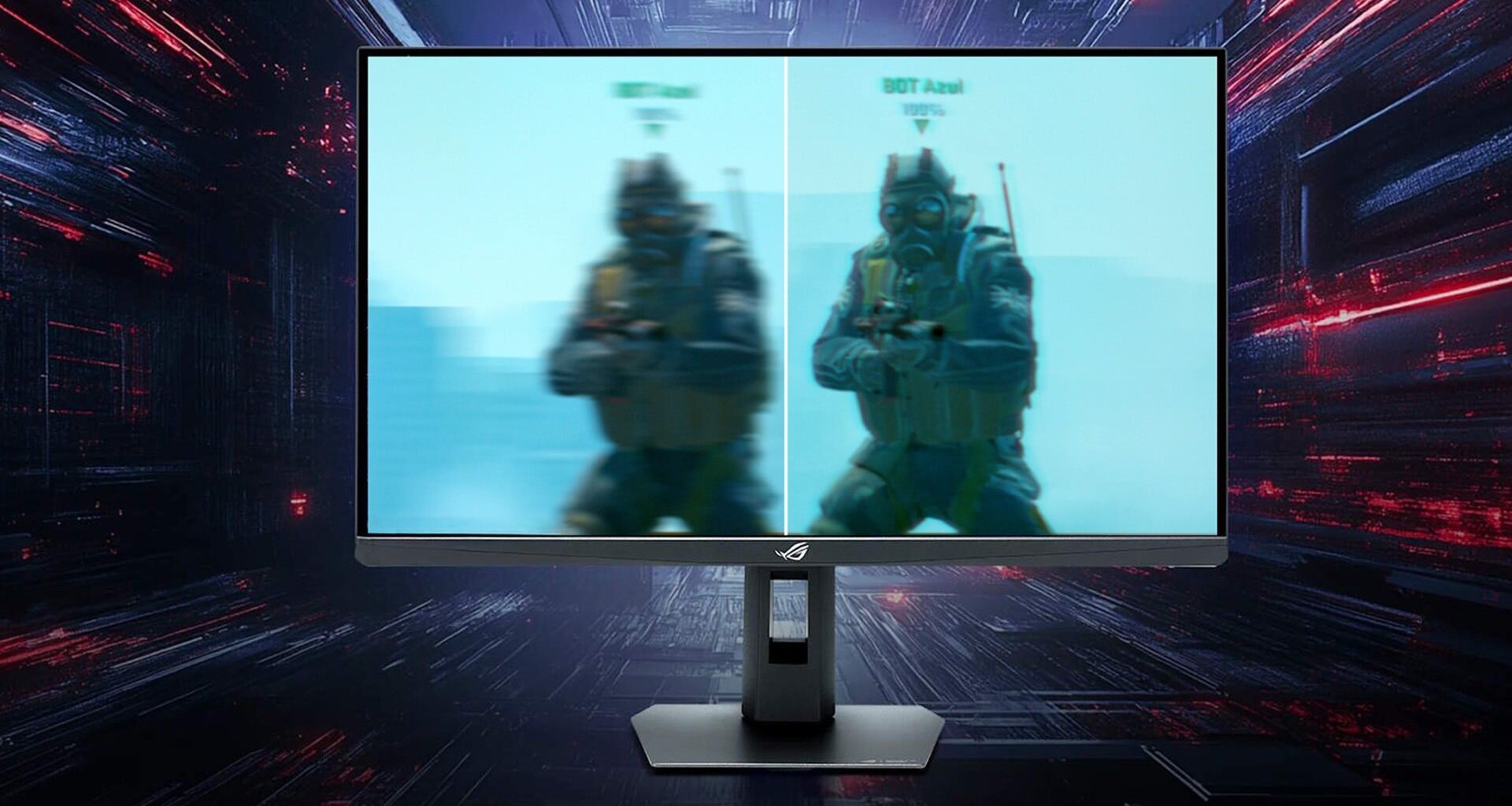
When we moved from CRT to LCD, gaming lost something of crucial importance: motion stability, motion clarity. Even today’s monitors exhibit motion blur, especially evident with strong lateral movement. Backlight strobing, black frame insertion and other methods have sought to mitigate the problem – but all have their drawbacks. Enter Nvidia G-Sync Pulsar – 4x motion clarity over standard LCD with full VRR support. While not quite perfect, it’s a genuine game-changer as John and Rich discuss.
Flat-panel displays will never be the same thanks to Nvidia G-Sync Pulsar. After nearly a month of testing one of the first compatible monitors ahead of their formal CES 2026 rollout, we can confirm that Pulsar-branded displays combine CRT-like motion clarity with variable refresh rate support and without any visible flicker – plus increased brightness, as opposed to the darkening inherent in other motion-adaptive display technologies.
Seeing is believing with something like Pulsar – though like other emerging screen technologies (ie HDR), there’s no way for us to fully reproduce its blur-reducing impact in a standard video, even with slow-motion capture. So we hope this in-depth look clarifies why we’re excited by Nvidia’s latest developments – and what we expect from Pulsar updates in the short- and long-term.
Flat-panel monitors may offer incredible convenience – and in the case of OLED panels, quality upgrades like infinite contrast ratios – compared to bulky cathode ray tube (CRT) monitors of old. But the trade-off has typically come in the form of motion blur, an issue that Pulsar almost completely resolves.
CRTs function by way of an electron gun in its titular tube firing out against a phosphor-coated screen glass. The way this system projects out and draws the screen’s image, from the top-left corner to the bottom-right, sweeps against the phosphors – and when they’re activated, they’re only visible for a short period of time. Pulse, decay and repeat. This lack of persistence aligns with how human eyes function, making any moving images appear to be free of motion blur.
When liquid crystal displays (LCDs) began rolling out as a more lightweight and affordable option for larger, pixel-dense monitors and TVs, these early models had noticeably slow pixel response times, so that moving objects would leave prior pixels in their wake. Take a high-speed pixel-art game like Sonic the Hedgehog and play it on an older or unoptimised monitor, and you’ll see the blue blur truly leave traces of his blue fur behind as still-lit pixels for multiple frames as he dashes forward.
 Anno 117 Pax Romana – here, Nvidia has used a standard LCD captured in motion with a high speed camera, on the left. The process is repeated with Pulsar active on the right, with vast improvements to clarity – and even higher brightness.
It has taken decades for panel makers to come up with alternative technologies to reduce apparent blur, though even with shrunken pixel response times – especially on responsive OLED panels – you’re still left with the noticeable issue of “sample-and-hold” blur – where an image hits the screen, the pixel updates, and it remains constant through an entire refresh cycle. As a result, your eye naturally perceives a blur as objects move across a screen. Make Sonic run on an OLED panel, and his trail of pixels – albeit much smaller – will still ever-so-briefly persist as perceptible pixels. Light information that travels from a real hedgehog’s fur to your eye doesn’t work the same way.
One solution to this issue has been backlight strobing, which blacks the panel out between every refresh of pixel information to eliminate sample-and-hold blur – a technique developed alongside research on 3D glasses. But this only works when a monitor is fixed to a specific frame-rate, which isn’t a great match for the often fluctuating frame-rates in modern video games. Worse, this constant blacking-out of a monitor creates visible flicker and reduces overall light output, resulting in a dimmer image.
As we’ve confirmed on the new ASUS ROG Strix Pulsar XG27AQNGV monitor, Pulsar handles this issue differently. Its IPS panel’s backlight operates via a rolling scan that’s broken up into horizontal segments across the screen. Instead of blacking out the entire panel, a Pulsar monitor can turn each segment off individually. Using a high-frame-rate camera to slow down a Pulsar monitor’s images, you can somewhat see the effect in motion – a rolling-screen effect much like a CRT.
The frame pulses for 25 percent of the draw time on the image, and that proportionately works out to what has been advertised as – and we agree – a 4x multiplier in image clarity. Nvidia documentation suggests that an animated image on a Pulsar screen running at 250fps will look to the human eye like 1,000fps on other panels. This 1,000fps target is the threshold that the monitor-quality experts at BlurBusters believe overcomes the visual issue of persistence blur on screens.
Yet even lower frame-rates benefit from Pulsar screens, with 120fps content looking like 360fps or higher. We fully believe that the perception of smoother motion on Pulsar-compatible monitors reduces the potential need for computers to run games at astoundingly high frame rates – the kinds of counts that we previously needed to reduce perceptible motion blur on standard LCD panels.
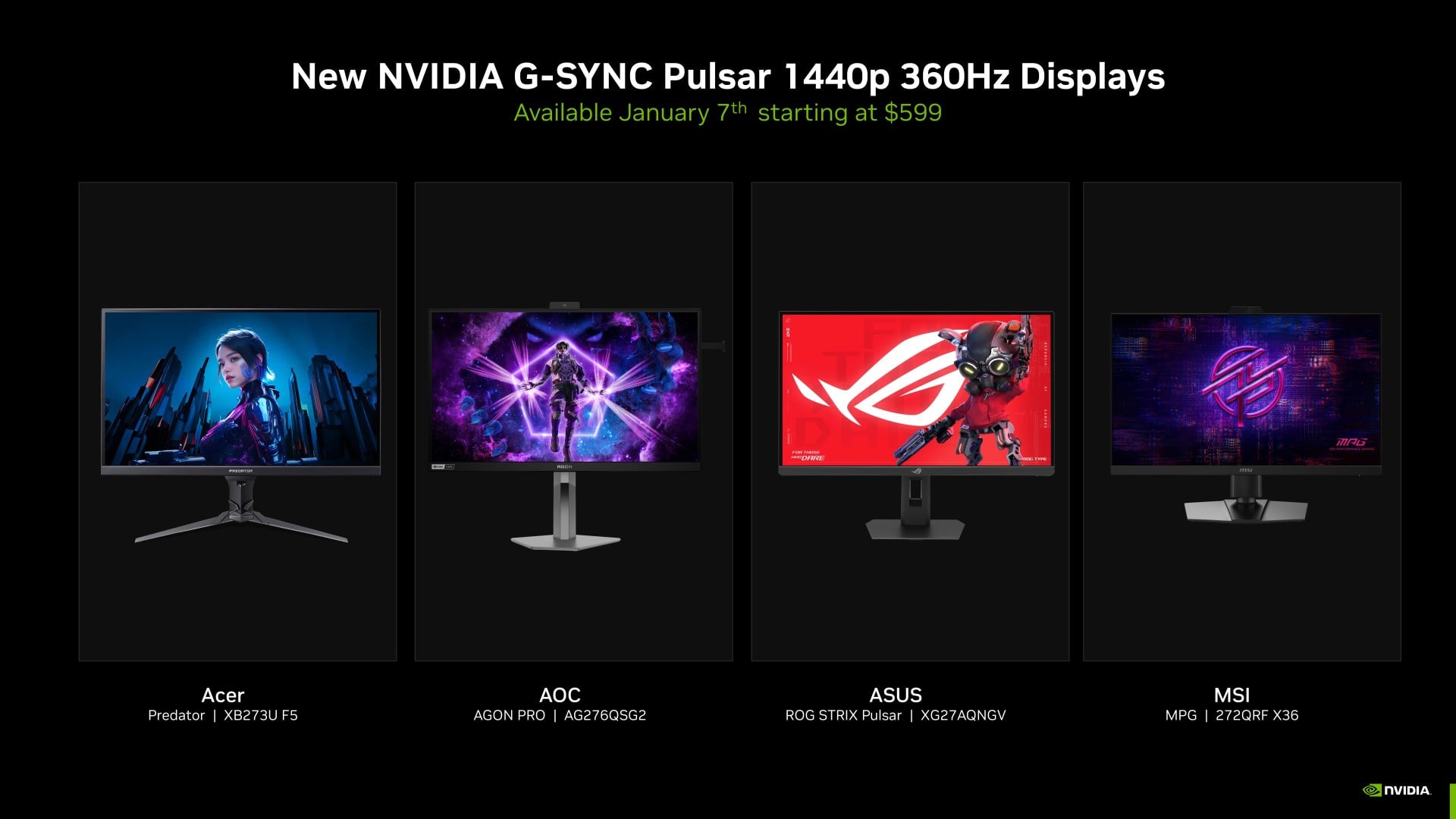 A quartet of Pulsar monitors are available for purchase now. Our experiences for this piece are based around a month of testing on the Asus ROG Strix Pulsar XG27AQNGV.
Pulsar doesn’t make games more responsive, though Pulsar monitors currently have incredibly low latency measurements between button taps and on-screen responses. Rather, Pulsar’s intelligent handling of pixel responsiveness and strobing creates such a reduced-blur image in high-speed games like first-person shooters that it reduces the seeming need to crank frame-rates as high as imaginable to look truly responsive to the naked eye.
Nvidia has been bullish about their Ada Lovelace and Blackwell GPUs utilising Multi-Frame Generation (MFG) to combine rasterised frames of visual information with generated frames and thus increase perceptible animation smoothness, and we can confirm that current MFG toggles for demanding path-traced software like Indiana Jones and the Great Circle lead to incredible fluidity and crispness on Pulsar panels. We’re curious how the upcoming, Blackwell-exclusive Dynamic Multi-Frame Generation (DMFG) system will look when combined with Pulsar technology.
Variable overdrive is an additional key component to Nvidia’s Pulsar rollout, as each segment of the LCD backlight is pulsed a second time to compensate for a game’s variable refresh rate (VRR). As previously mentioned, VRR support is a massive piece of Pulsar’s sales pitch, as it means Pulsar monitors can work without being fixed to specific frame-rates. During our testing period, however, this led to a considerable issue: a refresh-rate minimum of 75Hz.
Nvidia suggested this was implemented due to the backlight-pulse system possibly introducing visible flicker when running at lower frame-rates. But in conjunction with Mark Rejhon from BlurBusters, we sent pleas to Nvidia to consider how the tech works with lower frame-rates, and they’ve responded with an assurance that current Pulsar monitors will receive a patch to support a new Pulsar refresh-rate floor of 48Hz.
As of right now, the biggest limitations to the technology are made clear by the initial rollout. All of this month’s models are 27″ screens at 1440p resolution maximums, and all use IPS LCD technology, not OLED. Nvidia suggests that larger and more pixel-dense screens are inherently supported by their Pulsar technology – and what’s more, we’ve been told that per-scanline adjustments with every scanline being its own backlight section should be possible.
Decades on from their demise, CRTs continue to appeal. Sony Sony’s vintage 2003 GDM-FW900 CRT monitor is a 24-inch widescreen display renowned for delivering all of the advantages of CRT tech – stunning image quality and full motion resolution – combined with support for input resolution up to 2560×1600.
But Pulsar’s backlight-strobing system is important to note, as OLEDs are self-illuminated pixels and thus would require a very different system to operate in a way that resembles how Pulsar currently works. Somewhat related: Though all four of this month’s new Pulsar panels are advertised as HDR-compatible, our testing of the ASUS ROG Strix Pulsar XG27AQNGV confirmed that its slivered-backlight system delivers significant brightness – but not necessarily the contrast and depth needed for a convincing HDR presentation.
Additionally, as an Nvidia-exclusive technology, Nvidia GPUs are currently required to access Pulsar functionality on a compatible panel – much like how the initial rollout of G-Sync monitors required Nvidia GPUs, which is an unfortunate limitation.
We know that MediaTek is handling the chipset built into Pulsar screens, and we hope this more general-purpose chip can be updated to support other GPUs – or, for that matter, non-Windows devices like retro gaming systems and 4K-compatible upscalers. But we also know that Nvidia’s massive G-Sync push in the early 2010s eventually trickled out to general support for VRR – even making its way to the official HDMI spec – and we’re hopeful Pulsar’s innovations will similarly find their way across the entire TV and monitor ecosystem.
Nvidia’s current messaging about G-Sync Pulsar largely revolves around demanding, high-speed genres like competitive first-person shooters. Yet from our experience, the Pulsar impact scales as much, if not more, to other high-speed genres, particularly gorgeous pixel-art experiences that you could imagine feeling better on the blur-free majesty of old, bulky CRTs.
Thanks to the current 75Hz floor, we’ve been limited to testing titles like Freedom Planet 2 and Shinobi: Art of Vengeance, which support higher frame-rates, to combine their retro, 2D action with Pulsar’s incredible technologies. And the pairing of classic games with Pulsar’s benefits felt, quite simply, transformative. Thus, we’re excited about Nvidia’s upcoming 48Hz firmware update – and we imagine this topic will remain a talking point here at DF as bigger and more pixel-dense Pulsar panels make their way to store shelves.