
In a meeting with more than dozen major oil executives at the White House, Trump said, “When we own it, we defend it. You don’t defend leases the same way, you have to own it,” in reference to Greenland.
“We are going to do something on Greenland whether they like it or not.”
In a briefing to Congress on Jan. 6, Secretary of State Marco Rubio said the US would pursue a purchase of the territory, and Louisiana Governor Jeff Landry — appointed special envoy to Greenland by Trump — said he intends to “make Greenland a part of the U.S.”
At the same time, China and Russia have been increasing their military and shipping presence throughout the Arctic region, pressuring the US and Europe to ramp up their own combat preparedness and making Greenland a key security node. In January, a subsidiary of the Russian state-controlled nuclear corporation posted a video on Telegram of an icebreaking ship using the “Northern Sea Route,” which passes by Greenland to connect Europe and Asia in a path far faster than traversing the Suez Canal.
If Price’s company is successful, March GL’s operations could result in a major American energy presence in the High North at a time when territorial control has become a key focus of the White House.
Not that this was part of Price’s plan.
 Once the waters freeze over in Tasiilaq, no supplies will get in or out until the ice thaws. (Yahoo Finance/Jake Conley) · Jake Conley
The stakes are high for Price’s company.
March GL is planning to spend hundreds of millions of dollars, pooled from Price’s personal network and the company’s upcoming SPAC merger that will take it public, to develop the Jameson Land prospect, with plans to drill two initial wells at a cost of $40 million for the first and roughly $20 million for the second. Despite the arduous nature of operating in a region cut off from the rest of the world, Price is determined to install the exploratory wells in 2026.
“It takes a company with vision to get the first two wells drilled,” Price told Yahoo Finance. “Upon a discovery here, we all of a sudden become close to a major oil and gas company overnight.”
In Greenland, where the local government has spent decades desperate for any source of economic development, March GL’s success is also no small matter. Keeping Greenland from claiming its own sovereignty is an annual $560 million or so in funding that the territory receives from Denmark, accounting for more than half of the Greenlandic government’s revenue. Billions of barrels of oil exported from Greenland’s shores, from which the local government would collect a share of the profits, would go toward filling in that half-a-billion-dollar gap.
Yet, Price is chasing a major frontier prospect at a time where market dynamics in the oil industry have made costly new exploration efforts the most unattractive they’ve been since prices crashed in 2014. The market is headed for a major wave of oversupply as the Organization of Petroleum Exporting Countries, or OPEC, the 12-member cartel controlled by Saudi Arabia, has spent the past eight months raising its production targets and US shale oil operators and other exporters in the Americas have maintained or increased their own outputs.
Prices were trending toward four-year lows when Price’s team last traveled to Greenland in September, and the market is likely to be oversupplied by more than 3 million barrels per day in 2026, according to the International Energy Agency. Some on Wall Street have warned of prices on West Texas Intermediate crude, the US benchmark, falling to the $30 per barrel range next year if measures aren’t taken to curtail supply. And that’s accounting for the oil the world’s biggest producers have already identified, let alone what they haven’t.
“At the risk of flogging a very dead horse, our message to the market has remained consistent since June 2023,” JPMorgan strategists wrote in a report earlier this year. “While demand is robust, supply is simply too abundant.”
But oil drilling is never without risk. For Price, this is the biggest shot of his career, a moonshot.
Jameson Land sits more than 250 miles above the Arctic Circle, isolated from civilization. A ring of high mountains to the west, the Arctic Ocean to the north and east, and the deepest fjord system in the world to the south protect the basin from the harsh arctic environment and rip current winds that roar off the ice sheet covering nearly all of Greenland.
Reaching the peninsula is famously difficult and highly dependent on weather and light. Visitors fly from Iceland and land on the icy runway at Kulusuk, tucked in the mountains of Greenland’s southeastern corner, then fly more than 500 miles further north to land on the dirt at Nerlerit Inaat Airport, a tiny operating station known as Constable Point. Finally, they must take a helicopter or boat another 20 miles out to Ittoqqortoormiit.
Price, the 65-year-old visionary leading the team prospecting Jameson Land, has spent most of his life in the oil industry, and he is betting that the spoils of the peninsula are worth the effort. Throughout his more than 40 years in the field, the chief executive of recently formed oil exploration company March GL has drilled frontier “wildcat” wells across the continental US, in states ranging from North Dakota and Oklahoma to Kansas and Nebraska.
But Greenland has long drawn Price’s attention. Family history ties him to the region, as does a desire for a discovery on a scale that has eluded him thus far.
“I have drilled for and found millions of barrels of oil over my career,” Price told Yahoo Finance. “I have never, never drilled for billions of barrels.”
With no roads connecting Greenland’s settlements, all travel around the island must be done by air or sea. (Yahoo Finance/Jake Conley) · Jake Conley
As we flew over the Denmark Strait, Price described to me how he ended up leading the first major oil exploration project on Greenland in a generation. His father served as a weatherman in World War II, stationed by the US Air Force at a remote outpost on the arctic island. From that station, the elder Price wrote a series of letters describing the strangeness of being so far from civilization, the boredom and darkness, a polar bear fended off with a wooden two-by-four. Those letters were passed down to the younger Price, who was enamored with the alien world they depicted.
After making his way in the industry by managing some of the US’ largest oil and gas trusts — vast sums of riches made by earlier generations of wildcat oilmen — Price joined the ranks of a rarefied and dying breed of resource cowboys willing to take huge risks on even bigger payoffs, drilling for oil himself across the US.
Many of those sites turned up millions of barrels of oil. But the crown jewel — a billion-barrel discovery — never showed. It haunted Price and, eventually, drew him toward Greenland, one of the last untamed frontiers on the planet.
“I saw firsthand what oil wealth can do for families,” Price told me, “what it can do for communities and economic development.”
For several years, the prize of Greenland has been locked away from the market. In July 2021, the Naalakkersuisut government, concerned with preserving what remains of a pristine environment, passed a moratorium banning any new oil and gas drilling licenses.
In a statement issued when the decision was made public, Greenland’s government noted that, while data had shown vast potential for hydrocarbon development both on the island and beneath the waves off its shores, “the Greenlandic government believes the cost of extraction is too high.” The moratorium was being instated “for the sake of our nature, for the sake of our fisheries, for the sake of our tourism industry, and to focus our business on sustainable potentials.”
But in a stroke of luck for Price’s company, the government issued four hydrocarbon licenses to two small companies prior to the ban. Crucially, those licenses could not be annulled so long as the companies continued operating the sites.
Not that they were seen as having much promise. “My understanding is that the licenses that remain have very limited potential,” Mads Christensen, then the executive director of the Nordic branch of environmental advocacy group Greenpeace, told the Danish magazine Ingeniøren shortly after the decision was announced. But they remained active nonetheless. Today, three out of the four remain alive, all onshore oil and gas exploration licenses for acreage on Jameson Land.
When the set came up for an international bidding process, a subsidiary of the British exploration company 80 Mile bid for and won the licenses. Under the terms of a deal arranged between March GL and 80 Mile, Price’s company is funding new exploration efforts in return for a 70% stake in the license.
As the operational leader for the project, March GL will lead the drilling efforts, essentially grandfathered in under the nose of Greenland’s drilling moratorium. Upon merging with a blank-check company called Pelican Acquisition Corp. (PELIR), March GL will list on the public market in the first quarter of 2026 as Greenland Energy Company.
Data that Price’s company acquired and reprocessed tells him that, with these licenses, his team is sitting on 13 billion or more barrels of commercially recoverable oil, likely within the top five largest discoveries in the past 50 years, if accurate.
Price’s earthmoving equipment will remain stuck in Tasiilaq until it can be barged up the coast in spring. (Yahoo Finance/Jake Conley) · Jake Conley
Getting to all that oil, however, will be immensely difficult.
Ice flowing from the north and blocking prominent sea corridors can delay equipment deliveries and working time, and rogue weather can make it impossible to operate at times. Price is looking to spud, or begin drilling, his first well in the second half of 2026. But there are no highways or even backroads to Jameson Land from any of Greenland’s major settlements in the West, and the waterways in and out of the area freeze over in winter’s subzero conditions.
To get the hulking masses of metal that make up oil-drilling rigs out to the sites where Price and his lead petroleum engineer, Neel Duncan, are planning to drill their first wells, they must build their own roads. Equipment must be barged from Canada, Alaska, or the American Gulf Coast in a process entirely dependent on weather, and crews must be flown in by helicopter to work year-round in conditions that range from uncomfortable to dangerous.
Even once the drilling rigs are in place and ready to break ground, they may miss the “traps,” or spots in the rock hundreds or thousands of feet below the surface where oil has spent millennia collecting.
“There’s been plenty of other basins where, in theory, you do your work, your evaluation, and you see the potential for there to be a large resource, then the wells don’t ultimately yield what you hoped to find,” said Ruaraidh Montgomery, head of energy trends and analysis at the industry intelligence firm Welligence.
“It’s high risk stuff, and it will remain that way until they actually physically go and take a look at what can be done.”
The story of the oil industry is one of wild prospects that often left the explorers brave enough to chase them penniless. The masterstrokes of luck that have minted fortunes, however, keep investors coming back.
In the early 1960s, American geologists were pushing north, hunting for fossil fuels among the snow and ice of the Arctic Circle. By 1968, an American company called Atlantic Richfield Company (ARCO), today part of the British energy giant BP (BP), would make one of the most important discoveries in the history of the American energy sector: northern Alaska’s Prudhoe Bay, the largest oilfield in the US and a transformative asset for the country.
Decades later, in 2015, ExxonMobil (XOM) began drilling wells in the Atlantic waters about 100 miles off the coast of Guyana. Other companies tried and failed over the years to find oil beneath the seafloor, but in March 2015, workers onboard an oil-drilling ship called the Deepwater Champion placed the first of what would become dozens of wells into the water.
By 2022, Exxon had increased its Guyana estimates to 11 billion barrels of recoverable oil, a discovery that has helped the largest publicly owned oil company in the world vault past its peers. The area, called the Stabroek block, is now one of the most active and high-value oil plays globally.
Nearly 20 years after ARCO discovered Prudhoe Bay, the company was looking for new prospects, acquiring a license to explore a 10,000 square kilometer patch of land on Greenland’s Jameson Land. In the 1980s, the company spent more than $100 million in today’s dollars building out a bare minimum of infrastructure that included the Constable Point airport, a collection of less than a dozen buildings and a small aircraft hangar sitting adjacent to a dirt runway less than 1,000 feet from the waters of the peninsula’s fjords.
By 1989, a study of samples pulled from Jameson Land by ARCO and the Geological Survey of Greenland heralded good fortune for hydrocarbon exploration on the peninsula. Not only was there oil underfoot, but its profile was nearly identical to that of the oil being pulled from the floor of northern Europe’s North Sea — a light, sweet version of the substance, known as Brent (BZ=F), that has become the international benchmark for crude oil pricing, given demand for the oil’s profile.
Refiners may process 40 or 50 different grades, or chemical makeups, of oil on any given day. But light, sweet crude is particularly desirable because it requires a much smaller amount of processing to turn the substance into products like diesel or jet fuel than the heavier, more “sour” — or sulfurous — oils found elsewhere around the globe, according to several analysts at energy intelligence firms. Most of the oil discovered in Venezuela, for instance, is of this latter variety.
Millions of years ago, the areas that are now Greenland’s east coast and Europe’s North Sea were conjoined, geologic studies have shown. They were separated over time as volcanic activity shifted tectonic plates. But the fossil fuels, pushed apart with the land masses, remain similar.
The sky over Greenland glows pale yellow and blue as the sun rises. (Yahoo Finance/Jake Conley) · Jake Conley
“I’m very confident in those rocks just because it’s the same geology as the North Sea,” Duncan said. Even if the first two wells miss traps and come up dry, “We’ll still be fine,” Duncan told me. The data they’re able to gather, he said, will almost guarantee success on following attempts.
Yet, despite the promise of what could be another Prudhoe Bay-scale discovery, by 1990 ARCO had surrendered its Greenland licenses. The exploration rights, and all of the company’s data, were turned over to a Danish government-funded research institute called the Geological Survey of Denmark and Greenland. Years later, the 80 Mile subsidiary White Flame won the licenses and data, which Price and his team have reprocessed.
But it was not without reason that ARCO pulled out of Greenland. Not only had oil prices collapsed globally, making the risk of a frontier development with high upfront costs less attractive, but the logistics of operating in eastern Greenland are brutal, and the conditions even worse. In Jameson Land, roughly halfway up Greenland, the sun sets in early December and won’t reemerge over the horizon until late January — polar night.
For every Guyana-sized discovery, there are dozens of examples where the gamble didn’t pay off. Between 2005 and 2008, British energy major Shell (SHEL) went on a shopping spree, ultimately spending more than $2 billion buying up leases in the Chukchi Sea off the coast of Alaska. At the time, the Arctic, with its reserves long locked miles below the ice, was viewed as the next major frontier for oil wildcatting.
Shell’s progress in the Arctic was mired for years in delays ranging from pushback by environmental activists to the industry-wide public relations fallout of the Deepwater Horizon oil spill in the Gulf of Mexico. Once the company finally managed to mobilize and begin deploying resources to the area in 2012, Shell’s crews faced some of the harshest conditions on the planet, surrounded by water only four degrees above freezing in all directions and with only four months, from July to October, to get everything set up before ice set in for the winter.
Everything went wrong. A containment dome, meant to prevent blowouts, was “crushed like a beer can” during testing, according to a local radio station. One rig ran aground in a storm, and another suffered mechanical failures. Shell called off the efforts after spending $7 billion. Three years later, Shell tried one more time. But shortly after breaking ground on its first well, the company announced it was ending its Arctic campaign “for the foreseeable future.” Initial results from the wellhead weren’t enough to justify continuing.
Robert Price, right, is pursuing a frontier prospect in an era of mass de-risking for the oil and gas industry. (Yahoo Finance/Jake Conley) · Jake Conley
The largest discoveries throughout the industry’s history have long been the domain of the largest companies in the world. Mexico’s Cantarell Field has been handled by Petróleos Mexicanos — Mexico’s state-controlled oil company, referred to as PEMEX — since its discovery. The Stabroek oilfield, 100 miles off Guyana’s western coast, is operated by a partnership between Exxon Mobil, Chevron (CVX), and the China National Offshore Oil Corporation, or CNOOC. Kazakhstan’s Kashagan oilfield was discovered by a consortium that included Exxon, Shell, BP, and the French and Italian majors TotalEnergies (TTE) and Eni (E).
Throughout the 1980s and 1990s, at the same time that ARCO engineers were surveying Jameson Land, a coalition of companies, including Exxon, BP, and Shell, received licenses to prospect for oil through northeastern and northwestern Greenland, which were thought to be rich in fossil fuel reserves due to the regions’ geological history. The coalition, in partnership with the national Greenlandic oil company Nunaoil, performed initial testing on the regions, often with promising results, but in the mid-2010s, all of those companies surrendered their licenses.
“In a period of less than 10 years, Greenland has seen a dramatic change in industry interest from being one of the hottest regions for investments to virtually no activities at all,” said geologist Flemming Christiansen, who has spent the past 50 years studying Greenland’s petroleum and mineral extraction potential.
Some of the companies’ departures from Greenland were driven by new data that pared back reserve estimates or complicated the extraction process. Much of it was due to a crash in oil prices. In 2014, a wave of oversupply crushed the industry, cutting global prices by more than half. The largest oil and gas companies, which depend on stable returns to fund steady dividend payments, pivoted away from frontier developments and invested what exploration budgets they still had in well-known prospects located in countries with oil-producing histories.
The world’s major oil companies have never reentered Greenland, leaving an opportunity for March GL.
Tasiilaq is the largest settlement on Greenland’s isolated eastern coast. (Yahoo Finance/Jake Conley) · Jake Conley
“It would be a bit of a stretch [for the majors] to go and drop a lot of money on new exploration wells, just on the basis of seismic data that was shot in the ’70s,” Tom Liles, senior vice president of upstream research at industry intelligence firm Rystad Energy, told Yahoo Finance.
“But certainly, I think you could envision a scenario where there is a big discovery that proves analogous to the [Alaskan] North Slope or the North Sea in some respects, there could be some interest in gaining a portfolio position there.”
March GL’s assumptions on the oil reserves are based on seismic data, or underground radar readings, taken by ARCO in the 1980s, when the now-defunct company was first prospecting the basin. Price debated reshooting his own seismic data before drilling a well, but he told me he was counseled by colleagues in the field — including petroleum engineers who worked with ARCO at the time — that he would be better off skipping that step and going straight to getting a drill bit into the ground, which would provide reams of more accurate data.
“If it was a guaranteed discovery and it was all definitely going to be there, then someone else would have done it,” Saskia Goacher, an energy analyst at Welligence, told me. “It’s still kind of up in the air whether it will actually be there.”
It will take years before any true assessment of Jameson Land’s potential reserves can be made, and the seismic data Price’s team is working from only covers half of the basin, leaving the rest unknown, he told me. Exxon, for instance, drilled the first of its wells in the Stabroek field, called Liza 1, in 2015 and raised its projections for recoverable oil by piecemeal until they hit 11 billion barrels in 2022.
March GL, Price said, stands for March 2025, when the company was founded, and “Greenland.”
Or, depending on the day, “Good luck.”
We landed on Greenland at around 8 a.m. local time, but it could have been the middle of the night as the pilot touched the twin-engine plane down in between mountain peaks. In November, much of central and northern Greenland only experiences three to four hours of daylight.
By the end of the month, the entire share of the island above the Arctic Circle, roughly two-thirds of its landmass, won’t see the sun again until late January or early February.
A skeleton crew of maybe five greeted us with smoked salmon and cucumber sandwiches inside the slight building adjacent to the runway at Kulusuk, a settlement of around 240 people in Greenland’s southeastern corner, just as the sun began to breach the horizon. The plan had been to land in Kulusuk, fly north another couple of hours to Jameson Land and visit the sites Price and Duncan are prospecting for their first two oil wells, then fly west to the town of Tasiilaq, where contractors are preparing the Caterpillar (CAT) and Hitachi Construction Machinery Co. (6305.T) earth-moving equipment March GL will use to build a road from the coast to the company’s prospective drilling site.
Kulusk’s airstrip is manned by a small crew. (Yahoo Finance/Jake Conley) · Jake Conley
But when we arrived in Kulusuk, the polite but short-spoken pilot who had flown us from Iceland said a trip to Jameson Land would be impossible. Not only was there a storm brewing further north, but daylight was limited, and he worried we wouldn’t have time to arrive at Constable Point, see the drill site, and fly back to Kulusuk before sundown.
If we got stuck at Constable Point overnight, he said, there was no deicer at the site to prepare the plane for a flight south in the morning. Instead, we boarded a helicopter to Tasiilaq, cruising over the landscapes that keep settlements on the island geographically isolated.
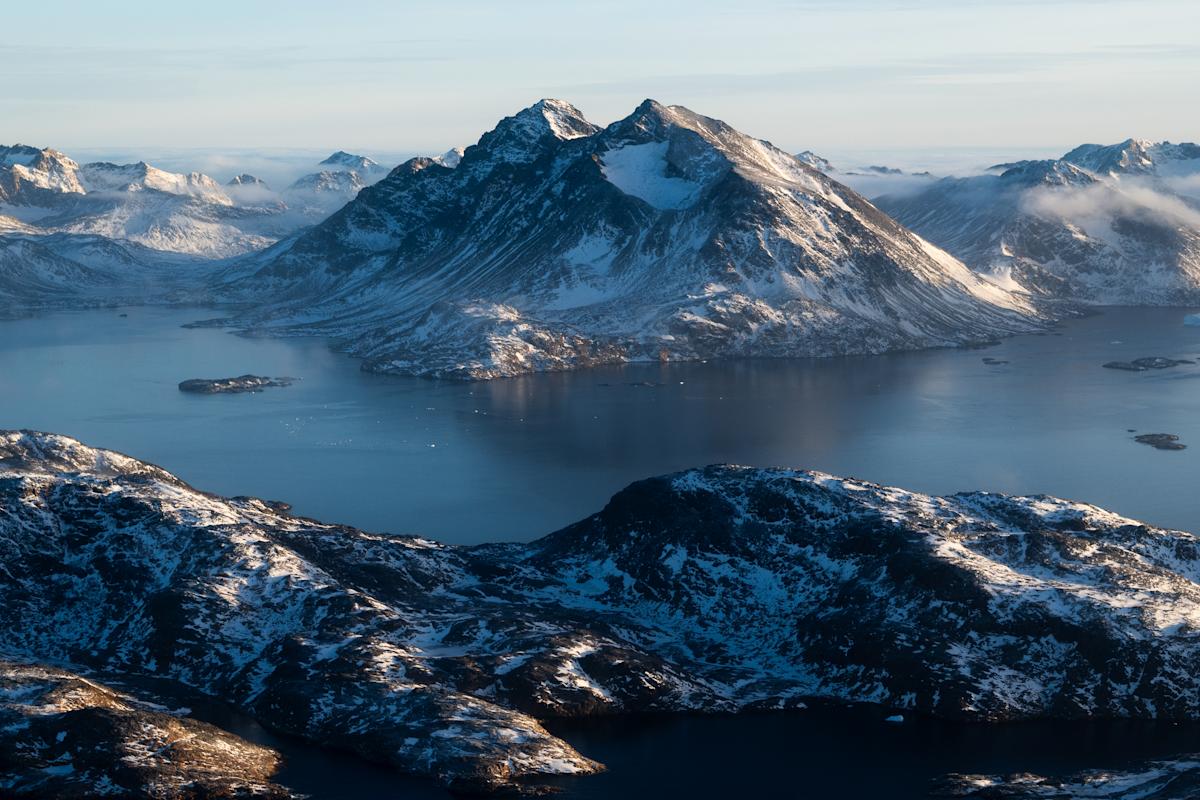
In the air over Greenland, outside of the settled regions, mountain ranges reach as far back as the horizon, cut by glaciers that have spent millions of years carving the landscape. The sky glows blue and yellow before reaching pitch-black darkness once the sun goes down, leaving only stars and the Northern Lights to illuminate swaths of the unsettled wilderness.
Greenland is more than twice the size of Texas, but there are fewer than 100 miles of roads throughout the island, and none of them connect Greenland’s towns to each other. All travel must be by air or sea.
Tasiilaq, a town of less than 2,000 permanent residents, is the largest settlement on Greenland’s remote east coast. Its port is a key pipeline for supplies that are delivered along the town’s waterways, but those waters freeze over the winter, typically around the end of November. Once winter sets in, no ships — and no deliveries — will get in or out of Tasiilaq until the ice melts, usually in late May.
March GL’s difficulty with its earthmoving equipment in Tasiilaq, delayed by the frozen waters off the coast, are visible proof of the precarity of operating in Greenland, where weather is less of a nuisance and more of a legitimate operational risk. And these delays, in part, also explain why the world’s largest oil companies have, for the past decade, largely ignored Greenland’s hydrocarbon potential despite a large body of evidence suggesting the land is oil-rich.
Price is attempting to pull off his company’s Jameson Land exploration during a period of de-risking for the largest players in the oil and gas sector. The majors, focused on cost-cutting and dividend payments, have laid off thousands of staff in the last year and cut back on their exploration efforts, instead focusing on finding new barrels by drilling more wells around existing hotspots in a process known as a “tieback.”
If Price and Duncan’s first set of wells yields the results they are hoping for — commercially recoverable reserves counted in the billions of barrels of oil — the majors’ reluctance toward Greenland is likely to change, several analysts said. The risk is not extracting the oil once a field has been established, but in taking the shot on the unknown and hoping for success.
Tasiilaq is full of Greenland’s signature brightly colored buildings. (Yahoo Finance/Jake Conley) · Jake Conley
March GL is already in conversation with some of the world’s largest energy companies, Price said, and his company has invited them to visit the site once March GL begins drilling. Some of those companies’ exploration managers, he told me, came to Jameson Land as young geologists early in their careers, and they are closely watching Price and Duncan’s success or failure.
“This is an exploratory project; it’s in the Arctic,” Price said. “Once we have success here, they will come and they will be very interested in potentially partnering with us.”
Such a move by an oil major would essentially be required for Price’s scheme to work, multiple analysts told Yahoo Finance, due to the sheer scale of infrastructure needed to extract massive volumes of oil. But if that were to happen, the Jameson Land basin would likely see a steel city spring up on its shores.
Storage tanks, pipelines, processing facilities, and power plants would all need to be built. In the deep waters of the nearby Scoresby Sund fjord system, a port big enough to berth crude oil tankers may be erected. Power plants will be required to electrify the operation.
For the crew, there will be need for a town like that built at Los Alamos. Airports, helipads, medical facilities, and a tangle of winterized roads would be necessary. As in Alaska’s Prudhoe Bay, where there once was nothing, a sprawling metal jungle could emerge.
Costs could balloon. And it’s not only analysts that think a maturing Jameson Land project would require backers with more resources than Price’s March GL.
“We hope that some of the big guys [would come] in and take over because they are the ones that can facilitate this in a proper way,” Jørgen Hammeken-Holm, the permanent secretary of Greenland’s Ministry of Business, responsible for overseeing mineral resources and energy, told Yahoo Finance.
Oil and gas are not Greenland’s only natural riches. The island, still largely unblemished, also holds beneath its surface a massive amount of minerals and metals crucial to the global economy. In the far northern region of Greenland, less than 500 miles from the North Pole, the Citronen Fjord is home to what is believed to be one of the largest undeveloped deposits of zinc on the planet.
To the West, licenses have been granted for potential extraction projects focused on graphite and the feedstock ores used to produce titanium, while others have proposed prospects focused on rare earth metals. In the South, miners plan to dig for gold. Eastern Greenland is oil territory.
“Greenland’s known and proven quantities of critical minerals, rare earths and oil could well provide the industrial building blocks necessary for an advanced global economy,” said James Kiernan, chairman of the company operating Greenland’s only active mining project, Lumina Global.
Kiernan’s private credit firm, Cordiant Capital, has provided backing to Lumina, which has spent the past decade operating in Greenland and currently runs the only commercially operating mine on the island. Lumina’s operations at a mining site in the southeastern corner of Greenland extract and export tens of thousands of tons of anorthite, a mineral used to manufacture glass and ceramics.
Anorthite is also used as a feedstock for the industrial production of cement and alumina, the primary chemical compound used to smelt aluminum. As in Greenland, where the environment can seem almost alien, anorthite is abundant in the crust of the moon.
Though the Greenlandic government has granted a litany of mining licenses over the years, only a few have ever been developed, and Lumina’s anorthite mine is the only one of those still standing. Many licensees surrender their rights before ever breaking ground, stymied by the same logistical hurdles that make oil and gas production unattractive to major global companies concentrated on low-risk opportunities.
With a population of less than 60,000, labor is in short supply, and most projects are fly-in, fly-out rotations of weeks at a time. Delivery of food and equipment is complex. Weather can keep crews stuck at a remote site for weeks longer than planned. The start-up costs are leagues higher than elsewhere in the world.
But the promise of economic development is enticing for many Greenlanders. When, in 2009, the island passed laws establishing its right of self-governance from Denmark, a requirement that half of any income above a certain threshold Greenland receives from its subsoil resources be deducted from the grants it receives from the Danish government was written into the act, chipping away at Greenland’s dependence on the European nation.
“There is a strong drive for activity within the minerals sector because that could lead up to more sovereignty or autonomy,” the Greenland Business Association’s managing director Christian Keldsen, who was involved with now-dormant offshore oil drilling projects in Greenland earlier in his career, told Yahoo Finance. “These are our rocks, this is our soil.”
Kulusuk, in the southeastern corner of Greenland, is tucked between mountains. (Yahoo Finance/Jake Conley) · Jake Conley
The locals, Keldsen told me, have been especially supportive of resource development, even as the government has pushed back and moved to lean toward environmental protection and renewable energy sources. Between flights, Price and Duncan described to our Air Greenland helicopter pilot, a gray-haired and brisk man named Jergen, what they were hoping to accomplish. The Greenlandic people, Jergen said, had been watching oil and gas developments closely for years, hopeful that one would come to fruition and begin generating tax revenue and royalties for the locals, at one moment telling Price to “please find oil.”
“We’ve seen for many, many years that Greenland would like to get independence, and in order to get independence, you have to be economically supporting your political system,” Christiansen, the Greenland analyst, said.
Driving the lack of environmental concern from many of Greenland’s locals is the fact that these resource developments — oil wells on Jameson Land, mines in the far north, and others — are so far removed from population that they are unlikely to affect local subsistence hunting and fishing activity, Hammeken-Holm told me.
“It doesn’t make me worried. It’s going to be set up in the middle of nowhere. It’s going to be a city without any connections,” he said. Hammeken-Holm pointed to the territory’s strict environmental protection policies for extraction projects as further reasoning for his security.
Yet, the world’s interest in Greenland’s resources hasn’t come without pushback. In 2007, an Australian company called Energy Transition Minerals (GDLNF) applied for a license to explore a patch of earth in southern Greenland, known as Kuannersuit in Greenlandic, or the Kvanefjeld deposit. Originally prospected in the 1950s for its uranium stores, the site is one of the world’s largest undeveloped deposits of rare earth minerals, which have become a crucial geopolitical sticking point amid the ongoing trade war between the US and China.
Eight years later, in 2015, Energy Transition Minerals submitted a plan to build an open pit mine focused on rare earth minerals, with plans to extract uranium as a co-product. But the project faced intense scrutiny from locals in the nearby town of Narsaq worried that uranium development so close to home would create significant radioactive waste posing steep health and environmental hazards.
In 2021, before the mine could be developed, the Greenlandic government passed laws banning the exploration and exploitation of resources that exceeded defined uranium content limits. Because the deposits at the Kvanefjeld deposit are above those limits, Energy Transition Minerals hasn’t been able to develop the site, which remains the subject of an active court case.
“That was a bit of an issue, the risk of contamination so close to the project,” Keldsen said. The further away from anywhere where there’s a relevant resource hunting ground or where people are living, Keldsen told me, the more supportive — or in some cases, indifferent — Greenland’s people are likely to be.
Greenland’s mountains have been cut by glaciers over millions of years. (Yahoo Finance/Jake Conley) · Jake Conley
There is also an expectation among Greenlanders that they will benefit from the extraction of resources from the island, Keldsen said.
For generations, hunting and fishing have been Greenland’s primary industries, providing the subsistence to support local communities. But large-scale industrial projects have remained an untouched development in Greenland despite its abundance of natural resources, in part because the territory does not have the expertise or capital to kickstart large-scale mineral extraction.
“It means that someone else is being allowed to make money off our resources,” Keldsen told me. In return, “There should be some income, there should be jobs created.”
Under the agreement made between March GL and the Greenlandic government, the territory will receive a sliding scale of payments from Price’s company, rising as March GL hits certain profit margins from a 3.75% royalty to a royalty of 15%. The scheme is known as an “R-factor” system, a model widely used by governments with frontier resource land, such as Egypt, Algeria, or Alaska.
Because the royalty payments don’t begin until the company running the extraction activity has reached a certain level of profitability, the system encourages exploration that is both high-risk and highly capital-intensive in the initial stages. If the project turns into a windfall, the host government can capture a greater slice of the profits.
The scheme also accounts for market instability without needing renegotiation. If oil prices were to suddenly jump while Price’s company is extracting crude oil, Greenland’s share of the profits rises in tandem with March GL’s profitability. If oil prices fell, the payments due to Greenland automatically scale down. At current prices, 13 billion barrels of crude oil would be worth more than $800 billion.
“That potential revenue stream is the closest revenue Greenland has to independence,” Price said. “It could be the genesis for transforming their country.”
The term “wildcatting” dates back to the Civil War period, when poorly collateralized banks established in the American West and willing to print paper currency in an era with no national banking system were said to be engaged in “wildcat banking,” a derogatory term meant to imply risk and unreliability. Over time, the term was co-opted by the hydrocarbon industry, applied to the oilmen who ventured beyond known land and took the risk of drilling for oil in untamed wilderness.
When Price talks about the project, he speaks with an unshakable faith that the oil he’s hoping to find will be there, that the reserves will contain the volumes he’s planning for, and that he will be the one to discover it.
But it is still, at its core, a wildcat prospect.
The weeks between our trip to Greenland and the publication of this story are another case in point.
Shortly after the US military’s removal of Nicolás Maduro from Venezuela, Katie Miller, a former Trump administration official and the wife of Trump’s key advisor, Stephen Miller, posted a cartoon of Greenland covered in an American flag on X, captioned: “SOON.”
If we don’t do it, Russia or China will take over Greenland, and we’re not gonna have Russia or China as a neighbor,” Trump said in his comments at the White House on Jan. 9.
“I would like to make a deal the easy way, but if we don’t do it the easy way, we’ll do it the hard way.”
President Donald Trump answers reporter questions during a meeting with oil executives in the East Room of the White House, Friday, Jan. 9, 2026, in Washington. (AP Photo/Alex Brandon) · ASSOCIATED PRESS
“This is the Western hemisphere, and American dominance is going to continue under this president,” White House Press Secretary Karoline Leavitt said in comments to the press on Jan. 7, noting that President Trump “keeps his options open” and therefore would not rule out potential military force in Greenland.
Responding to the White House’s statements over control of Greenland — including a refusal by Trump and Secretary of State Marco Rubio to rule out militaristic action — Danish Prime Minister Mette Frederiksen said such a move would trigger a breakdown of international relations.
“I will also make it clear that if the US chooses to attack another NATO country militarily, then everything stops, including NATO and thus the security that has been established since the end of the Second World War,” Frederiksen said to Danish broadcaster TV2 on Jan. 5
On Jan. 8, Denmark’s ambassador to the US and Greenland’s chief representative to the US met with members of the White House National Security Council about Trump’s renewed push for potential annexation, according to the Associated Press.
“Greenland’s return to the headlines is no coincidence, and the intensity of this debate confirms that energy security and national security are now inseparable,” Price told Yahoo Finance last week.
In September 2025, Price’s team took the arduous route to Jameson Land to finalize decisions over where they plan to install their first wells. Difficult and tiring as it is, Price and Duncan, the petroleum engineer, believe the journey was worth it.
The two men are steadfast in their conviction that every time they visit the peninsula, they are standing on one of the largest untapped hydrocarbon reserves in the world, projected to hold billions of barrels of oil that have never been recovered.
On Jameson Land, rolling lowlands stretch for miles in each direction, covered in a layer of vegetation that has thrived in the basin’s weather-protected region. The ground, a rust-colored mossy carpet, bends and bounces back into shape underfoot.
As they stood near the proposed drill sites in September, Duncan bent down and touched the shimmery liquid pooled beneath his feet, seeping out of the mossy ground. He stood and brought his hand close to his face, rubbing the fluid between his fingers. The petroleum engineer had, by this point in his life, spent more than 40 years working on oilfields and was intimately familiar with the substance.
“Beautiful,” he said. “Smells like crude.”
Jake Conley is a breaking news reporter covering US equities for Yahoo Finance. Follow him on X at @byjakeconley or email him at jake.conley@yahooinc.com.
Click here for in-depth analysis of the latest stock market news and events moving stock prices
Read the latest financial and business news from Yahoo Finance