
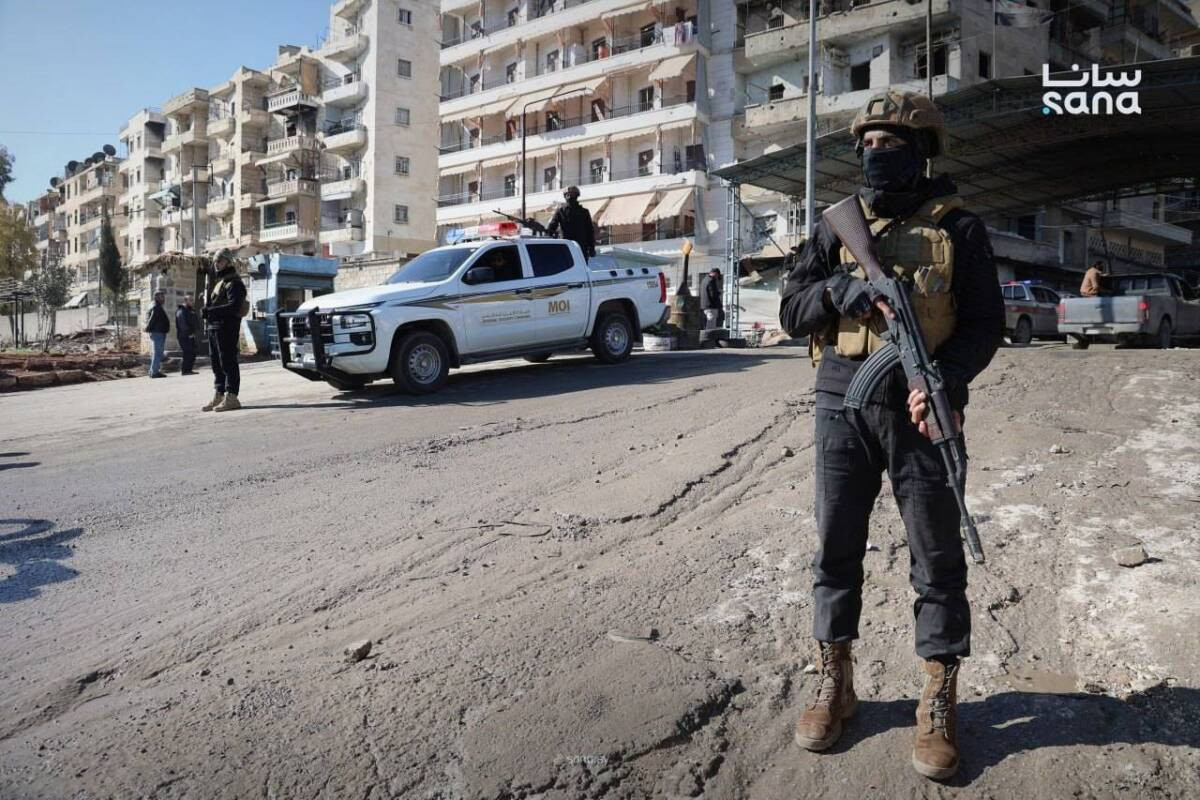
PARIS/QAMISHLI — Syrian security forces deployed inside Aleppo’s Sheikh Maqsoud neighborhood on Saturday morning, extending their foothold in the last Syrian Democratic Forces (SDF) stronghold in the country’s second-largest city following days of clashes.
Syrian state media announced all military operations inside Sheikh Maqsoud would cease at three o’clock in the afternoon local time on Saturday, alongside the evacuation of remaining SDF forces. However, sporadic clashes continued on Saturday evening, while a suicide drone struck the Aleppo governorate building following a press conference by government officials.
The Syrian Ministry of Defense launched a “precise” military operation against SDF forces in Aleppo’s predominantly Kurdish neighborhoods of Sheikh Maqsoud, Ashrafieh and Bani Zeid on January 6. Government forces took control of Ashrafieh and Bani Zeid earlier this week. More than 155,000 people have been displaced by the fighting.
The military operation in Aleppo city followed days of shelling and accusations between the two sides. The SDF accused Damascus of targeting Sheikh Maqsoud and Ashrafieh, while Syria’s government said its forces responded to the sources of fire coming from within the two neighborhoods.
As tensions rose inside Aleppo city, a military police checkpoint in the eastern Aleppo countryside was attacked by drones on Monday. The Syrian Ministry of Defense accused the SDF of responsibility for the attack, which injured three soldiers and disabled two vehicles. The SDF denied the accusation.
This week’s escalation in Aleppo falls within a recurring pattern of clashes and tensions in Syria’s second city over the past several months. These include an outburst of violence in December, as well as large-scale clashes in October—following the discovery of an SDF tunnel extending into Damascus-controlled neighborhoods—that ended with a ceasefire agreement sponsored by the United States (US).
The clashes also come amid a deepening political crisis between Damascus and the SDF. Negotiations surrounding the implementation of a March 2025 agreement to integrate SDF institutions into the state have stalled. Most recently, a meeting on January 4 produced no concrete motion towards implementing the deal. The deadline to implement the agreement passed at the end of 2025.
As Syria’s new government seeks to assert security control over the entire country, questions mount over whether this week’s military escalation forms part of a broader pressure campaign with repercussions not only for Aleppo, but for Syria’s coastal region and southern Suwayda province.
What led to this week’s fighting in Aleppo, and what are its political and military implications? Where does the SDF stand, and has it shifted from a negotiating party to a disruptive actor seeking to preserve gains that are no longer guaranteed?
Sheikh Maqsoud
“The limited military operation in Aleppo came after all negotiating solutions with the SDF were exhausted. It is in response to the ongoing ceasefire violations,” a media source in the Ministry of Defense told Syria Direct on condition of anonymity. Syria’s government decided to “extend stability and security in Aleppo, to protect residents of the city, of all Syrian components,” he added.
“The military escalation in Aleppo is a natural outcome of the failure of the negotiation track,” independent Syrian political researcher Mahmoud Allouch told Syria Direct. This failure “is not because the [March] agreement was flawed or its deadline was not sufficient, but because the SDF bet on everything except integration into the Syrian state and had no genuine national will to do so.”
Despite the military solution in Aleppo, a comprehensive political settlement with the SDF remains “possible” if the latter shows “realism and rationality,” Allouch said. At the same time, forcibly ousting the SDF from Aleppo “marks the beginning of a new Syrian-Turkish approach to resolve this file and impose solutions by partial or total force if necessary.”
Kurdish forces had controlled Aleppo’s Sheikh Maqsoud and Ashrafieh neighborhoods since 2015, and remained present when opposition forces took control of the rest of the city in November 2024 before toppling the Assad regime.
In April 2025, the new Syrian government signed an agreement with the SDF in Aleppo that stipulated the withdrawal of the latter’s forces with their weapons to SDF-controlled areas east of the Euphrates River. The Ministry of Interior, in cooperation with the SDF’s Internal Security Forces (Asayish) were to assume responsibility for security in the two neighborhoods. At the time, the agreement was broadly seen as a litmus test for the success of the broader March 10 agreement.
While the SDF withdrew part of its forces from the Aleppo neighborhoods last April, it did not fully implement the agreement, leaving the fate of Ashrafieh and Sheikh Maqsoud an open question until this week.
“The Sheikh Maqsoud agreement has been suspended by the transitional government in Damascus for four months, with no progress towards implementing it. This attack is the result of suspending the agreement,” Hevin Sulaiman, co-chair of the Sheikh Maqsoud and Ashrafieh neighborhood council and one of the signatories to the April agreement, told Syria Direct. “We are determined to make this agreement a success, and are in constant communication with the government to this end,” she added.
A ‘disruptive actor’
The deadline for implementing the March 2025 agreement to integrate all SDF civil and military institutions into the Syrian state expired at the end of the year, reigniting mutual accusations. The SDF asserts it remains committed to the deal, while the Syrian government accuses it of procrastination and evasion.
Military action in Aleppo is “mainly designed to pressure the SDF to engage in negotiations leading to a political settlement,” researcher Allouch said. “There is division and currents within the SDF—tied to the wing of the [Kurdistan Workers’ Party] PKK in Qandil—that do not want this agreement and seek to disrupt it and thwart the peace process between Turkey and the PKK.”
“It is clear that this current has great influence on the SDF, and is what is pushing it to engage in a game of deception,” Allouch added.
But Lazgin Ibrahim, a researcher at the Qamishli-based Euphrates Center for Studies, said “the talk about two conflicting currents within the SDF is often used as a ready-made narrative to portray it as a confused force or a party evading its obligations.” This portrayal is “exaggerated and weak,” he told Syria Direct.
“There may be different assessments or disagreements on the priorities, such as the pace of integration, guarantees and the form of security arrangements. However, these differences do not automatically become opposing currents that paralyze decision making,” Ibrahim added.
For his part, one researcher in Aleppo, who asked not to be identified for security reasons, held that the SDF has stalled the agreement’s implementation “in the hope there would be a regional change towards the al-Sharaa government, or that it would be overthrown. However, the international climate today favors Damascus.”
“The SDF is trying to entrench itself in the file of chaos, not solutions, to reproduce itself as a disruptive actor, not one that builds stability. This serves only Iran and Israel in the region,” the researcher added.
Ibrahim, of the Euphrates Center for Studies, rejected this characterization of the SDF “transitioning from a negotiating party to a disruptive actor.” The SDF, in his view, has maintained a clear approach since last year’s March agreement: “calm coupled with implementation, not open-ended negotiations without commitments.”
“The essence of the SDF’s behavior in the past period was to push for stabilizing the ceasefire and opening a course for institutional integration and political arrangements to ensure representation and partnership, while maintaining anti-IS operations within the requirements of shared security,” he said.
“The real dilemma lies not in the presence of horizonless negotiations on the part of the SDF, but in the absence of executive will from Damascus,” Ibrahim said. “It resorts to managing negotiations as a tool to buy time, improve its image or ease external or internal pressures, then returns to pressure tactics on the ground as soon as the obligations of concrete implementation draw near.”
Accordingly, “Sheikh Maqsoud and Ashrafieh have become an arena of political pressure on the ground,” he added, accusing Damascus of using “civilian suffering as a negotiating lever.”
The most recent negotiating session “revealed that Damascus is treating the March 10 agreement as a flexible framework for political consumption, rather than as a binding contract with steps for implementation,” Ibrahim said. He pointed to the “striking coincidence between the course of domestic negotiations and Damascus’ preoccupation with highly sensitive foreign files, headed by the American-mediated Syrian-Israeli negotiations in Paris to reactivate the 1974 disengagement agreement.”
Shortly following the fall of the Assad regime on December 8, 2024, Israel unilaterally declared the 1974 disengagement agreement between the two countries null and void and invaded Syrian territory. Over more than a year since, Israel has entrenched its military presence inside southern Syria.
Damascus “appears less willing to make genuine domestic concessions because it feels the cost of intransigence has decreased after its external position improved and economic restrictions on it eased” with the lifting of international sanctions, Ibrahim added.
Separatism
Over the past months, the SDF has been accused of supporting and financing calls for secession in Druze-majority Suwayda province and on the Syrian coast. Recent media reports accused the SDF of providing financial and logistical support to local factions in Suwayda, and providing refuge to former regime officers and loyalists, narratives that the SDF denies.
“The SDF played a role in inciting [Sheikh Hikmat] al-Hijri and regime remnants against President al-Sharaa in the past period, and this approach is one of the reasons that led the situation with Damascus to explode,” Allouch said. Such actions aim to “keep projects of separatism, political decentralization and federalism on the table,” he added.
However, “these wagers did not succeed, and the SDF came under great pressure, especially given the major shifts that have taken place in external interventions and roles in Syria,” Allouch said.
Damascus aims to “stop the SDF from moving its tools” by taking “the cards of Suwayda and the coast out of its hands—intensifying security campaigns on the coast and increasing pressure on regime remnants there and keeping hundreds of suspected regime officers under surveillance,” the Aleppo researcher said. “In Suwayda, the government is working to dismantle the al-Hijri militias.”
Yasser al-Suleiman, spokesperson for the Autonomous Administration (AANES) delegation negotiating with Damascus, rejects accusations that the SDF supports separatist movements. “We are not on a desert island, there are no sea ports that would make the Autonomous Administration aspire to secession,” he told Syria Direct. “Likewise, there is no Kurdish-Kurdish consensus, nor regional, Arab or international agreement on this matter.”
“Secession is not among the principles of the [Autonomous] Administration,” al-Suleiman said. “If independence were given, the Kurdistan Region of Iraq—which has enjoyed international sponsorship—would have obtained it, but independence or secession was not allowed.”
US pressure
As Allouch sees it, in Aleppo the SDF tried to drag the Syrian government into “a confrontation on its own timing, rather than the timetable of Ankara and Damascus, but al-Sharaa is now in a better position,” Allouch said. The Syrian president was able to “consolidate the leadership’s stability over the past year, neutralize some pressing challenges and oversee significant progress in the Syrian-Israeli negotiations during recent meetings in Paris.”
Therefore, “the timing of these military moves is more or less linked to the breakthrough achieved in the negotiations in Paris, especially in terms of the US becoming more serious about demonstrating its commitment to pressure the SDF and force it to implement the integration agreement,” he added.
Last week, the fifth round of Syrian-Israeli negotiations was held in Paris under US mediation, after stalling for two months. Following the session, the US, Syria and Israel issued a joint statement announcing the establishment of a “dedicated communication cell” to coordinate intelligence sharing, military de-escalation and diplomatic engagement.
If the US were to “lift cover from the SDF and pressure it to engage in a real negotiating path leading to implementing the integration agreement and preventing a military confrontation, I believe the SDF would have one option: to make a decision on the path along which things will proceed,” Allouch said.
However, the US “does not want to present a united Syria to al-Sharaa before taking what it wants from Syria, which includes many demands, including an agreement with Israel,” he said. Washington “used the SDF to put pressure on al-Sharaa over the past year, and as a tool of influence in shaping the relationship with the new Syria.”
The political researcher in Aleppo went further, saying “the provocation with the SDF coincides with Israeli negotiations.” In his view, “the SDF wants to provoke the government to commit mistakes and repeat what happened on the coast and in Suwayda to use it politically against Damascus.” However, “the government learned the lesson and will not give this card to the SDF.”
“Damascus’s success in Aleppo will be followed by a freeze in negotiations and increased Syrian-Turkish intelligence work to dismantle the SDF,” the researcher added. Damascus “has been preparing for military scenarios in eastern Syria for two months, to prepare for controlling the Jazira” region.
“The future of negotiations between the SDF and Damascus will not be decided inside the negotiation room alone, because this track is linked to the balance of regional pressures and international understandings,” researcher Ibrahim said.
“Whenever foreign issues move in the interest of Damascus, it tends to reduce its willingness to offer internal concessions, and goes back to using pressure tactics on the ground,” he added.
This report was originally published in Arabic and translated into English by Mateo Nelson.
