
At CES 2026, Japanese startup 3DC showcased a new 3D graphene nanomaterial designed to improve fast-charging and high-power battery performance. The material, called Graphene MesoSponge (GMS), uses a porous, nanoscale structure that allows electrons to move more freely inside battery electrodes. Unlike flat graphene sheets, GMS forms a connected internal network, which 3DC says reduces resistance and improves charging efficiency.
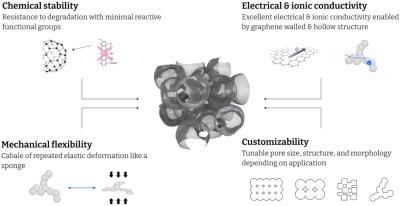
Image credit: 3DC
Founded in 2022, 3DC is commercializing research that began nearly a decade earlier at Tohoku University. The company is backed by Open Innovation funding from Hyundai and is currently operating at pilot scale while working with global battery manufacturers.
GMS’ structure is different than that of conventional graphene. It forms a hollow, sponge-like network with walls only one atom thick. The company controls pore size, layer count, and overall shape during manufacturing. The nanoscale structure allows electrons to travel through interconnected pathways rather than across flat surfaces.
According to the company, that design improves electrical conductivity inside battery electrodes without relying on additional conductive additives. By embedding the material directly into the electrode structure, 3DC aims to improve how batteries handle rapid energy flow during charging and discharging. The company says this design can also help reduce degradation over time. Improved electron transport lowers stress on battery materials during repeated charging cycles, which can extend usable life.
The company is already supplying pilot-scale samples to manufacturers worldwide and testing its material with major battery companies. Several global manufacturers are evaluating GMS for use in lithium-ion and next-generation battery designs. The startup plans to scale up production soon. It aims to move from pilot manufacturing to full mass production in 2026.
Beyond batteries, 3DC says it can tailor the material’s structure for other uses, including semiconductor thermal management.