
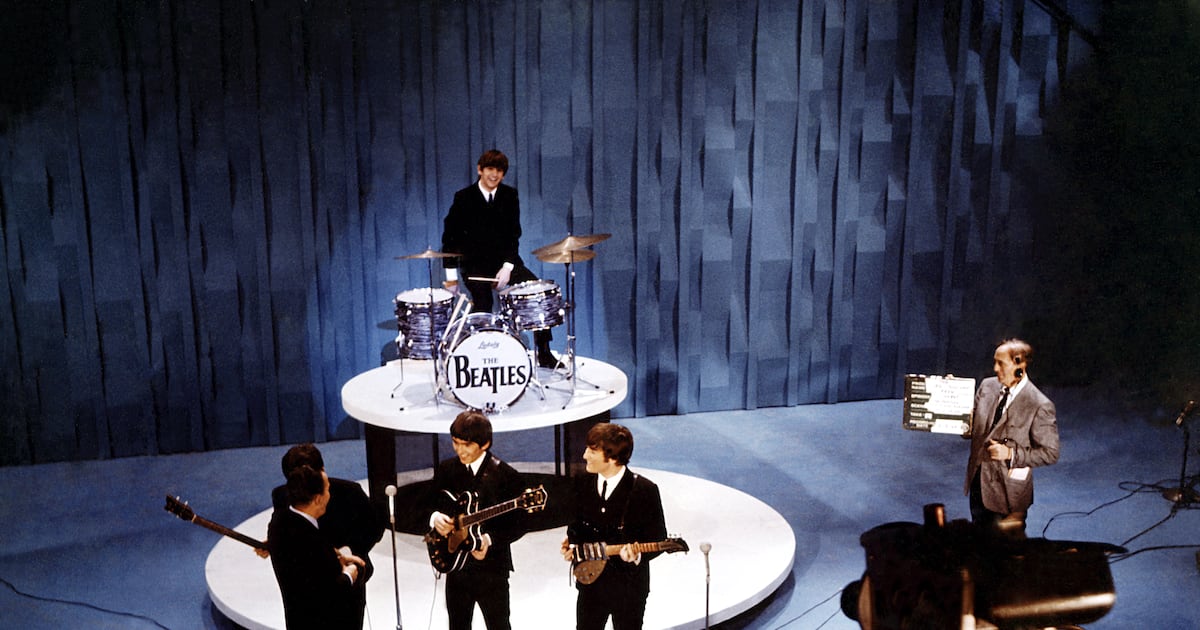
So we begin 2026 wondering if The Beatles may soon vanish from public consciousness. It seems unlikely. But even Paul McCartney once admitted the possibility of the band having a mayfly existence.
“I couldn’t care less, really, if we flopped tomorrow,” he told David Frost way back in 1964. “It’d be sad, you know. But it wouldn’t really worry me.”
This then seemed a realistic prospect. The “respectable” media fully expected The Beatles to pass from memory as quickly as the trad-jazz boom that preceded their rise. Shortly before McCartney appeared on Frost’s show, Newsweek magazine published a famously premature obituary. “A preposterous farrago of Valentine-card romantic sentiments,” the weekly bellowed. “The odds are they will fade away, as most adults confidently predict.”
That didn’t happen. The group prospered through the 1960s and, following their dissolution, in 1970, have continued to hold a grip on public consciousness.
Ian Leslie’s lovely John & Paul: A Love Story in Songs, a study of the relationship between (obviously) John Lennon and McCartney, received breathless reviews last year. Conan O’Brien recently appeared on the unavoidable Rest Is History podcast to eulogise his favourite band. Most ambitiously, Sam Mendes is preparing a tetralogy of films, each focusing on an individual Beatle. They will resonate forever, right?
Maybe not. Sean Ono Lennon, son of Lennon and Yoko Ono, triggered the debate in a recent interview with CBS News. “I’m just doing my best to help make sure that the younger generation doesn’t forget about the Beatles,” he said of efforts to keep the music alive.
“Do you think that’s even possible?” Anthony Mason, a CBS broadcaster, replied.
“To forget about it? I do, actually,” Lennon said. “And I never did before.”
It is worth noting that The Beatles’ divinity remained, if anything, even more unquestioned in the United States than it did in their home country. Malcolm McLaren’s disingenuous claim that Glen Matlock, original bass player of the Sex Pistols, had to leave the band because he “liked The Beatles” didn’t raise many laughs in the rock clubs of West Hollywood. Mason does not question whether The Beatles are likely to fade from view; he questions if such a thing is “even possible”. As if Lennon jnr had argued that the moon might spontaneously abandon Earth orbit.
The interview, conducted just before Christmas, generated a rustle of discourse, including a fretful column in the Wall Street Journal from Matthew Continetti. “Troubling news from Strawberry Fields,” he wrote. “Sean Ono Lennon suggested his father’s music might fade from memory.”
Why would this be so unlikely? Is it because they were so good? Is it because they were so popular? Many are the celebrated artistic entities that faded from consciousness as the decades advanced. Leaving aside aesthetic arguments (which must be subjective), the case is more that, if The Beatles were going to vanish, then they would surely have done so by now. Sixty years of popularity is maybe enough to guarantee another 100.
“Who now listens to the Glenn Miller Orchestra, for example?” Continetti, a millennial Beatles fan, ponders. “Which DJ spins Bing Crosby?”
This strikes me as the wrong question. Better to ask how many youngish people in the 1960s still listened to music that emerged in the 1910s and 1920s. To Al Jolson? To Fanny Brice? How many then dressed in celluloid collars and flapper dresses? Not many.
We are now at the same remove from the emergent Beatles, Rolling Stones, Kinks and Who as the 1960s generation was from those already dusty turn-of-the century figures. Not everybody under 30 could name a track from Revolver. Quite a few could not pick Keith Richards out of a line-up.
But what, say, Geese, the most lauded rock group of 2025, were doing on their fine, angular album Getting Killed is unmistakably in the same ballpark as the more awkward corners of The Beatles’ White Album. The Brooklyn band wear jeans and T-shirts. They have shaggy haircuts. Nobody would remark on their oddness if they wandered across the Let It Be sessions disinterred in Peter Jackson’s mammoth Get Back documentary.
My thesis is that, at the centre of the 1960s, some quality emerged in popular culture that, for all the intervening twists and turns, has never entirely gone away. If The Beatles fade into the mists then so does everything else from that decade’s creative nebula.
“Do you still think people will still be listening to The Beatles in 500 years?” Tom Holland asked Conan O’Brien on The Rest Is History.
“Yeah. I do,” he replied. “That is with the caveat: if we are all still here.”
That may be stretching it. But they should certainly manage another 50.