
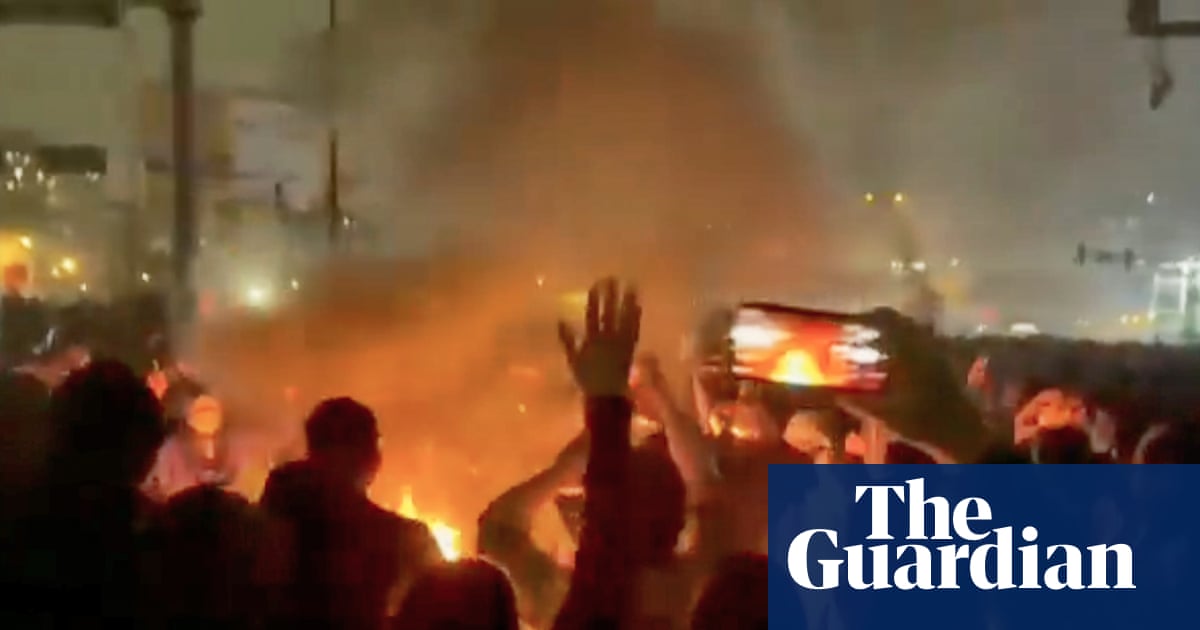
Iran warned the US not to attack over protests that have rocked the country, as Donald Trump weighed all options for a response from Washington, with the reported death toll from the demonstrations soaring to the hundreds.
More than 500 people have now been killed in the violence surrounding demonstrations, according to the US-based Human Rights Activists News Agency (HRNA), including 490 protesters. The group reported that more than 10,600 people were arrested by Iranian authorities. The regime has not supplied its own figures and it was not possible to independently verify them.
The drastic rise in the reported death toll came as authorities intensified their crackdown on the protests, now in their second week. Rights groups were struggling to reach contacts within Iran due to a complete internet shutdown in the country, and warned that the death toll was likely to climb even further.
The brutal crackdown has raised the likelihood of US intervention, with Trump saying he would “rescue” protesters if the Iranian government killed them.
He reiterated his threat to intervene on Saturday night as the protests raged. “Iran is looking at FREEDOM, perhaps like never before. The USA stands ready to help!!!,” the US president said on the Truth Social platform.
The Wall Street Journal reported that Trump was to be briefed by his team on Tuesday on options including military strikes, using secret cyber weapons, widening sanctions and providing online help to anti-government sources. Iranian officials bristled at the prospect of a US strike, with the speaker of parliament warning that Israel and US interests in the Middle East would be “legitimate targets” if Washington struck Iran.
“In the event of an attack on Iran, both the occupied territory and all American military centres, bases and ships in the region will be our legitimate targets,” Mohammad-Bagher Ghalibaf said.
The protest movement in Iran is the most significant unrest the country has experienced in years. Though triggered initially by a sudden slide in the country’s currency, protesters soon demanded political reform and called for the downfall of the government.
Iran’s regime has weathered mass protest movements before, but analysts say the current unrest is happening because the government has been weakened by an economic crisis and in the aftermath of its summer war with Israel.
Iranian authorities arrested key members of the protest movement, the national police chief has said.
“Last night, significant arrests were made of the main elements in the riots, who, God willing, will be punished after going through legal procedures,” the police chief, Ahmad-Reza Radan, told state TV on Sunday, without specifying the number of those arrested.
Iran’s attorney general had said earlier that those who were caught protesting, or even helping protesters, could be charged with being “an enemy of God” – which is punished with the death penalty.
US senators echoed Trump’s call, with Sen Lindsey Graham saying on social media that Iranians’ “long nightmare is soon coming to a close”.
Israeli officials said they were on high alert for any US intervention in Iran, with Israeli media reporting that they are remaining silent on the issue to avoid allowing Iranian authorities to cast the protest movement as foreign-backed.
A screengrab from footage circulating on social media from Iran shows protesters in Tehran. Photograph: AP
Authorities cut off internet access in the country on Thursday, imposing a nearly impenetrable nationwide blackout. Human rights groups said Iranian authorities had used the cover of the internet shutdown to expand their crackdown against protesters, using deadly force and live ammunition to disperse demonstrations.
A map show the size and spread of the protestsDemonstrators rally in London on Sunday in support of protesters in Iran. Photograph: Suzanne Plunkett/Reuters
Previously, when the US struck Iran’s nuclear enrichment sites in June, Iran carried out a strike on a US military base in Qatar. The strike was seen as mostly symbolic as it was telegraphed and did not lead to any deaths among US military personnel.
Despite the crackdown, protests continued overnight on Saturday and more were expected on Sunday. Videos showed what appeared to be thousands of protesters in northern Tehran, banging pots and chanting protest slogans. In Mashhad, the birthplace of Iran’s supreme leader, Ali Khamenei, protesters appeared in videos facing off with police, creating roadblocks and lighting fires.
Protesters gather in Mashhad in Iran’s Razavi Khorasan province in this screengrab from social media. Photograph: Social Media/Reuters
Rights groups have said that while proper, exhaustive documentation is near-impossible due to the communications blackout in the country, there have been increasing reports of soaring a death toll among protesters. The Center for Human Rights in Iran said on Sunday that it had received credible reports from witnesses that hundreds of protesters had been killed in recent days.
Messages and videos trickle out of Iran sporadically, mainly ferried by activists who have Starlink satellite internet services.
A protester in the central Iranian city of Sari, according to messages forwarded via the US-based Abdorrahman Boroumand Foundation, said security forces had placed the city under complete martial law.
“A large number of security forces armed with military weapons have set up checkpoints. Every car is being stopped, even if there are just two people inside. They are telling everyone that anyone who is outside will be shot,” the protester said.
An Iranian activist abroad told the Guardian their cousin managed to call them via Starlink on Saturday night in a panic. She was fleeing a protest in the Andarzgoo neighbourhood in Tehran after authorities started using “military weapons” on unarmed protesters, describing security forces opening fire on men, women, and children at close distance.
In videos forwarded to the Guardian, large crowds can be seen streaming through the streets with what appears to be teargas around them. A second video shows the protester fleeing, with the sound of gunshots heard in the background as she repeats the word “shameless”.
A video verified by the Hengaw human rights group shows several bodies of what the group said were protesters killed by authorities in a warehouse in the Kahrizak area of Tehran. The organisation said the warehouse was a facility adjacent to a morgue and was being used as an overflow facility as the morgue was too overcrowded. Iranian state media blamed the death on protesters.
Iran’s president, Masoud Pezeshkian, who previously offered to enter into dialogue with protesters, appeared to adopt a harder line on Sunday. “People have concerns, we should sit with them and if it is our duty, we should resolve their concerns,” Pezeshkian said. “But the higher duty is not to allow a group of rioters to come and destroy the entire society.”
While it faces protests at home, Iran’s government has become increasingly concerned about a possible strike from the US or Israel.