
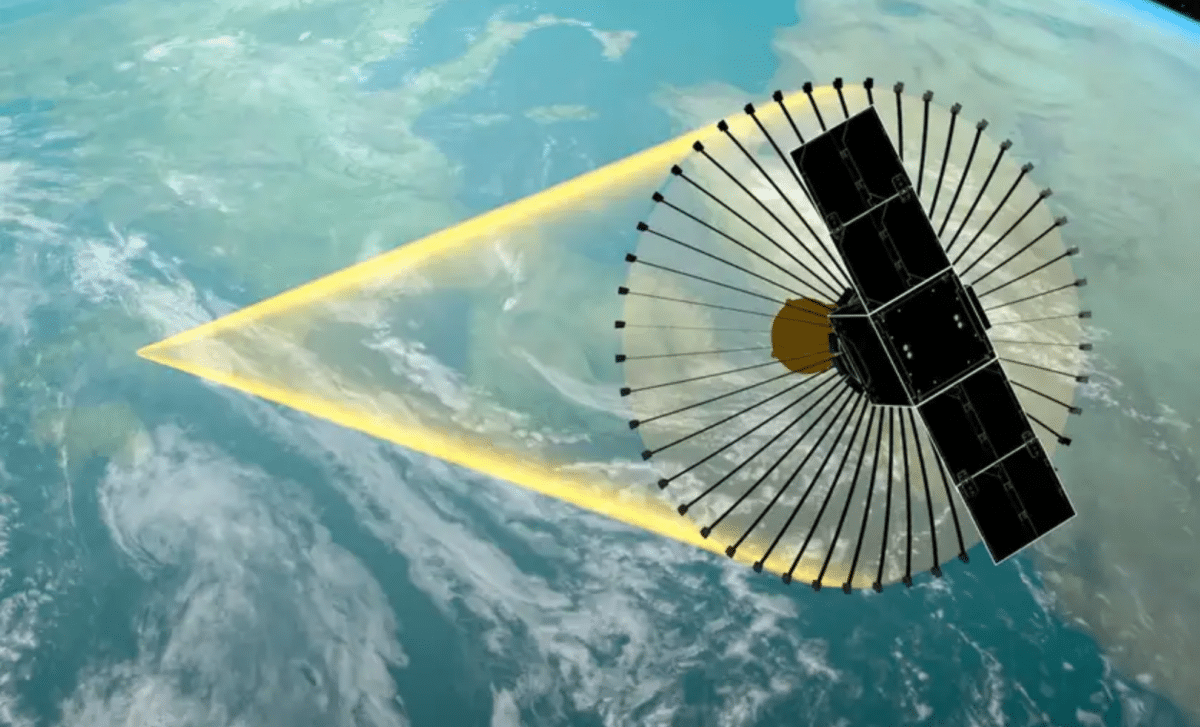
The UK’s CarbSAR satellite is set to revolutionize Earth observation with a uniquely crafted radar antenna. Unlike traditional antennas, CarbSAR’s mesh antenna is produced using a method commonly found in textile factories. The satellite, developed by Oxford Space Systems (OSS) in collaboration with Surrey Satellite Technology Limited (SSTL), is set to deploy a radar system that could bring unprecedented precision to Earth imaging.
A Knitted Antenna for High-Tech Space Imaging
The CarbSAR satellite’s radar antenna, a pivotal component in its design, is produced using an industrial knitting machine, an approach that sets it apart from other satellites in orbit. This knitting machine, typically used in textile factories to create garments, has been modified to handle tungsten wire coated in gold. According to Amool Raina, the production lead at OSS, “It’s a very standard, off‑the‑shelf industrial machine used for knitting jumpers. All we’ve done is add some bells and whistles to let it stitch our special yarns.” This innovative design technique allows for the creation of an extremely lightweight and flexible mesh radar antenna capable of operating in space.
A standard industrial knitting machine has been modified to produce fabrics from tungsten wire coated in gold, which are used to form the dish on the CarbSAR satellite https://t.co/pC7Xlz7tDx
— New Scientist (@newscientist) January 9, 2026
The unique properties of the mesh antenna make it not only efficient in radar signal transmission but also highly cost-effective. Traditional radar antennas are typically built using rigid and bulky materials, which increase the overall weight and complexity of the satellite. CarbSAR’s knitted mesh antenna, however, offers both versatility and efficiency. The structure can easily unfurl once in space, maintaining the required precision to create a functional radar system. As Sean Sutcliffe, OSS’s chief executive, explains,
“But for the imaging we want to do, we also need to unfurl with precision—to get that perfect parabolic shape. And that’s the beauty of our design.”
According to New Scientist, testing has confirmed the antenna’s ability to maintain its ideal shape with extraordinary accuracy, as the mesh remains within a millimeter of the desired structure. This precision is critical in ensuring that the radar system can capture high-resolution images of Earth’s surface. The engineering behind CarbSAR’s antenna proves that small, innovative changes in manufacturing can lead to significant advancements in space technology.
The Importance of Collaboration in Satellite Innovation
The development of CarbSAR is a perfect example of how collaboration between different sectors can lead to extraordinary technological breakthroughs. The partnership between Oxford Space Systems and Surrey Satellite Technology Limited has brought together expertise from both space engineering and industrial manufacturing. This collaboration has paved the way for the creation of a cost-efficient and highly effective satellite capable of achieving precise radar imaging.
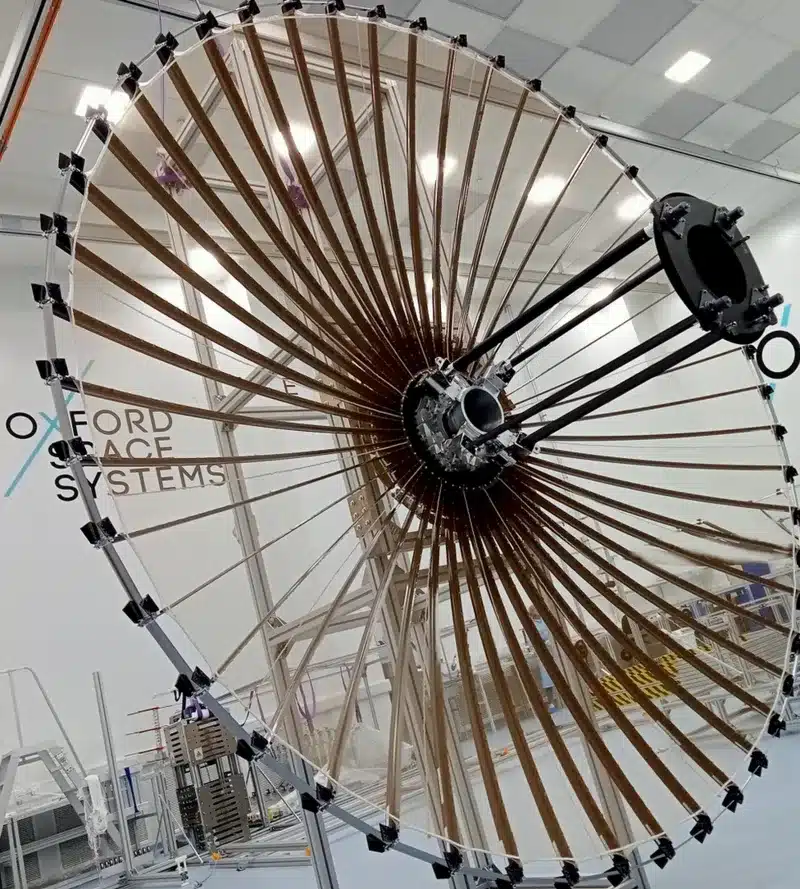 Credit: Oxford Space Systems
Major General Paul Tedman, the commander of UK Space Command, acknowledges the significance of CarbSAR’s capabilities in pushing the boundaries of satellite technology. He praises the project by stating,
“CarbSAR is a testament to the innovation and collaboration of one of the UK’s most forward‑thinking space companies.”
Tedman’s endorsement highlights the importance of the satellite’s potential to enhance Earth observation and support future space exploration missions. The satellite’s unique design could also be integrated into larger satellite programs, such as the ISTARI satellite initiative.
CarbSAR’s Impact on Earth Imaging and Space Exploration
CarbSAR’s mission goes beyond simply being a technical marvel; it holds immense potential for advancing our understanding of Earth’s surface. Equipped with a radar system capable of capturing high-resolution images, CarbSAR will offer a new tool for scientists and researchers to monitor changes in the environment, track natural disasters, and assess global climate patterns. The satellite’s precision radar images will allow for unparalleled detail in Earth observation, enabling more accurate predictions and improved responses to environmental challenges.
Moreover, CarbSAR’s design could inspire future developments in satellite manufacturing, potentially leading to more affordable and adaptable space technologies. The innovative use of a knitting machine for fabricating the antenna opens up new possibilities for how we think about satellite construction. The lightweight, flexible nature of the mesh antenna could be a game-changer for deploying satellites quickly and cost-effectively.