
As humans, we like to think we’re one of a kind. But pull the camera back and the picture gets simpler: humans, like every other species, run on instincts shaped by evolution.
One of those instincts kicks in when something outside the group feels threatening. Give people a shared problem, or a shared opponent, and they often grow closer.

Researchers call it the “common enemy effect”: we tighten our bonds when we believe we’re facing the same challenge.
It’s not just a human thing. Chimpanzees do it. And now a new study suggests bonobos also do it – just in their own, quieter style. Somewhere along their evolutionary path, bonobos leaned hard into social connection, and it shows.
Bonobos, bonding, and cohesion
The new findings hint that the link between outside threats and inside togetherness isn’t new at all. It may go back several million years, to a time before humans, chimpanzees, and bonobos split into separate branches.
An international research team led by Kyoto University set out to test an old idea that dates back to Darwin: groups that pull together when facing other groups may have had an advantage. That logic makes sense for animals with intense rivalries.
But bonobos complicate the story. They aren’t famous for lethal raids or brutal turf wars.
So the researchers asked a simple question: if bonobos don’t fight like chimps, do they still “circle the wagons” when they sense outsiders nearby?
Bonobo basics
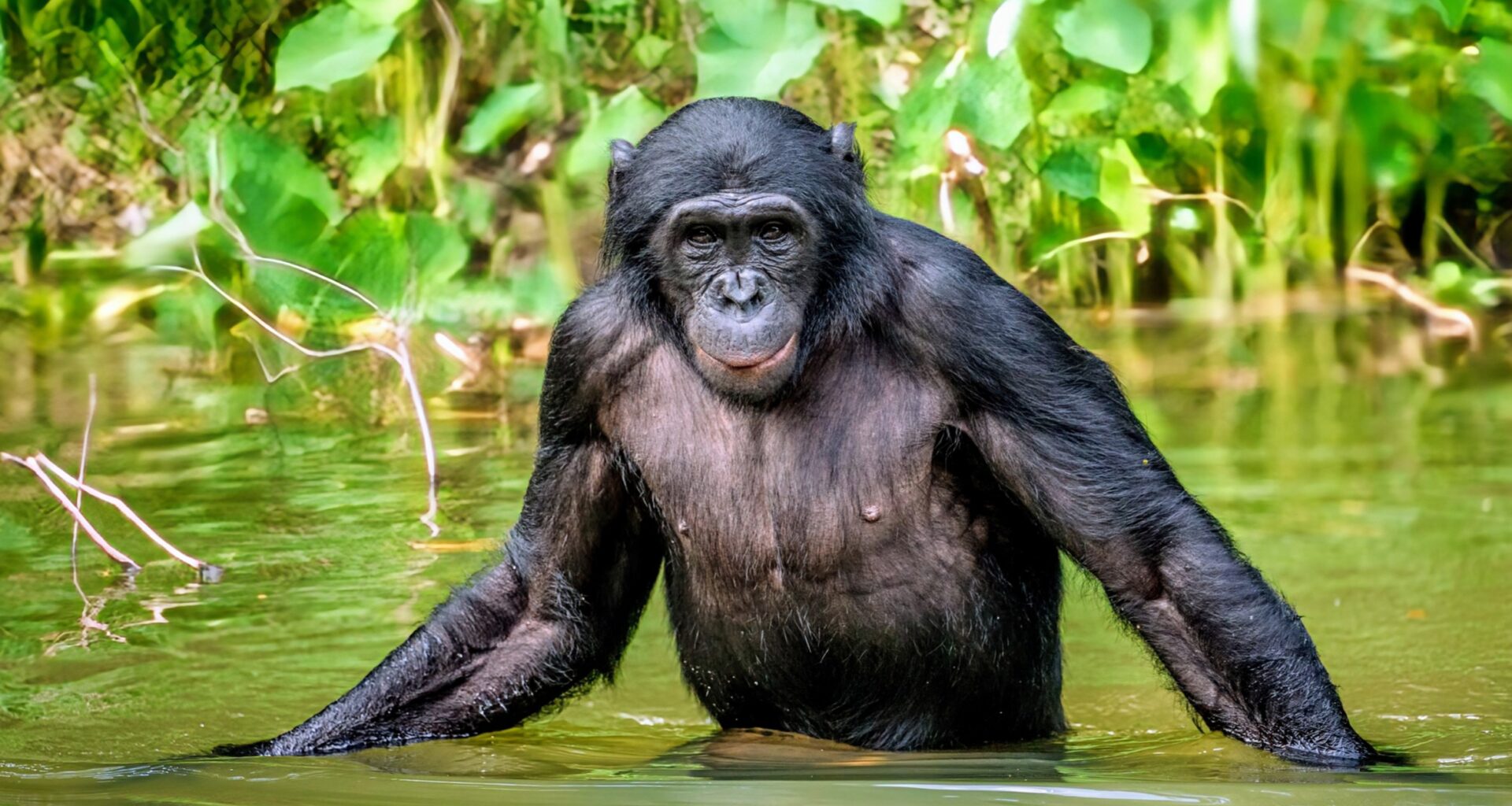
Bonobos sit right next to us on the family tree, sharing roughly 98.7% of their DNA with humans. They also stand out from their chimpanzee cousins in one big way: bonobo society tends to run on cooperation more than confrontation.
They live in female-led communities where relationships matter – a lot. Bonobos often use sexual behavior to ease tension, settle disputes, and reinforce bonds.
They’re leaner than chimps, with dark faces, pink lips, and strikingly expressive eyes that can feel almost human when they lock onto you.
In the wild, they spend plenty of time in the trees but move confidently on the ground too.
They forage for fruit, leaves, and small animals, and they communicate through a rich mix of calls, gestures, and facial expressions. In short: bonobos stay socially tuned-in, and they make connection a survival skill.
Bonobos bond when stressed
To find out how bonobos respond to outsiders, researchers observed eight groups across five sites in four countries.
They designed the experiment to mirror earlier chimpanzee studies: play recordings of calls from other groups and watch what happens next.
Lead author James Brooks put it bluntly: they didn’t know what they’d find.
If group bonding only matters in species that regularly engage in deadly conflict, bonobos might show nothing at all.
But if the common-enemy effect runs deeper – older than the split between chimps and bonobos – then bonobos might still carry traces of it.
They did.
The bonobos clearly noticed the outside calls. They became more alert – sitting upright more, resting less. They also showed a small uptick in affiliative behavior, including grooming, which plays a central role in primate social life.
The key word is small. Compared with chimpanzees, the increase in bonding behavior was modest.
How bonobos react to outsiders
That subtle shift is the point. When chimpanzees detect outsiders, the response often comes with aggression. As with most primates, chimpanzee group tension rises, defensive behavior spikes, and conflict can escalate.
Bonobos take a different route. They still register the “outgroup signal,” but instead of gearing up for a fight, they lean into their social fabric. They reinforce relationships without turning the dial toward violence.
That pattern suggests an evolutionary strategy built less around warfare and more around alliance-building. Bonobos don’t ignore potential threats. Instead, they answer them with connection rather than aggression.
Shared past with humans
The authors suggest our shared ancestor – living around 5-6 million years ago – may have dealt with some form of group conflict.
Over time, as bonobos evolved along a path with less intense intergroup violence, the strength of the common-enemy effect may have faded too.
Brooks summed up the bigger implication: conflict runs deep in our lineage, but it isn’t destiny. Bonobos likely stopped lethal aggression altogether a long time ago.
Other great apes – including gorillas, orangutans, chimpanzees, gibbons, and humans – have been observed killing members of their own species. Bonobos stand out as the exception that refuses to become the rule.
Importance of bonobo bonding
Bonobos give us a living example of how a close relative responded to the same evolutionary pressures and came out with a different social toolkit.
If we want to understand why humans so easily fall into “us versus them,” it helps to know how deep those instincts go, and what alternatives evolution has already produced.
Senior author Shinya Yamamoto put it clearly: humans can do both. We can turn outsiders into enemies, and we can also cooperate across borders. Bonobos remind us that what our ancestors did doesn’t lock us into one future.
And that’s the real takeaway. The next time you feel yourself getting pulled into a tribal mindset – be it during an argument, a political fight, even a workplace dispute – pause and remember the bonobos. They prove that a species can sense threat, choose connection, and rewrite the script.
The study is published in the journal PLOS ONE.
—–
Like what you read? Subscribe to our newsletter for engaging articles, exclusive content, and the latest updates.
Check us out on EarthSnap, a free app brought to you by Eric Ralls and Earth.com.
—–