
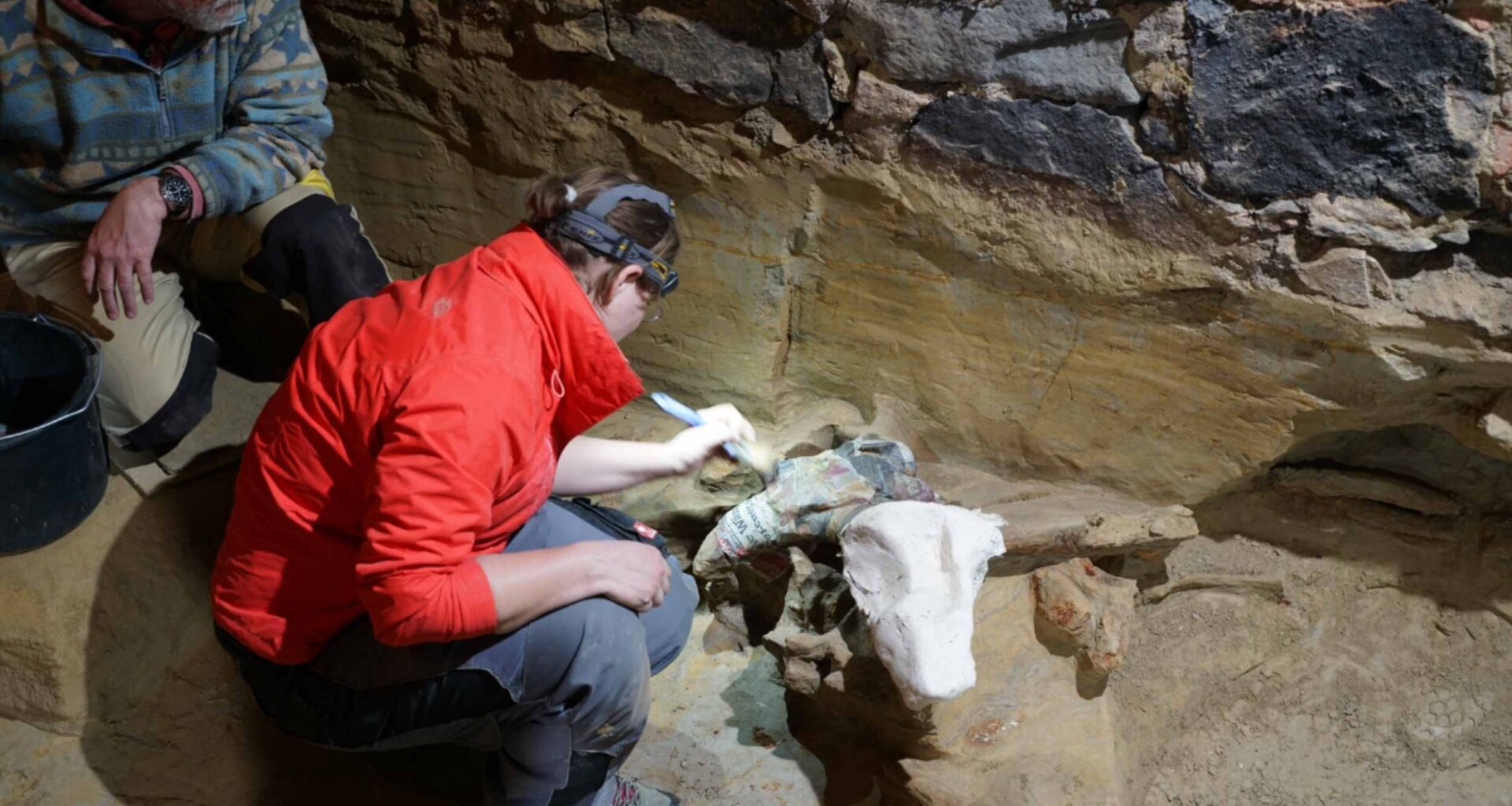
A winemaker renovating a cellar in Lower Austria uncovered bones from several Ice Age woolly mammoth dating between 30,000 and 40,000 years ago, making the find one of Austria’s most important in over a century.
The remains emerged beneath a private wine cellar in the village of Gobelsburg, near Krems, where Stone Age activity once shaped the surrounding landscape.

The find prompted immediate involvement from the Austrian Archaeological Institute to prevent damage or loss of contextual information.
The work was led by Thomas Einwögerer at the Austrian Archaeological Institute of the Austrian Academy of Sciences, whose research focuses on Ice Age archaeology and early human behavior.
His team began controlled excavation in mid May, carefully removing sediment layers to document bone placement and associated materials.
Layers of mammoth bones
Several tightly packed layers of skeletal material were exposed beneath the cellar floor during excavation.
Archaeologists identified bones from at least three individual animals based on size differences and repeated skeletal elements.
Such dense accumulations are uncommon, especially when preserved intact beneath a modern structure.
The remains were dated using associated stone tools and charcoal recovered from the same sediment layers.
These materials indicate human activity during the Upper Paleolithic period, roughly 30,000 to 40,000 years ago.
Charcoal provides radiocarbon dating, a method measuring radioactive carbon decay to estimate organic material age.
Cellar site stratigraphy, reading soil layers to track time order, helps separate a single event from bones mixed later.
Meet the mammoths
The discovery connects to a broader picture of Ice Age ecosystems across Europe. Woolly mammoths, Mammuthus primigenius, were adapted to cold climates with thick fur and large fat reserves.
These animals coexisted with early modern humans during periods of rapid climate fluctuation.
A large dataset of mammoth radiocarbon dates mapped changing European ranges, and the authors linked movement to climate and people.
The mammoth bones discovery offers scientists a chance to apply modern excavation techniques unavailable during earlier finds.
Comparable mammoth bone layers in Austria were last excavated about 150 years ago, long before careful stratigraphic methods became standard.
Many older sites were cleared quickly, permanently removing clues about how humans interacted with mammoths.
Killed by humans
The mammoth bones discovery includes stone artifacts found directly alongside the skeletal remains.
These tools suggest deliberate human presence rather than a natural accumulation caused by floods or scavengers.
The proximity raises questions about whether the animals were hunted, trapped, or processed at the site.
The discovery invites a harder question: what tactics let people kill animals that outweighed them?
Ice Age hunters often relied on teamwork, spears, and landscape pinch points, because a wound can make an animal slow.
Use-wear analysis, reading tiny chips and polish on stone edges, linked many tools to thrown weapons.
The find team uses careful mapping, samples, and lab tests to keep the bones tied to place.
Photogrammetry, building measurements from overlapping photos, can record bone positions before lifting, even in tight cellar spaces.
It marks the first opportunity in Austria to investigate such a dense mammoth bone layer using modern archaeological methods, allowing precise documentation of bone placement and surrounding sediments.
The mammoth bones discovery may represent the location where the animals actually died.
Similar mammoth bone concentrations appear at Dolní Věstonice and Kraków Spadzista, and researchers often compare layers and toolkits between sites.
Natural traps can include steep gullies or muddy banks, because heavy animals can lose footing and get stuck.
Lessons from mammoth bones
The mammoth find will move from the cellar to the Natural History Museum Vienna for restoration. Museum technicians remove sediment and add gentle binders, because fresh adhesives can fill cracks and hold flakes together.
Funding for the excavation came from the Federal Monuments Office and Lower Austria, which supports heritage work locally.
The discovery still leaves open whether one event or repeated visits built the bone bed over time.
A publication summarizes early interpretations of the Gobelsburg mammoth find, and deeper digs may test those ideas in future seasons as new stratigraphic and dating evidence accumulates.
—–
Like what you read? Subscribe to our newsletter for engaging articles, exclusive content, and the latest updates.
Check us out on EarthSnap, a free app brought to you by Eric Ralls and Earth.com.
—–