
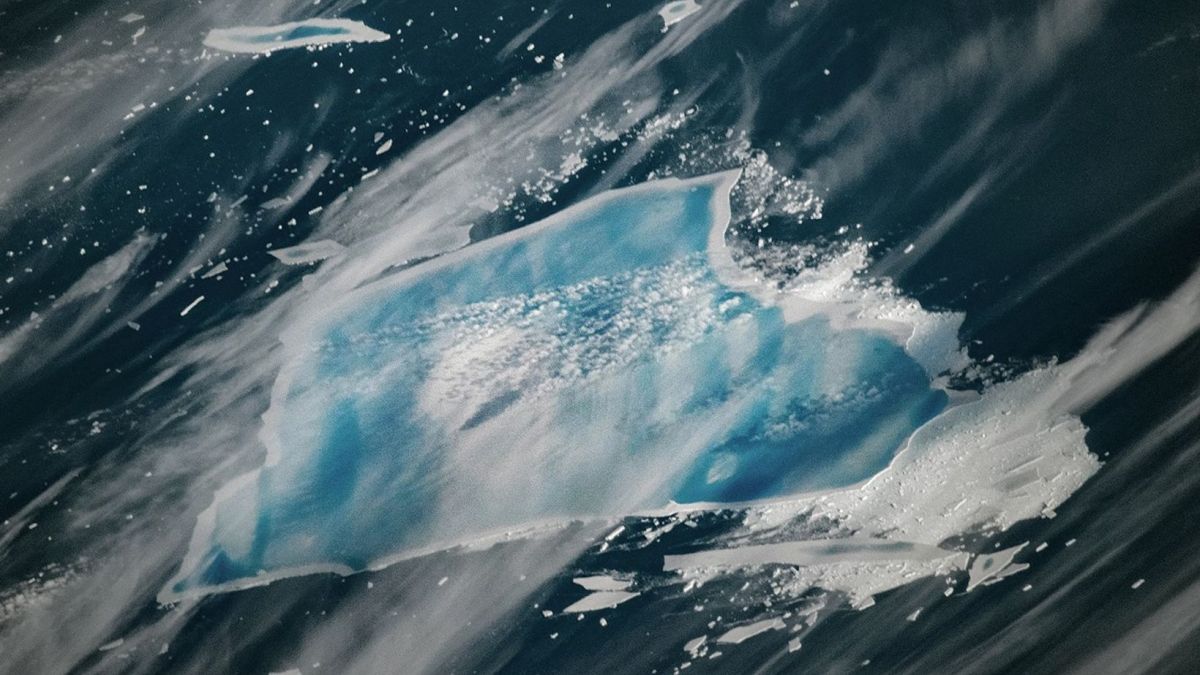
An iceberg that calved from the Antarctic ice sheet in 1986 is dramatically turning blue as it rapidly heads towards total annihilation.
Earth satellites that have been monitoring iceberg A-23A over decades show that, in a very short space of time, the massive, crumbling berg went from snowy white to vivid cyan as meltwater pooled in cavities on its surface.
This spells the final days for the berg, one of the longest-lived ever tracked, as the meltwater likely accelerates its disintegration.
“I certainly don’t expect A-23A to last through the austral summer,” says retired Earth scientist Chris Shuman, formerly of the University of Maryland Baltimore County.
Related: Rare Black Iceberg Goes Viral – So What Is Going on Here?
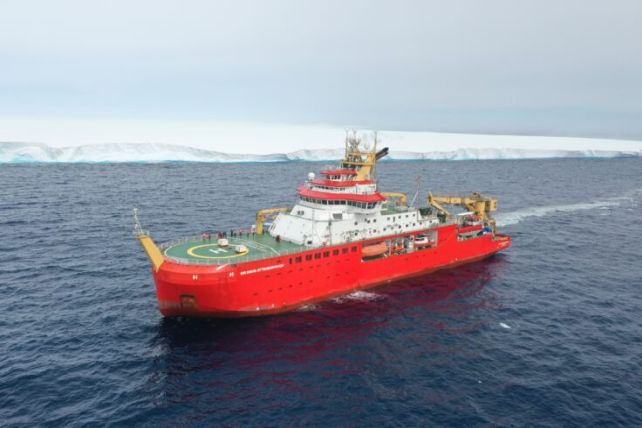 Iceberg A-23A and the British Antarctic Survey research vessel RSS David Attenborough in December 2023. (British Antarctic Survey)
Icebergs appear in different colors for a few different reasons. Many are as white as the driven snow due to air bubbles that become trapped in the ice as it forms, increasing the efficiency at which light is scattered and reflected.
As the ice ages, it compresses, squishing the air bubbles out and making the ice more transparent. Materials trapped in the ice can turn it green, while pure ice is bluer.
That is not what is happening with A-23A. The 40-year-old berg is not a classic ‘blue iceberg,’ but one that is rapidly melting as it drifts in the warmer summer waters of the Southern Ocean-South Atlantic boundary, between the Falkland Islands and South Georgia Island.
After it calved from Antarctica’s Filchner Ice Shelf in 1986, A-23A grounded itself against the bed of the Weddell Sea, where it remained relatively unchanged for about 30 years. By 2023, it finally became loose, only to become trapped in a vortical current known as a Taylor column for several months, before breaking free and continuing its weird journey.
In March 2025, the iceberg became wedged against the seafloor; it freed itself in June 2025, and from that point, it declined rapidly.
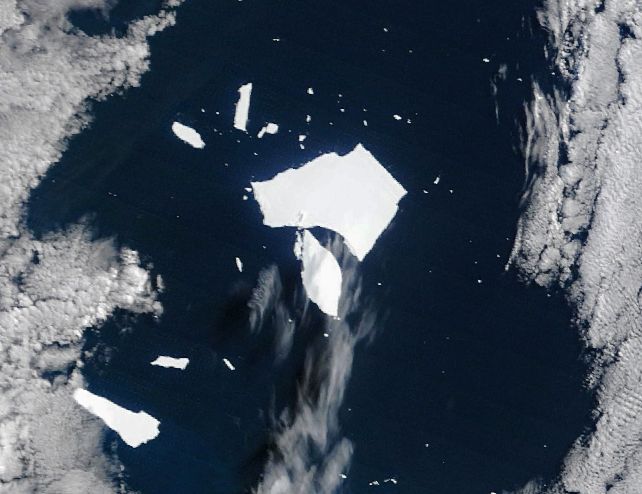 Image of A-23A disintegrating in September 2025, photographed by NASA’s Terra satellite. (NASA)
A-23A’s demise has been on the cards for months, with scientists watching as chunks broke off at an increasing rate. In January 2025, its estimated area was 3,640 square kilometers (1,410 square miles) – then the largest iceberg in the world. By September, it had shrunk to 1,700 square kilometers after several chunks of it broke away.
As of 9 January 2026, its size was just 1,182 square kilometers.
The once gargantuan block of ice isn’t likely to last much longer; as NASA notes, A-23A is “on the verge of complete disintegration” as meltwater pools, its weight sitting in weaker cracks and forcing them open more quickly.

Satellite photos also show that the surface appears to have a white border. That’s a ‘rampart-moat’ effect caused by bending at the edges as the ice is melted at the waterline. The rampart traps the meltwater, giving it nowhere to go but through the iceberg.
In fact, there may already be a hole next to the region, labeled “ice melange” in the image below. The weight of the meltwater at the edges can create enough pressure to punch through; fresh meltwater pours out into the salty ocean and mixes with the icy bits floating next to the iceberg, creating a sort of iceberg slushee.
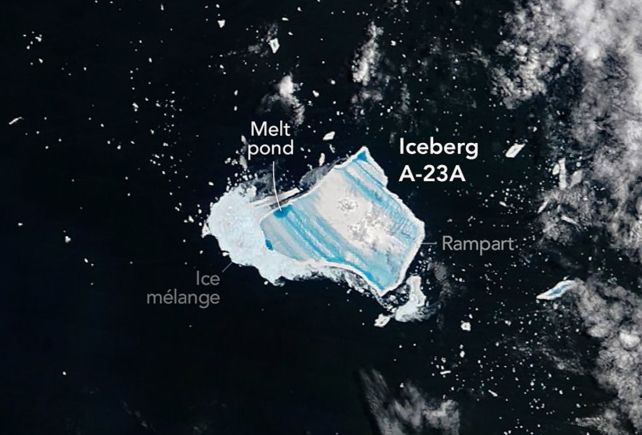 Image of the iceberg from NASA’s Terra satellite on 26 December 2025. (NASA)
It’s now on its way to a region known as an iceberg graveyard, not far from South Georgia Island, where it will melt and merge back into the ocean.
“I’m incredibly grateful that we’ve had the satellite resources in place that have allowed us to track it and document its evolution so closely,” Shuman says. “A-23A faces the same fate as other Antarctic bergs, but its path has been remarkably long and eventful. It’s hard to believe it won’t be with us much longer.”