

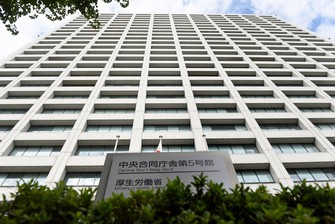
The Central Government Building No. 5 housing the Ministry of Health, Labor and Welfare is pictured in Tokyo’s Kasumigaseki district. (Mainichi/Kimi Takeuchi)
Japan’s Ministry of Health, Labor and Welfare has identified 77 ingredients in so-called “OTC-like drugs” — prescription medicines that are similar in composition and effect to over-the-counter products — that will be subject to additional out-of-pocket costs for patients. The proposal was announced at a meeting of the Social Security Council’s medical insurance subcommittee.
These 77 ingredients are found in approximately 1,100 products, such as pain relievers and antiallergic drugs, potentially affecting a wide range of patients. The Mainichi Shimbun briefly answers some questions readers may have about “new extra charges for OTC-like drugs.”
Question: What are OTC-like drugs?
Answer: Among prescription drugs covered by public health insurance, this category refers to medicines that have similar ingredients and effects to over-the-counter products. Because patients typically pay only 10% to 30% of the cost under the insurance system, these drugs can be cheaper than buying OTC medicines when looking solely at the price of the medication.
Q: Why is an additional charge being proposed?
A: The health ministry explains that the aim is to ensure fairness with patients who purchase OTC drugs and to reduce the insurance premium burden on the working population. It is estimated that this measure will reduce medical expenses by approximately 90 billion yen (roughly $ 574 million) annually.
Q: Which drugs will be subject to the new extra charges?
A: The 77 ingredients requiring additional patient copayments are contained in approximately 1,100 items such as the pain reliever Loxonin, the antiallergic drug Allegra used for conditions like hay fever, the skin moisturizer Hirudoid Gel, the expectorant Mucodyne, the laxative Magmitt, the nasal inflammation medication Alesion, the gargle solution Isodine and medicated patches.
Q: When will the additional charge be implemented?
A: Following the establishment of the new system, additional fees will be charged starting March 2027. Patients will be required to pay 25% of the drug cost as a “special fee.” The remaining 75% will be covered by public health insurance, with patients paying an additional 10% to 30% copayment.
Q: How much more will patients have to pay compared to before?
A: According to the health ministry, patients with a 30% copayment are expected to see their costs rise to about 1.6 times the previous amount. However, the ministry plans to exempt children, cancer patients, people with intractable diseases, and those with chronic conditions requiring special consideration from the additional “special fees.”
(Mainichi)