
Back to Article List
The solar system’s largest planet is now at its best and brightest, opening the morning with a transit of Callisto.
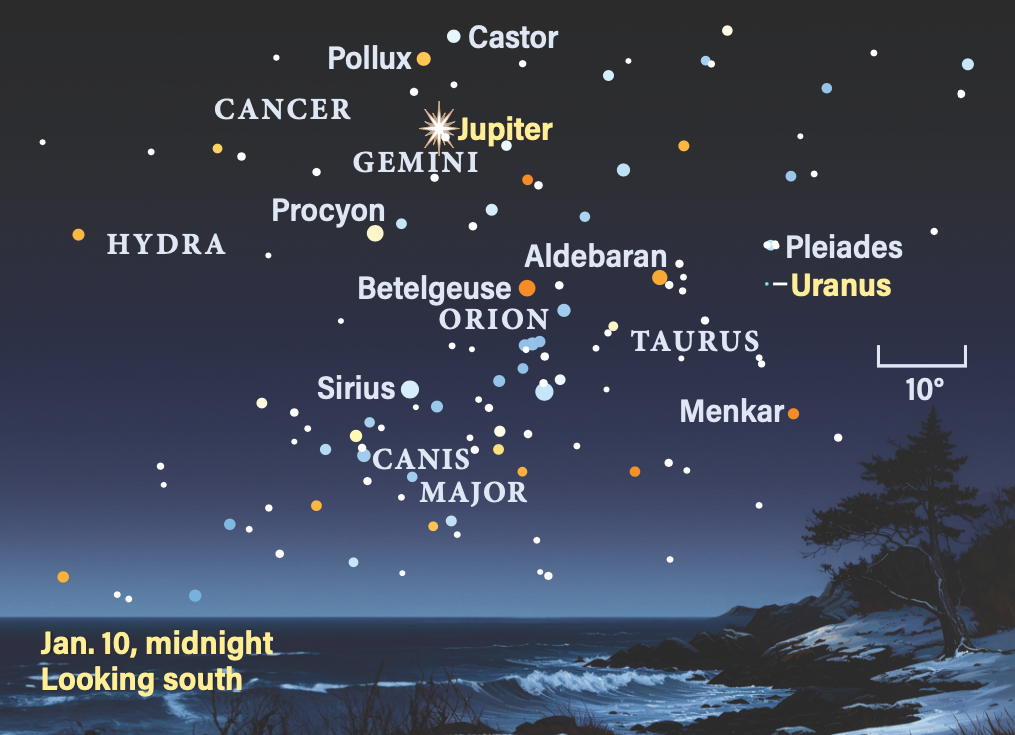
Jupiter shines brightly in Gemini as it reaches opposition this month. It’s also a great time to view Uranus near the Pleiades in Taurus, though you’ll need binoculars or a telescope. Credit: Astronomy: Roen Kelly
Looking for a sky event this week? Check out our full Sky This Week column.
January 9: View the Keystone of Hercules
Jupiter officially reaches opposition at 4 A.M. EST, and its moon Callisto is helping us usher in the big moment with a transit — moving simultaneously with its shadow across the face of the gas giant.
Jupiter is located in Gemini, sitting about 7° southwest of the star Pollux (Beta [β] Geminorum), which shines at magnitude 1.2. Glowing at magnitude –2.7, you absolutely can’t miss Jupiter, which outshines even the Northern Hemisphere’s brightest star, Sirius.
Callisto reaches begins to transit just minutes before 2 A.M. EST this morning (11 p.m. PST on the 9th in this time zone only). Within 10 minutes, it’s passed fully in front of the planet, moving from east to west. Two hours later, around 4 A.M. EST, Callisto is roughly central on the disk.
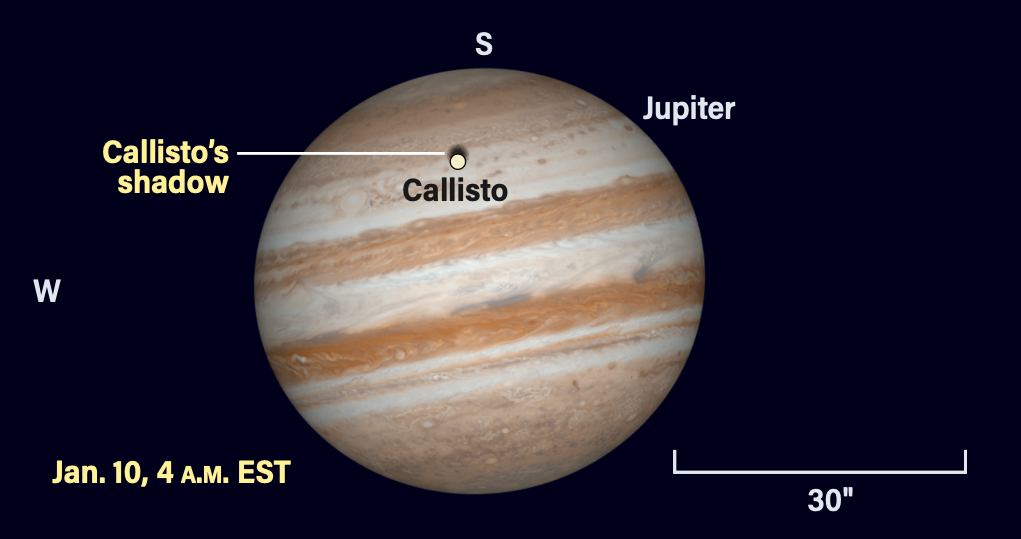
The day Jupiter reaches opposition, Callisto nearly blends with its shadow as they transit. Can you spot the shadow, just peeking out from Callisto’s southern edge? Credit: Astronomy: Roen Kelly
At opposition, the Sun appears directly behind us as we look at Jupiter and from a viewpoint above the solar system, Earth stands directly between the Sun and the gas giant. That means as moons cross Jupiter on this date only, they directly overlap their shadows. With Callisto central on the disk, look closely at the moon’s southern edge. Does this limb appear slightly darker or distended? This may be all the evidence of its shadow, also crossing the cloud tops at the same time, that you may see. You’ve got plenty of time to hunt for (or even try to photograph) it — Callisto’s transit ends shortly after 6 A.M. EST, roughly an hour before sunrise on the East Coast.
Even if you’re not an early riser, don’t worry. At opposition, planets rise around sunset and set around sunrise, so both morning and evening observers have plenty of time to view them. As Gemini rises in the east after sunset, Jupiter appears roughly level with Pollux, standing to the right of this star (which hangs beneath Castor [Alpha (α) Gem] as the Twins climb above the horizon in the early evening).
Sunrise: 7:22 A.M.
Sunset: 4:54 P.M.
Moonrise: 12:04 A.M.
Moonset: 11:13 A.M.
Moon Phase: Waning crescent (45%)
*Times for sunrise, sunset, moonrise, and moonset are given in local time from 40° N 90° W. The Moon’s illumination is given at 10 P.M. local time from the same location.