
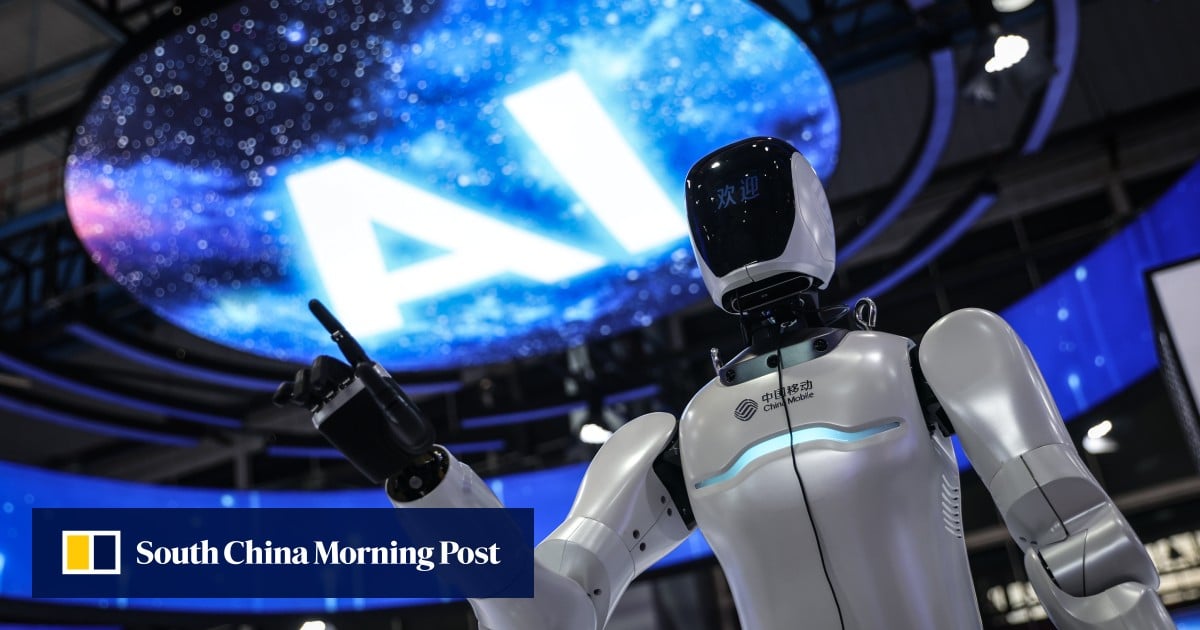
China’s artificial intelligence efforts are unlikely to catch up with the United States in the near term despite making significant headway in recent years, according to the country’s leading AI researchers.The comments at a major industry conference in Beijing on Saturday underscored the gap between the two countries in semiconductor chips and chipmaking equipment, key resources for building out the infrastructure needed for developing cutting-edge AI models.Lin Junyang, technical lead of Alibaba Group Holding’s Qwen team, said there was a less than 20 per cent chance – already a “highly optimistic” estimate – that any Chinese company would surpass US tech giants such as Google DeepMind and OpenAI in the next three to five years due to “computational resources in the US being one to two orders of magnitude larger”. Alibaba owns the Post.
“Most critically, OpenAI and others are pouring massive computational resources into next-generation research,” he said. “Meanwhile, in China, we are stretched to the limit just from meeting daily demand, which already takes up the vast majority of our compute.”
Lending support to the cautionary assessment was Tang Jie, co-founder and chief AI scientist at Zhipu AI, known internationally as Z.ai, who appeared alongside Lin on a panel at the AGI-Next summit hosted by Tsinghua University in Beijing’s Zhongguancun technology hub.
 China’s less than 20 per cent chance of exceeding the US is already a “highly optimistic” estimate, according to Alibaba’s Qwen team. Photo: Shutterstock
Chinese models had narrowed the performance gap with leading US models in recent years, according to third-party benchmarks. While US models have largely remained closed-source, Chinese developers have overwhelmingly open-sourced their models, driving adoption globally.