
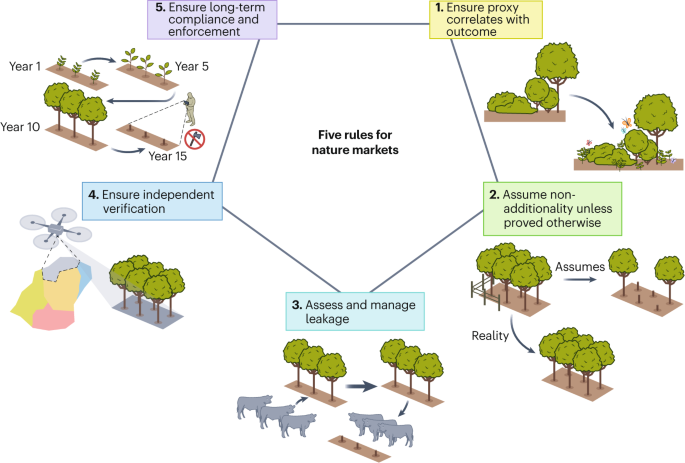
UNEP. State of Finance for Nature 2023 (UNEP, 2023).
Kedward, K., zu Ermgassen, S. O. S. E., Ryan-Collins, J. & Wunder, S. Heavy reliance on private finance alone will not deliver conservation goals. Nat. Ecol. Evol. 7, 1339–1342 (2023).
Bull, J. W. & Strange, N. The global extent of biodiversity offset implementation under no net loss policies. Nat. Sustain. 1, 790–798 (2018).
zu Ermgassen, S. O. S. E. et al. The current state, opportunities and challenges for upscaling private investment in biodiversity in Europe. Nat. Ecol. Evol. 9, 515–524 (2025).
Damiens, F. L., Porter, L. & Gordon, A. The politics of biodiversity offsetting across time and institutional scales. Nat. Sustain. 4, 170–179 (2021).
Swinfield, T., Shrikanth, S., Bull, J. W., Madhavapeddy, A. & zu Ermgassen, S. O. S. E. Nature-based credit markets at a crossroads. Nat. Sustain. 7, 1217–1220 (2024).
zu Ermgassen, S. O. S. E. et al. The ecological outcomes of biodiversity offsets under ‘no net loss’ policies: a global review. Conserv. Lett. 12, e12664 (2019).
Rau, E.-P. et al. Mitigating risk of credit reversal in nature-based climate solutions by optimally anticipating carbon release. Carbon Manage. 15, 2390854 (2024).
Balmford, A. et al. Realizing the social value of impermanent carbon credits. Nat. Clim. Change 13, 1172–1178 (2023).
Maron, M. et al. Taming a wicked problem: resolving controversies in biodiversity offsetting. BioScience 66, 489–498 (2016).
Badgley, G. et al. California’s forest carbon offsets buffer pool is severely undercapitalized. Front. For. Glob. Change 5, 930426 (2022).
Hough, P. & Robertson, M. Mitigation under Section 404 of the Clean Water Act: where it comes from, what it means. Wetl. Ecol. Manage. 17, 15–33 (2009).
Rampling, E. E., zu Ermgassen, S. O. S. E., Hawkins, I. & Bull, J. W. Achieving biodiversity net gain by addressing governance gaps underpinning ecological compensation policies. Conserv. Biol. 38, e14198 (2024).
zu Ermgassen, S. O. S. E. et al. Exploring the ecological outcomes of mandatory biodiversity net gain using evidence from early-adopter jurisdictions in England. Conserv. Lett. 14, e12820 (2021).
Defra. Biodiversity Net Gain and Local Nature Recovery Strategies: Impact Assessment (Defra, 2019).
Duffus, N. E., zu Ermgassen, S.O.S.E., Grenyer, R. & Lewis, O. T. Early outcomes of England′ s new biodiversity offset market. Preprint at bioRxiv https://doi.org/10.1101/2025.06.22.660961 (2025).
White, T. B., Bull, J. W., Toombs, T. P. & Knight, A. T. Uncovering opportunities for effective species conservation banking requires navigating technical and practical complexities. Conserv. Sci. Pract. 3, e431 (2021).
Grimm, M. Regulation, the hybrid market, and species conservation: the case of conservation banking in California. Ambio 52, 769–785 (2023).
Balmford, B. Mechanism Design in Payment for Ecosystem Service Schemes. Thesis, Univ. Exeter (2022).
Needham, K., de Vries, F. P., Armsworth, P. R. & Hanley, N. Designing markets for biodiversity offsets: lessons from tradable pollution permits. J. Appl. Ecol. 56, 1429–1435 (2019).
Teytelboym, A. Natural capital market design. Oxf. Rev. Econ. Policy 35, 138–161 (2019).
West, T. A. et al. Action needed to make carbon offsets from forest conservation work for climate change mitigation. Science 381, 873–877 (2023).
Sylvera. The State of Carbon Credits 2023 (Sylvera, 2023).
Hahn, R. W., Hendren, N., Metcalfe, R. D. & Sprung-Keyser, B. A Welfare Analysis of Policies Impacting Climate Change (NBER, 2024).
Malan, M. et al. Evaluating the impacts of a large-scale voluntary REDD+ project in Sierra Leone. Nat. Sustain. 7, 120–129 (2024).
Hahn, R. W. Economic prescriptions for environmental problems: how the patient followed the doctor’s orders. J. Econ. Perspect. 3, 95–114 (1989).
Bull, J. W. et al. Quantifying the ‘avoided’ biodiversity impacts associated with economic development. Front. Ecol. Environ. 20, 370–378 (2022).
Damiens, F. L., Backstrom, A. & Gordon, A. Governing for ‘no net loss’ of biodiversity over the long term: challenges and pathways forward. One Earth 4, 60–74 (2021).
Walker, S., Brower, A. L., Stephens, R. & Lee, W. G. Why bartering biodiversity fails. Conserv. Lett. 2, 149–157 (2009).
Carver, L. & Sullivan, S. How economic contexts shape calculations of yield in biodiversity offsetting. Conserv. Biol. 31, 1053–1065 (2017).
zu Ermgassen, S. O. S. E. et al. The hidden biodiversity risks of increasing flexibility in biodiversity offset trades. Biol. Conserv. 252, 108861 (2020).
Evans, M. C. Backloading to extinction: coping with values conflict in the administration of Australia’s federal biodiversity offset policy. Aust. J. Public Adm. 82, 228–247 (2023).
Dal Bó, E. Regulatory capture: a review. Oxf. Rev. Econ. Policy 22, 203–225 (2006).
Macintosh, A. et al. Non-compliance and under-performance in Australian human-induced regeneration projects. Rangel. J. 46, RJ24024 (2024).
Swinfield, T. & Balmford, A. Cambridge Carbon Impact: evaluating carbon credit claims and co-benefits. Preprint at Cambridge Open Engage https://doi.org/10.33774/coe-2023-bl26j (2023).
Wauchope, H. S. et al. What is a unit of nature? Measurement challenges in the emerging biodiversity credit market. Proc. R. Soc. B 291, 20242353 (2024).
Lynch, J., Cain, M., Pierrehumbert, R. & Allen, M. Demonstrating GWP*: a means of reporting warming-equivalent emissions that captures the contrasting impacts of short- and long-lived climate pollutants. Environ. Res. Lett. 15, 044023 (2020).
Simpson, K. H., de Vries, F. P., Dallimer, M., Armsworth, P. R. & Hanley, N. Ecological and economic implications of alternative metrics in biodiversity offset markets. Conserv. Biol. 36, e13906 (2022).
Salzman, J. & Ruhl, J. Currencies and the commodification of environmental law. Stanf. Law Rev. 53, 607–694 (2000).
Robertson, M. M. The nature that capital can see: science, state, and market in the commodification of ecosystem services. Environ. Plan. D 24, 367–387 (2006).
Lave, R., Doyle, M. & Robertson, M. Privatizing stream restoration in the US. Soc. Stud. Sci. 40, 677–703 (2010).
Robertson, M., Lave, R. & Doyle, M. Making a market in environmental credits I: streams of value. Environ. Plan. E 6, 2516–2538 (2023).
Duffus, N. E. et al. A globally influential area-condition metric is a poor proxy for invertebrate biodiversity. J. Appl. Ecol. 62, 2529–2540 (2025).
Marshall, C. A. et al. England’s statutory biodiversity metric enhances plant, but not bird nor butterfly, biodiversity. J. Appl. Ecol. 61, 1918–1931 (2024).
Gamarra, M. J. C. & Toombs, T. P. Thirty years of species conservation banking in the US: comparing policy to practice. Biol. Conserv. 214, 6–12 (2017).
Moilanen, A. et al. Monitoring in biodiversity offsetting. Glob. Ecol. Conserv. 54, e03039 (2024).
Inkinen, V. Wetland Mitigation Banking in the United States. Doctoral thesis, Univ. of Gothenburg (2023).
Mayfield, H. J. et al. Guidelines for selecting an appropriate currency in biodiversity offset transactions. J. Environ. Manage. 322, 116060 (2022).
Dorrough, J., Sinclair, S. J. & Oliver, I. Expert predictions of changes in vegetation condition reveal perceived risks in biodiversity offsetting. PLoS ONE 14, e0216703 (2019).
Gibbons, P., Macintosh, A., Constable, A. L. & Hayashi, K. Outcomes from 10 years of biodiversity offsetting. Glob. Change Biol. 24, e643–e654 (2018).
Pascoe, S., Cannard, T. & Steven, A. Offset payments can reduce environmental impacts of urban development. Environ. Sci. Policy 100, 205–210 (2019).
Defra. Nature Markets: A Framework for Scaling Up Private Investment in Nature Recovery and Sustainable Farming (Defra, 2023).
Li, L. & Zhang, D. Forest carbon offset protocols in compliance carbon markets. For. Policy Econ. 165, 103253 (2024).
Akerlof, G. A. in Uncertainty in Economics (eds Diamond, P. & Rothschild, M.) 235–251 (Elsevier, 1978).
Jack, B. K. & Jayachandran, S. Self-selection into payments for ecosystem services programs. Proc. Natl Acad. Sci. USA 116, 5326–5333 (2019).
Engert, J. E. & van Oosterzee, P. Limits to the ability of carbon farming projects to deliver benefits for threatened species. Nat. Ecol. Evol. 9, 134–141 (2024).
zu Ermgassen, S. O. S. E. et al. Evaluating the impact of biodiversity offsetting on native vegetation. Glob. Change Biol. 29, 4397–4411 (2023).
Macintosh, A. et al. Australian human-induced native forest regeneration carbon offset projects have limited impact on changes in woody vegetation cover and carbon removals. Commun. Earth Environ. 5, 149 (2024).
Sonter, L. J., Barnes, M., Matthews, J. W. & Maron, M. Quantifying habitat losses and gains made by US Species Conservation Banks to improve compensation policies and avoid perverse outcomes. Conserv. Lett. 12, e12629 (2019).
Badgley, G. et al. Systematic over-crediting in California’s forest carbon offsets program. Glob. Change Biol. 28, 1433–1445 (2022).
Coffield, S. R. et al. Using remote sensing to quantify the additional climate benefits of California forest carbon offset projects. Glob. Change Biol. 28, 6789–6806 (2022).
Stanley, T. & Cusworth, G. Legitimacy in the making: conservatism, additionality and natural capital accreditation in the UK’s Woodland Carbon Code. Environ. Plan. E 8, 2018–2037 (2025).
Maseyk, F. J., Maron, M., Gordon, A., Bull, J. W. & Evans, M. C. Improving averted loss estimates for better biodiversity outcomes from offset exchanges. Oryx 55, 393–403 (2020).
Mitchell, E. et al. Making soil carbon credits work for climate change mitigation. Carbon Manage. 15, 2430780 (2024).
Schleicher, J. et al. Statistical matching for conservation science. Conserv. Biol. 34, 538–549 (2020).
Guizar-Coutiño, A., Jones, J. P., Balmford, A., Carmenta, R. & Coomes, D. A. A global evaluation of the effectiveness of voluntary REDD+ projects at reducing deforestation and degradation in the moist tropics. Conserv. Biol. 36, e13970 (2022).
Delacote, P. et al. Restoring credibility in carbon offsets through systematic ex post evaluation. Nat. Sustain. 8, 733–740 (2025).
Rau, E. P. et al. Strengthening the integrity of REDD+ credits: objectively assessing counterfactual methods using placebos. Environ. Res. Lett. 20, 114051 (2025).
Isometric. Reforestation protocol. isometric.com https://registry.isometric.com/protocol/reforestation/1.0 (2025).
Verra. VM0047 Afforestation, Reforestation, and Revegetation v.1.1. verra.org https://verra.org/methodologies/vm0047-afforestation-reforestation-and-revegetation-v1-1/ (2025).
Revalue. Our models. revalue.earth https://www.revalue.earth/our-models/avoid (2025).
Balmford, A. et al. Time to fix the biodiversity leak. Science 387, 720–722 (2025).
Meyfroidt, P. et al. Middle-range theories of land system change. Glob. Environ. Change 53, 52–67 (2018).
Meyfroidt, P. et al. Ten facts about land systems for sustainability. Proc. Natl Acad. Sci. USA 119, e2109217118 (2022).
Filewod, B. & McCarney, G. Avoiding carbon leakage from nature-based offsets by design. One Earth 6, 790–802 (2023).
Swinfield, T. & Toye Scott, E. Scientific credibility for high-integrity voluntary carbon markets. Preprint at Cambridge Open Engage https://doi.org/10.33774/coe-2025-f0j70-v2 (2025).
Cerullo, G. et al. The global impact of EU forest protection policies. Science 381, 740 (2023).
Kujala, H. et al. Credible biodiversity offsetting needs public national registers to confirm no net loss. One Earth 5, 650–662 (2022).
Delacote, P. et al. Strong transparency required for carbon credit mechanisms. Nat. Sustain. 7, 706–713 (2024).
Poudel, J., Zhang, D. & Simon, B. Estimating the demand and supply of conservation banking markets in the United States. Land Use Policy 79, 320–325 (2018).
Clean Energy Regulator. Third independent review of human-induced regeneration gateway checks. cer.gov.au https://cer.gov.au/news-and-media/news/2024/december/third-independent-review-human-induced-regeneration-gateway-checks (2024).
Skidmore, A. K. et al. Priority list of biodiversity metrics to observe from space. Nat. Ecol. Evol. 5, 896–906 (2021).
Bennett, M. M., Chen, J. K., Alvarez Leon, L. F. & Gleason, C. J. The politics of pixels: a review and agenda for critical remote sensing. Prog. Hum. Geogr. 46, 729–752 (2022).
Bos, A. B. et al. Global data and tools for local forest cover loss and REDD+ performance assessment: accuracy, uncertainty, complementarity and impact. Int. J. Appl. Earth Obs. Geoinf. 80, 295–311 (2019).
Vatn, A. Markets in environmental governance: from theory to practice. Ecol. Econ. 117, 225–233 (2015).
Lederer, M. Market making via regulation: the role of the state in carbon markets. Regul. Gov. 6, 524–544 (2012).
Clare, S. & Krogman, N. Bureaucratic slippage and environmental offset policies: the case of wetland management in Alberta. Soc. Nat. Resour. 26, 672–687 (2013).
Macintosh, A. et al. Reply to: National-scale datasets underestimate vegetation recovery in Australian human-induced native forest regeneration carbon sequestration projects. Commun. Earth Environ. 6, 803 (2025).
ICVCM. The Core Carbon Principles. icvcm.org https://icvcm.org/core-carbon-principles/ (2024).
Laitila, J., Moilanen, A. & Pouzols, F. M. A method for calculating minimum biodiversity offset multipliers accounting for time discounting, additionality and permanence. Methods Ecol. Evol. 5, 1247–1254 (2014).
Vaissière, A.-C., Tardieu, L., Quétier, F. & Roussel, S. Preferences for biodiversity offset contracts on arable land: a choice experiment study with farmers. Eur. Rev. Agric. Econ. 45, 553–582 (2018).
Theis, S. & Poesch, M. Mitigation bank applications for freshwater systems: control mechanisms, project complexity, and caveats. PLoS ONE 19, e0292702 (2024).
Robertson, M., Galatowitsch, S. M. & Matthews, J. W. Longitudinal evaluation of vegetation richness and cover at wetland compensation sites: implications for regulatory monitoring under the Clean Water Act. Wetl. Ecol. Manage. 26, 1089–1105 (2018).
Reed, M. S., McCarthy, J. M., Jensen, E. A., Everett, R. & Rudman, H. Governing high-integrity markets for ecosystem services. Ecosystem Services 75, 101760 (2025).
Sax, J. L. Defending the Environment: A Strategy for Citizen Action (Knopf, 1971).
Macintosh, A., Gibbons, P., Jones, J., Constable, A. & Wilkinson, D. Delays, stoppages and appeals: an empirical evaluation of the adverse impacts of environmental citizen suits in the New South Wales land and environment court. Environ. Impact Assess. Rev. 69, 94–103 (2018).
Theis, S. et al. Compliance with and ecosystem function of biodiversity offsets in North American and European freshwaters. Conserv. Biol. 34, 41–53 (2020).
Guizar-Coutiño, A., Coomes, D., Swinfield, T. & Jones, J. P. Sensitivity of estimates of the effectiveness of REDD+ projects to matching specifications and moving from pixels to polygons as the unit of analysis. Preprint at bioRxiv https://doi.org/10.1101/2024.05.22.595326 (2024).
Wunder, S. et al. Modest forest and welfare gains from initiatives for reduced emissions from deforestation and forest degradation. Commun. Earth Environ. 5, 394 (2024).
Busch, J. & Ferretti-Gallon, K. What drives and stops deforestation, reforestation, and forest degradation? An updated meta-analysis. Rev. Environ. Econ. Policy 17, 217–250 (2023).
Spash, C. L. Bulldozing biodiversity: the economics of offsets and trading-in Nature. Biol. Conserv. 192, 541–551 (2015).
Simmonds, J. S. et al. Aligning ecological compensation policies with the Post-2020 Global Biodiversity Framework to achieve real net gain in biodiversity. Conserv. Sci. Pract. 4, e12634 (2022).
Dempsey, J. et al. Biodiversity targets will not be met without debt and tax justice. Nat. Ecol. Evol. 6, 237–239 (2022).
Galaz, V. et al. Tax havens and global environmental degradation. Nat. Ecol. Evol. 2, 1352–1357 (2018).
Svartzman, R. & Althouse, J. Greening the international monetary system? Not without addressing the political ecology of global imbalances. Rev. Int. Polit. Econ. 29, 844–869 (2022).
Clark, M. A. et al. Global food system emissions could preclude achieving the 1.5 and 2 C climate change targets. Science 370, 705–708 (2020).
Gonon, M. et al. Subsidies against Nature: a multidimensional framework for biodiversity-aligned national budgets. Ecol. Econ. 235, 108661 (2025).
Bruner, A. G., Gullison, R. E. & Balmford, A. Financial costs and shortfalls of managing and expanding protected-area systems in developing countries. BioScience 54, 1119–1126 (2004).
Wunder, S. et al. Biodiversity credits: an overview of the current state, future opportunities, and potential pitfalls. Bus. Strategy Environ. 34, 8470–8499 (2025).
Atmadja, S. S. et al. How do REDD+ projects contribute to the goals of the Paris Agreement?. Environ. Res. Lett. 17, 044038 (2022).
Calvet, C., Le Coent, P., Napoleone, C. & Quétier, F. Challenges of achieving biodiversity offset outcomes through agri-environmental schemes: evidence from an empirical study in Southern France. Ecol. Econ. 163, 113–125 (2019).
Grimm, M. Conserving biodiversity through offsets? Findings from an empirical study on conservation banking. J. Nat. Conserv. 57, 125871 (2020).
Fox, J. & Murcia, A. Status of species conservation banking in the United States. Conserv. Biol. 19, 996–1007 (2005).
Randazzo, N. A., Gordon, D. R. & Hamburg, S. P. Improved assessment of baseline and additionality for forest carbon crediting. Ecol. Appl. 33, e2817 (2023).
Stapp, J. et al. Little evidence of management change in California’s forest offset program. Commun. Earth Environ. 4, 331 (2023).
West, T. A., Börner, J., Sills, E. O. & Kontoleon, A. Overstated carbon emission reductions from voluntary REDD+ projects in the Brazilian Amazon. Proc. Natl Acad. Sci. USA 117, 24188–24194 (2020).
Haya, B. K. et al. Comprehensive review of carbon quantification by improved forest management offset protocols. Front. Forests Global Change 6, 958879 (2023).
Karnik, A., Kilbride, J. B., Goodbody, T. R., Ross, R. & Ayrey, E. An open-access database of nature-based carbon offset project boundaries. Sci. Data 12, 581 (2025).
Department of Environment, Land, Water and Planning. Native Vegetation Gain Scoring Manual (Department of Environment, Land, Water and Planning, 2017).
Department of Environment, Land, Water and Planning. Guidelines for the Removal, Destruction or Lopping of Native Vegetation (Department of Environment, Land, Water and Planning, 2017).