
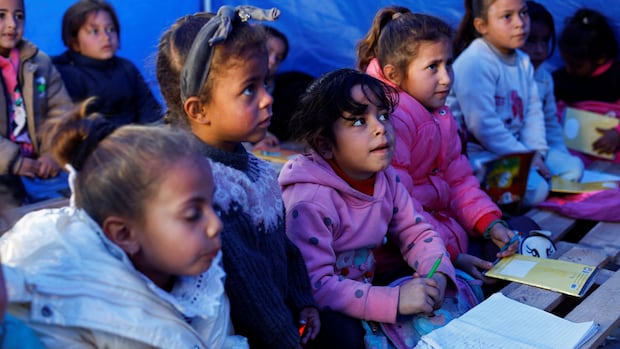
Mona Al-Zanati is happy that her son is back in school, even though she lives in terror every moment he’s out of her sight.
“Every hour he is away from me, I feel fear,” Al-Zanati, 45, told CBC News.
“If I hear one strike or two, I just want to send someone to the school to check on him. A few days ago they were late at school. I sent his father to check why.”
Her 10-year-old son, Yamen, is among the tens of thousands of children in the Gaza Strip who are resuming their education after two years of near-constant Israeli bombardment.
He’s attending a makeshift school set up in blue plastic tents in the ruins of the northern community of Beit Lahiya. It’s within eyesight of the so-called “yellow line” that now divides Gaza under the terms of a fragile ceasefire in place since October.
Despite this ceasefire, parents and teachers say the students are far from safe, and Israel’s ongoing blockade of Gaza means many children lack even the most basic school supplies.
‘The lengths children go to to study’
UNICEF, which is operating several makeshift schools in Gaza, says it’s doing its best to give students the tools they need to excel. But spokesperson James Elder says Israel has barred supplies like pens, pencils and notebooks from entering Gaza.
“There are some children, maybe one in five or more, who have some paper. Sometimes they’re writing on the back of paper that’s already had things written on it,” Elder told Nil Köksal, host of CBC Radio’s As It Happens. “So I’ll go into tents and see the lengths children go to to study.”
CBC has reached out to the Israeli government for comment.
LISTEN | Full interview with UNICEF’s James Elder:
As It Happens7:09Gaza’s children are thrilled to be back in school
Despite these obstacles, Elder says there’s a palpable joy in the classrooms he’s visited.
On a recent trip to a UNICEF-run school in Jabalia, he says a beaming girl told him how pleased she is to be with her friends again, and to have the opportunity to make new ones.
“It’s amazing when you see 50 children in a classroom and still it’s absolute silence when the teacher speaks,” Elder said.
“They’re yearning for that education. So they were thrilled to be honest, to be there. You couldn’t have had happier kids.”
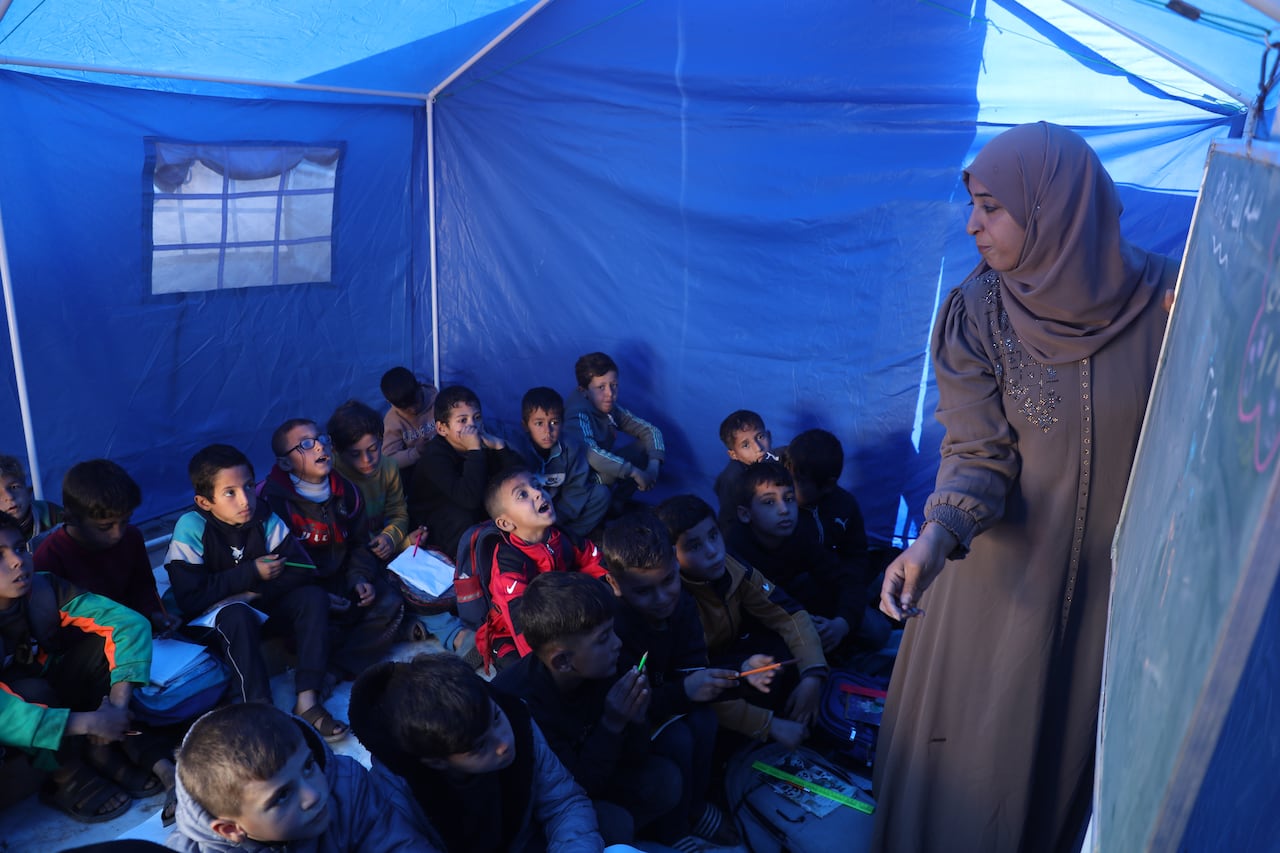 Yara Abu Ghalwa teaches children in a blue tent in Beit Lahiya. (Mohamed El Saife/CBC)
At the North Educational School in Beit Lahiya, seven-year-old Toulin Al-Hindi echoed that sentiment.
“Although we do not sit on chairs, thank God we started attending school,” she said. “During the war, there were no schools, and we were bored.”
Safety not guaranteed
The latest Israeli-Hamas war began on Oct. 7, 2023, after Hamas-led militants attacked Israel, killed about 1,200 people and abducted 251, according to Israeli officials.
In the years since, Israel has killed more than 71,000 people in Gaza and displaced more than 90 per cent of its population, according to the enclave’s health ministry.
Aid group Save The Children estimates more than 20,000 children have been killed, while UNICEF says more than 58,000 children have lost one or both parents.
At the International Court of Justice in The Hague, South Africa has accused Israel of committing genocide in Gaza, an allegation supported by human rights organization Amnesty International. Israel has repeatedly and vehemently denied this.
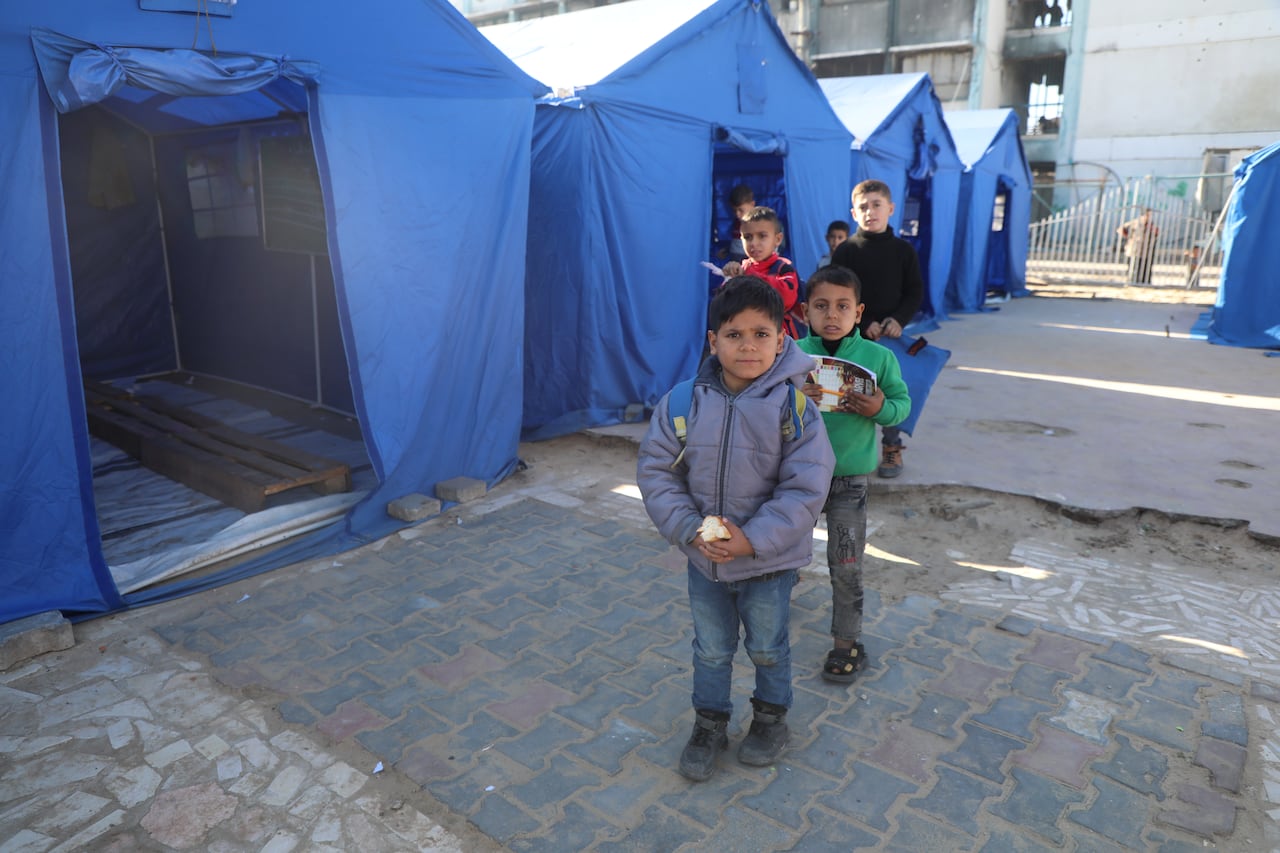 Children line up for their lessons in Beit Lahiya. (Mohamed El Saife/CBC)
Under a ceasefire negotiated late last year, Israel still occupies more than half of the Gaza Strip and bars civilians from other areas. Nearly all buildings in the Israeli-controlled sector have been leveled and residents driven out.
Although major fighting has stopped, Israel has routinely opened fire at Palestinians it accuses of approaching the yellow line, saying it aims to eliminate threats to troops.
More than 440 Palestinians have been killed since the October deal came into effect, while militants have killed three Israeli soldiers
Staff at Yamen and Toulin’s school said they hear gunfire daily.
“We taught the children that as soon as we hear fire … to lie down. This is not safe, and safety depends on God, but this is what we can do,” Yara Abu Ghalweh, a school supervisor, said.
UNICEF can’t guarantee the children’s safety at its schools, either, says Elder.
“You’d like to say everywhere is safe,” he said. “But children continue to be killed during a ceasefire.”
A high value on education
Nevertheless, anxious parents are willing to take the risk.
Before the war, Palestinians had one of the highest literacy rates in the world, according to a 2018 Palestinian Central Bureau of Statistics.
But a recent report from Cambridge University estimates that children in Gaza will have lost the equivalent of five years’ worth of education due to repeated school closures since 2020, first through COVID-19, and then war.
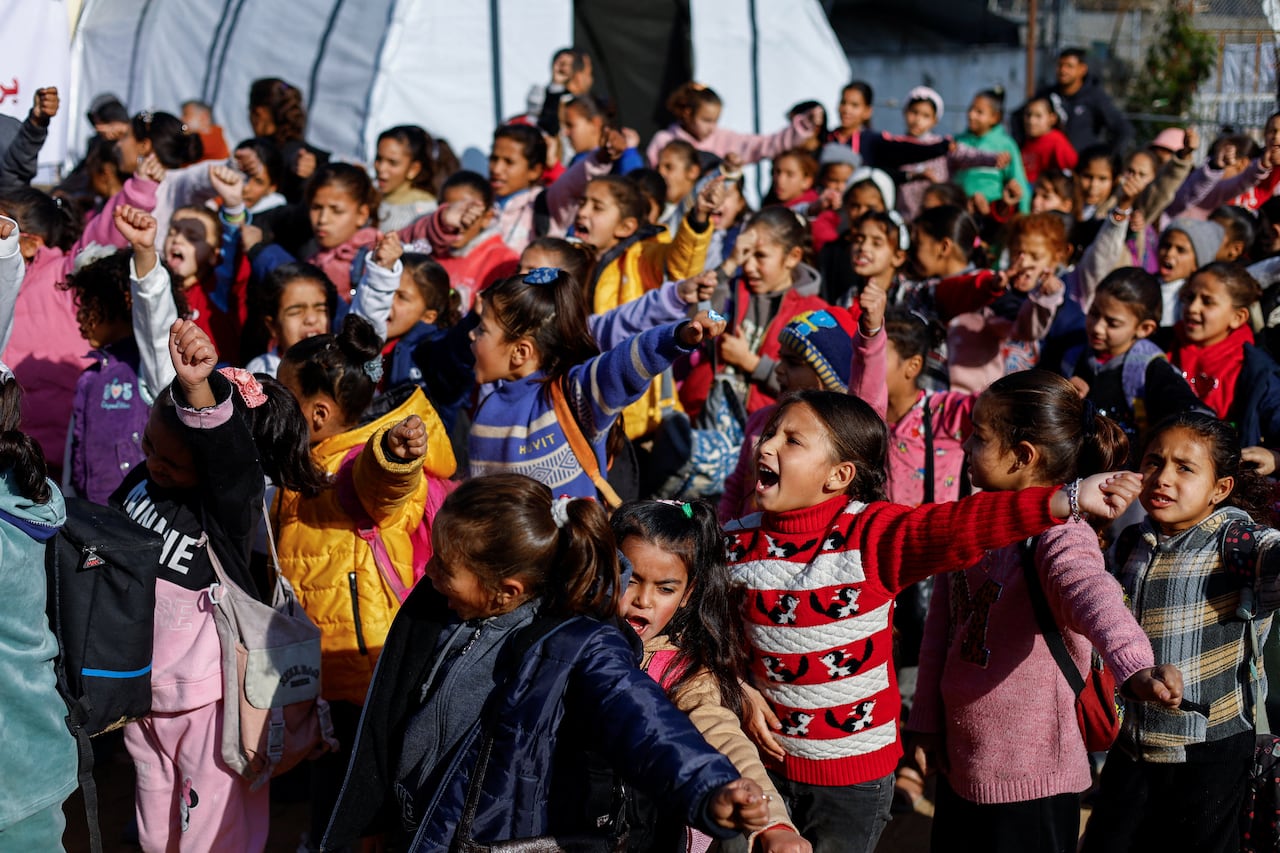 isplaced Palestinian students gather outside a tent near the Israeli-designated ‘yellow line.’ (Mahmoud Issa/Reuters)
So despite her fear, Al-Zanati, Yamen’s mother, displaced from Khan Younis, registered him for school the minute she could.
“We are very close to the yellow line, so some nights pass where we don’t sleep at all,” she said.
But, come morning, if things appear calm, she sends him off to school.
“He should be learning,” she said. “He is a child.”