
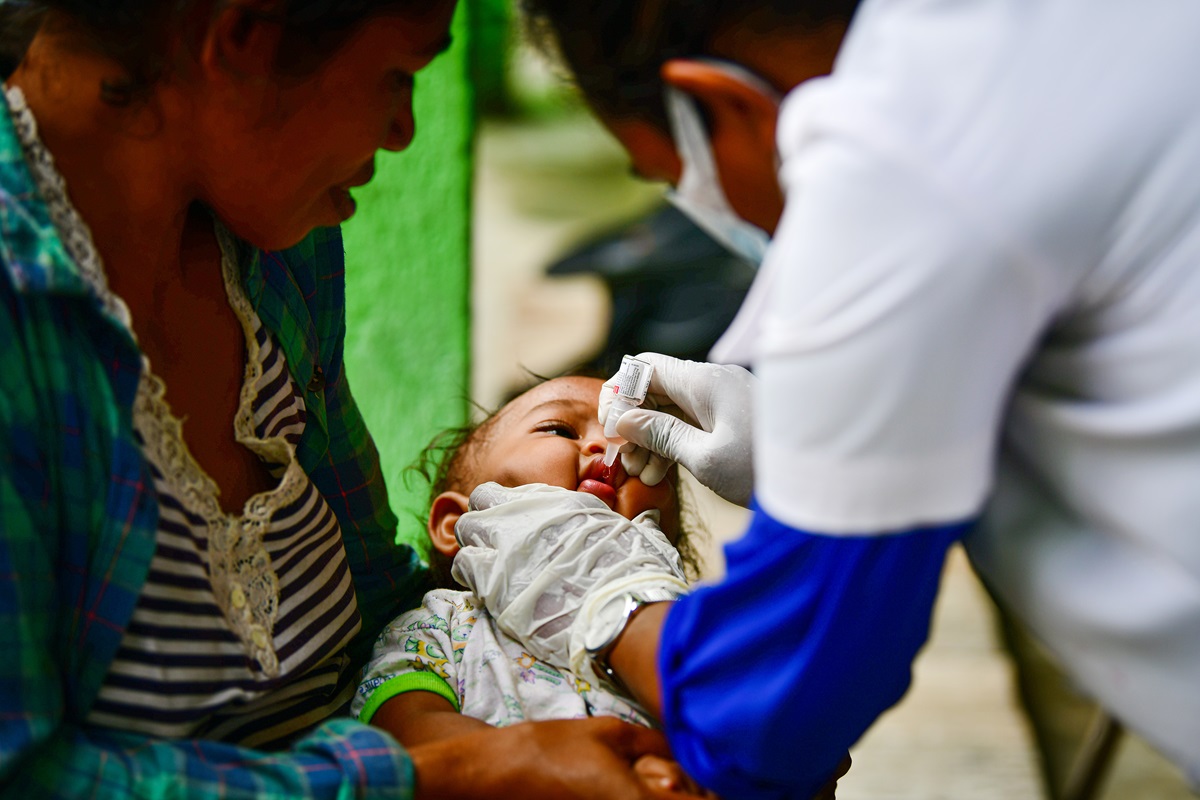
Fifteen years after recording its last case of wild poliovirus, the WHO South-East Asia Region with a quarter of the world’s population, continues to sustain its polio-free status while harnessing innovations and lessons from the polio programme to accelerate broader public health progress.
“This extraordinary achievement followed unparalleled efforts and demonstrates what can be accomplished and sustained through unwavering government leadership, a dedicated health workforce, and strong partnerships, including with communities,” said Dr Catharina Boehme, Officer-in-Charge, WHO South-East Asia Region.
On this date in 2011, an 18-month-old girl was paralyzed by wild poliovirus in Howrah, West Bengal, India. The extensive and intensive response that followed ensured that this remained the last case of wild poliovirus in the Region. Three years later, the WHO South-East Asia Region was certified polio free on 27 March 2014.
The Region continues to maintain strict vigil against poliovirus importation and protect children through vaccination against a disease that once caused widespread paralysis and death.
In 2025, more than 50 000 stool samples were collected across the Region and tested through a network of 13 WHO-accredited polio laboratories, including national, regional and global reference laboratories. Surveillance across the Region continues to exceed the standards required to maintain polio-free certification.
Adding a further layer of sensitivity to detect any potential poliovirus transmission, environmental surveillance is being conducted at 93 sites among high risk population in five countries.
As per annual WHO/UNICEF Estimates of National Immunization Coverage (WUENIC), the Region has maintained high population immunity through consistently strong immunization coverage. Coverage with bivalent oral polio vaccine and at least one dose of inactivated polio vaccine has remained above 90% for many years.
Even during humanitarian emergencies, natural disasters and the COVID-19 pandemic, countries sustained high-quality surveillance and immunization services, safeguarding these hard-won gains.
Providing independent oversight, the South-East Asia Regional Certification Commission for Poliomyelitis Eradication (SEA-RCCPE) meets annually to review country progress, assess risks and verify the Region’s continued polio-free status.
The polio programme continues to deliver benefits far beyond a single disease. Member countries have applied innovations, systems and operational lessons from polio eradication to strengthen routine immunization, advance measles and rubella elimination, enhance public health laboratory capacities and emergency preparedness. These efforts have been instrumental in expanding routine immunization coverage, reaching previously unreached communities, and closing immunity gaps.
Member countries have also recorded major progress against other vaccine-preventable diseases. The Region continues to sustain elimination of maternal and neonatal tetanus, while the introduction and scale-up of vaccines against pneumococcal disease, rotavirus, hepatitis B, Japanese encephalitis, typhoid and human papillomavirus, continues to reduce mortality and long-term disease burden.
As long as polio exists anywhere in the world, the risk of importation remains. Countries must sustain high immunization coverage, sensitive surveillance and rapid response capacities for polio as well as other vaccine-preventable diseases, the Officer-in-Charge said.
“The journey from polio endemicity to sustained polio-free status demonstrates that ambitious public health goals are achievable,” Dr Boehme said, adding, “WHO remains committed to supporting countries to protect every child through strong routine immunization systems and to advance disease elimination across the Region.”