
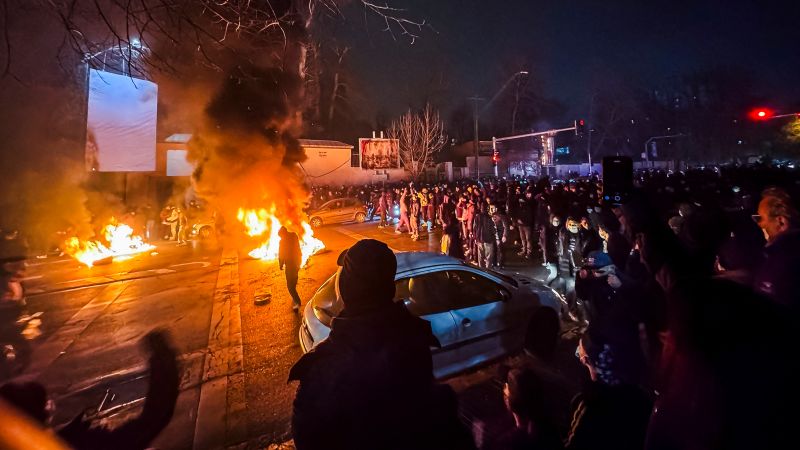
Many thousands of Iranians are again risking their lives to protest their authoritarian, theocratic regime. And as it has done during previous protests, the regime is responding by cutting off the country’s Internet access, unleashing violence on its citizens, and blaming foreign scapegoats. The protests’ death toll is rising: Iran Human Rights, a Norway-based nongovernmental organization, estimates that over 600 demonstrators have been killed nationwide since late December.
Perhaps emboldened by his recent ouster of Nicolás Maduro, the Venezuelan leader, U.S. President Donald Trump has repeatedly vowed to launch military strikes if Tehran continues to repress protest. The United States “will start shooting too,” he warned on January 6, if Iranian protesters keep getting killed. Tehran’s heavily armed troops and militias have brutally suppressed previous demonstrations, and there is a genuine need to prevent a larger massacre. Moreover, the Islamic Republic appears more fragile than ever after last June’s 12-day war. The regime seems incapable of addressing the root causes of the economic crisis that has driven its people to the streets; protests have spread from Tehran to every corner of the country, revealing Iranians’ widespread lack of faith that their current leaders can set the country on a better course.
All these factors surely increase the Trump administration’s temptation to deal Supreme Leader Ayatollah Ali Khamenei’s regime a deathblow—or even a warning shot to try to convince it to negotiate a change in governance. But an attack by Trump would damage the protest movement far more than the regime and could undermine an effort that has plenty of momentum for change on its own.
THE LAST STRAWS
These protests represent broader concerns than did Iran’s other, recent popular uprisings. After Iran’s 2009 presidential election, widespread demonstrations broke out over vote rigging; in 2019, an overnight spike in gas prices prompted large protests; and 2022’s “Women, Life, Freedom” protests focused on the theocratic regime’s draconian punishment for behavior and dress-code violations. But although the crash of the Iranian rial—which, in late December, declined in value by 50 percent—was the immediate trigger for the ongoing protests that began on December 28, that devaluation merely represents the broader economy’s catastrophic condition: for most Iranians, the country has become unlivable. According to the UN Food and Agricultural Organization, food prices overall have jumped by 72 percent since January 2025. An Iranian government spokesman warned that they could rise by another 20 to 30 percent in the coming weeks.
For many years, Tehran regulated and subsidized the prices of essential commodities such as rice and cooking oil, but after the currency devaluation cut into the regime’s economic reserves it has instructed that free-market prices should prevail. But few Iranians can afford to pay these prices, thanks to longer-term disastrous shifts in the Iranian economy. Between January and December of 2025, inflation soared by over 48 percent and housing costs climbed by almost 37 percent. According to the government-run Statistical Center of Iran, the average Iranian would now have to save for 100 years to be able to purchase a modest apartment in a major city.
Meanwhile, crumbling infrastructure and outdated equipment have stalled Iran’s industrial expansion. The country’s economy relies on oil and gas for 80 percent of its exports and 30 percent of national revenue, a dependence that will not go away even if U.S. sanctions are lifted. Domestic manufacturing has largely ground to a standstill as customers are unable to pay for orders. Work stoppages and strikes are increasingly frequent. Together, these factors drove GDP growth down from 5.3 percent in 2023 to 0.6 percent in 2025. A shadow economy has flourished as the formal economy has stalled, but the benefits of commodity smuggling and human trafficking disproportionately flow to elites because of judicial corruption.
For most Iranians, the country has become unlivable.
Educated youth and professionals have been hit especially hard. The country’s overall unemployment is officially 9.2 percent, with youth unemployment around 23 percent. But these numbers likely underestimate the scale of the problem. Iran’s population is well educated—over 61 percent of both men and women have completed a university degree, according to the World Bank—but few can gain any economic rewards or professional stability from their knowledge.
Citizens are also frustrated by the theocratic regime’s reckless exploitation of Iran’s natural resources, which has accelerated environmental degradation. Major rivers supplying Isfahan and Shiraz with water now routinely run dry, and Tehran is running out of water. In November 2025, the government proposed a likely unworkable plan to relocate the nation’s capital to the southeastern coast of the Persian Gulf. Pollution, meanwhile, is turning the urban air toxic and extreme heat is rendering parts of the country uninhabitable, especially around the southern and southwestern oil and gas fields. Population migration northward is depleting the oil industry’s workforce, and rising temperatures are limiting farmers’ ability to raise livestock and harvest. The Iranian government has been incapable of managing climate change, in part because of corruption among officials tasked with implementing remediation projects.
One factor not actively influencing the protests is the collapse of Iran’s so-called axis of resistance and the country’s various military humiliations by Israel and the United States since October 7. Although citizens are, by and large, relieved that the regime is incurring less expense supporting foreign proxies in Gaza, Lebanon, and Syria, ordinary people have yet to see any real benefits.
A REGIME ON THE ROCKS
Like other successful domestic revolts in Iran—the 1905–6 constitutional revolution and the 1978–79 Islamic Revolution—the recent demonstrations unite men and women from a range of socioeconomic classes and professions: merchants, public and private employees, students, seminarians, public intellectuals, and moderate Shiite clerics. Although merchants facing business collapse initially organized the demonstrations, university students and unemployed young adults picked up on this momentum in cities across the country. The government inadvertently helped spread the protests to smaller villages by criticizing protesters in state media; the reporting prompted otherwise isolated citizens to express their discontent. Now the uprising has become self-sustaining.
Iran’s government has sought to placate the public by announcing an increase of more than 300 percent to the monthly credit subsidy that much of the population receives. But the truth is that Iran’s central bank does not have the money to deliver this promise. If it tries to pay off citizens, it is likely to trigger a further depreciation of the rial. Iran’s domestic problems simply cannot be solved without integrating Iran’s economy into the region and the world. This is why Tehran has made some rapprochements with Riyadh and suggested a willingness to negotiate with Washington and European governments.
But Khamenei is now in a Catch-22: he understands that opening Iran’s markets and society enough to fix its economic problems will also speed the end of his rule. So he and some other hard-line leaders have resorted to blaming alleged external instigators. State-controlled media outlets claim that the protests are “manufactured chaos” originating from spy agencies in Israel, Washington, and even the United Kingdom.
Iranian leaders are more split on how to respond than they have been in the past. Iranians know that Khamenei cannot halt, let alone reverse, these rapidly mounting national crises. In December, Iran’s parliament rejected the executive branch’s proposed 2026 budget, declaring to President Masoud Pezeshkian that it was inadequate to address the country’s problems. The regime has raced to appoint a new central bank governor, hopelessly tasked with lowering the inflation rate, stabilizing the currency, and curtailing the shadow economy all at once. Pezeshkian and other senior officials have thrown up their hands and instructed regional authorities to solve crises locally.
Pezeshkian himself has made a series of extraordinary admissions of failure, acknowledging to government officials in December that “the government is stuck, really badly stuck. … Catastrophes are raining down. … The problem is us.” He told a group of university students, “If someone can do something, by all means go for it. I can’t do anything; don’t curse me.” The antigovernment demonstrations have forced Tehran to ask opposition leaders for dialogue. On December 30, in another unprecedented move, an official administration spokesperson acknowledged that “we see, hear, and recognize the reasons for protests.” These are signs that the regime knows it is on the ropes.
BOOMERANG EFFECT
The success of the protests in generating real change is not guaranteed. One major problem handicapping the demonstrations is that the protesters also have not rallied behind a single public face. During the Islamic Revolution, by contrast, the charismatic Ayatollah Ruhollah Khomeini led the uprising against Shah Mohammad Reza Pahlavi, creating a unifying national figure for the cause.
The various Iranian dissident groups supporting the protests—and which could lead a post-Khamenei regime—also lack a shared ideology and method. Former Crown Prince Reza Pahlavi, the son of the deposed Shah Mohammad Reza Pahlavi, retains symbolic support in a country with a long imperial history. The United States and Israel could turn to him to try to stabilize a post-theocratic Iran; Pahlavi even has an administrative plan sketched out to restore the monarchy. But having spent almost 50 years in exile, Pahlavi and his advisers have very limited organizational capacity within Iran. And Iranians may not want to risk a return to an older form of absolutist rule—especially not a monarchy beholden to the United States, which supported the shah.
The National Council of Resistance of Iran, meanwhile—an opposition coalition periodically favored in Washington—is linked to the People’s Mojahedin Organization of Iran, or MEK. The MEK has some organizational capacity within Iran, but it is widely disliked by many Iranians for its support of Iraq during the Iran-Iraq War and for its Marxist orientation. The leaders of the so-called Green Movement, which came close to overthrowing Khamenei’s government during a wave of 2009–10 protests, are now elderly and remain in government detention. If they were freed, they could play a role in transitioning Iran to more secular and representative government. So could former Iranian presidents Mohammad Khatami and Hassan Rouhani, who both attempted reforms during their terms in 1997 to 2005 and 2013 to 2021, respectively.
There is one thing, however, that might unify the country temporarily, but in the wrong way: a foreign attack. Iran’s leaders know that U.S. or Israeli strikes would shift ordinary citizens’ focus away from protesting. Antigovernment protests were gaining momentum last June, when the 12-day war broke out. But as Israeli and U.S. bombs fell, ordinary citizens had to go into hiding, giving Tehran a six-month reprieve from popular discontent. Trump’s threats do not seem to be making the regime more reluctant to brutalize protesters, and in recent days, commanders of Iran’s Revolutionary Guards have spoken about launching preemptive strikes to tempt the United States and Israel into retaliating. In a Sunday interview on state television, even the usually relatively temperate Pezeshkian’s rhetoric became more hard-line: he blasted the protesters as “rioters” and “terrorist elements,” echoing Khamenei.
HOMEMADE LEVERAGE
Exactly when and how Iran’s current regime will fall is unclear. Khamenei, who is 86, could cling to power until he is incapacitated or dies. Midlevel Revolutionary Guards leaders, seeking to preserve their organization’s economic clout, may step in and impose military rule. Protesters could overwhelm local and national security forces, forcing pro-regime religious leaders and politicians to flee. But irrespective of their feelings about their regime, Iranians in the country have no desire for U.S.-led regime change. They have seen it fail along their own borders in Iraq and Afghanistan. And in the first few days of 2026, they have witnessed the United States’ incursion into Venezuela with no plan for political succession or stabilization. They do not want the Trump administration to plunder their oil industry, either.
Iran does not need a government built from scratch. It already has executive and legislative branches of government, a popularly elected president, and representatives who appoint justices to the judicial branch—even if the independence of those three branches of state is undermined by their subordination to Iran’s theocratic wing. Most important, Iran has previous experience with citizen-driven political change, during the constitutional revolution of 1905–6. That democratic breakthrough resulted in political reforms including a popularly elected parliament, multiple political parties, a free press, and civic involvement from all societal groups. Iranians can replicate those events in the twenty-first century.
The plain fact is that the Khamenei regime’s days are numbered, at least in its present form. Even with brutality, the ayatollah and his cohort are struggling to drive protesters off the streets. Missiles are not needed. Iran’s citizens can topple the theocrats on their own.
Loading…