
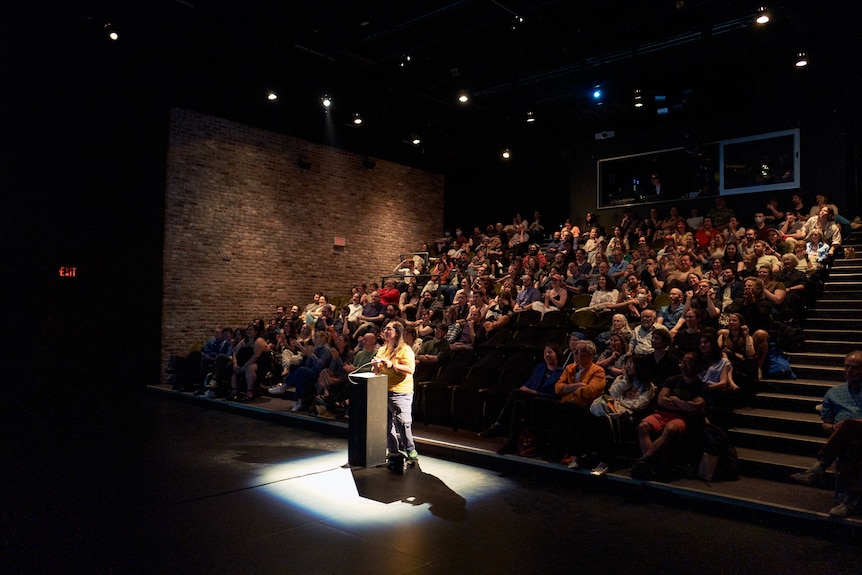
In the drama theatre of the Sydney Opera House, a group of audience members will gather for a performance quite unlike other shows at the Sydney Festival this month.
On the stage will be a single ‘player’ and this performer will pick up a controller placed on a plinth, taking the rest of the audience on a journey until their turn is over.
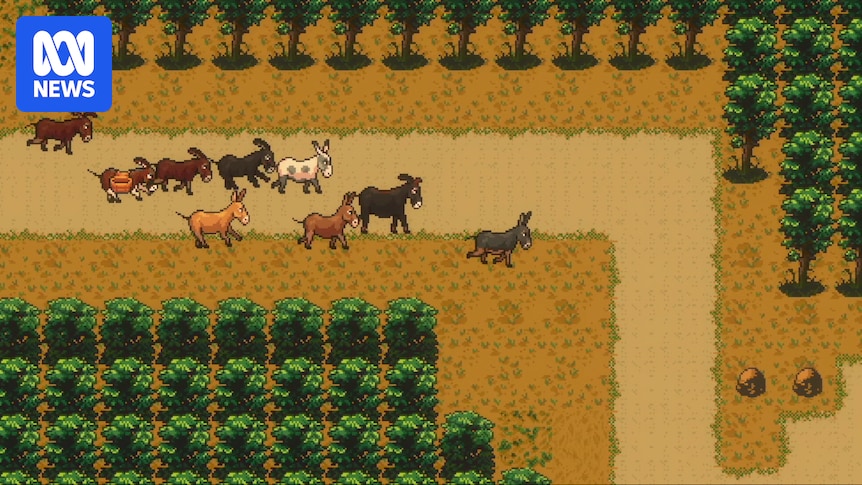
It’s part of the interactive video game theatrical show asses.masses by Canadian theatre makers Patrick Blenkarn and Milton Lim, where a group of donkeys find a new role in the world after they’ve been replaced by automation.
One player is selected as champion from the audience, but others can switch in at any time to help complete the challenges. (Supplied: Patrick Blenkarn, Milton Lim)
Lim says the custom video game, played over almost eight hours, was designed for audience interaction and collaborative storytelling.
“There’s a controller at the front of the room, and people take turns stepping up and becoming the player and leading everyone else on the journey,” Lim says.
“A group of unemployed donkeys have lost their employment due to rapid industrialisation in their area, they don’t really know what to do next, but they know that the way things are going is not how it should be.”Social experience of playing together
The show explores the “politics of the basement”, drawing on the nostalgia of sitting and watching friends and siblings play games in the 1990s and early 2000s, and assisting or hindering in a social setting, thereby challenging the idea that it was a solitary activity.
A single player would play at any one time, but Patrick Blenkarn says the whole group was playing together.
“The basement had a really beautiful — idiosyncratic, maybe — way of sharing power, negotiating who gets to be in control, who’s best at this type of game or this type of level and creating opportunities for flashes of democracy,” Blenkarn says.
“There are hundreds of other people in the audience, usually very, very willing to give feedback, commentary, perhaps even a little bit of criticism as to how that person is leading the herd through the obstacles that lie ahead of them.”
Throughout the performance, the social dynamics of the group determine how each performance unfolds, with audience members cheering when the player overcomes a difficult challenge or takes an extra long break for dinner at the halfway mark, as they did in Barcelona.
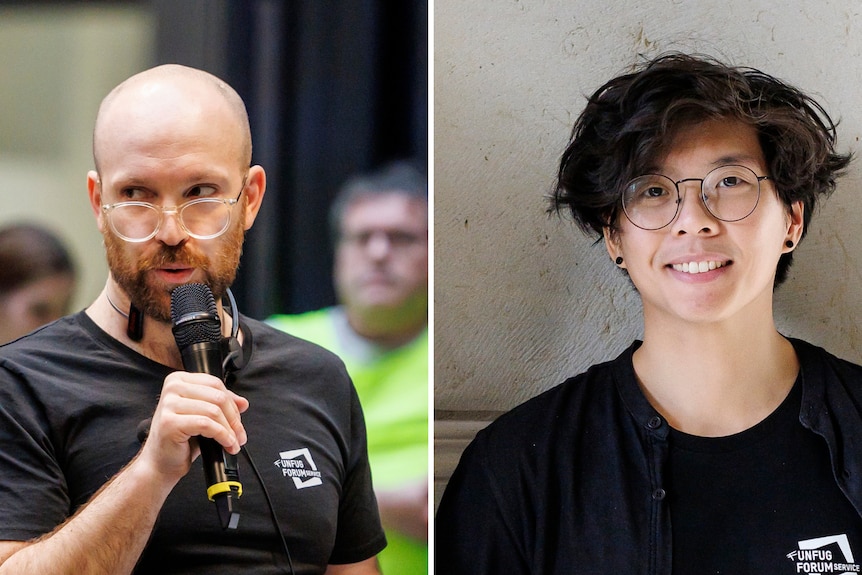
Patrick Blenkarn (left) and Milton Lim (right) say the game explores the dynamics of game play in the late 90s and early 2000s. (Supplied: Frank Sperling)
“We’ve been stuck in a mine for an extra half hour because everyone was very supportive of a particular person who was maybe just learning how to jump, and that’s fine because when that person finally made that jump, the aforementioned infamous jump, the struggle was overcome,” Blenkarn says.
“Conflict was vanquished. That is not part of our story, but it was the story of that version of asses.masses.”
A story for each audience
Lim says the dynamic nature of the game, which was developed by the pair themselves rather than working with an established studio, means each story has its own telling.
“One thing narratively is that it’s not one singular hero’s journey. asses.masses is a herd of donkeys, and each of them has different perspectives on labour, on play, on what it means to live and lead a meaningful life,’ Lim says.
“That mirrors what’s happening inside of the audience; there’s not one singular perspective, not one singular way to experience the story.”

asses.masses is designed to be played in a theatre with a crowd of people, with one audience member at a time using the controller. (Supplied: Patrick Blenkarn, Milton Lim)
Blenkarn and Lim want to draw on the audience’s experiences and expertise with certain genres of video games, so that players will switch during the show.
However, they didn’t want it to be a punishing experience.
“We were very interested in testing different game genres and different aesthetics with one of the express interests in inviting changes to the person playing,” Blenkarn says.
“Maybe you’re not so great with 3D cameras, but maybe you’re really great at 2D platformers, so you hand the controller over.
“Those aesthetic shifts would invite a conversation about whether or not the person who was playing should continue.”
Designing a game for the masses
Lim says while challenging games like Dark Souls, which are built on repetitive failure, were part of the design conversations, it wasn’t always fun to see someone struggle in a theatre environment.
“The ability for games to be so difficult that — quote-unquote — someone has to get good at it was very much in the air as we were making the game,” Lim says.
“We’ve made some directorial decisions around what kind of game aesthetics we want to borrow from; you don’t necessarily need to be a good gamer to be the right person for the challenge.
“asses.masses is not just theatre, it’s not just games, it’s not just about a social gathering; it’s all those things and we hope that everyone finds their way there.”
asses.masses is part of Sydney Festival at the Sydney Opera House on January 24 and 25.