
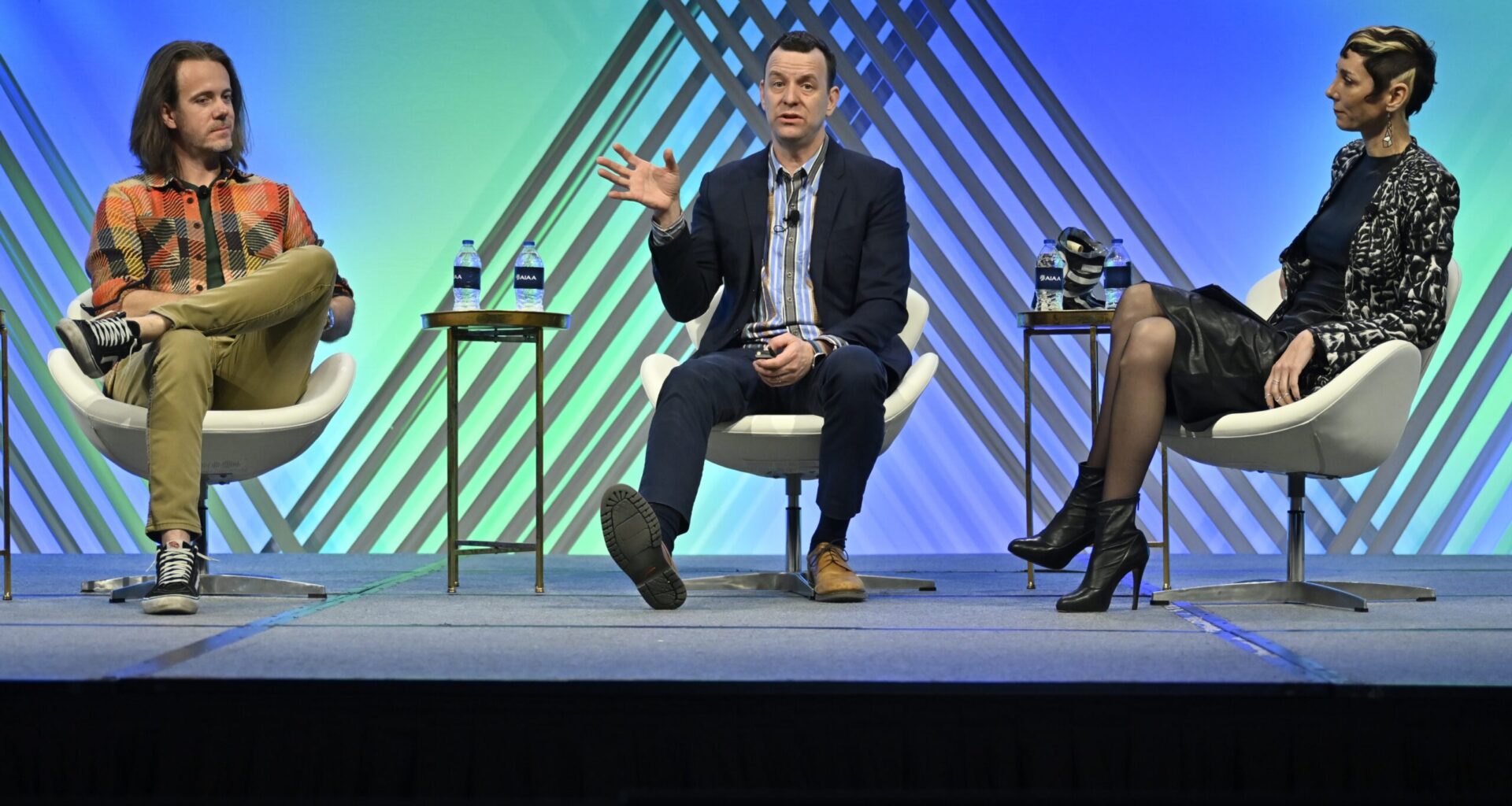
From designing Victoria’s Secret models’ angel wings to zero‑Kelvin‑compatible moon‑habitat suits, Ted Southern’s career arc has been anything but predictable. But an unconventional, nonlinear career can veer off to a meaningful career in aerospace, according to a cross‑disciplinary panel convened 12 January at AIAA SciTech Forum in Orlando.
In a discussion titled “The Art of Innovation: Distilling Vision Into Design,” experts explored how storytelling, entertainment‑industry practices, and other more artistic careers can influence engineering, and vice versa. Danica Vallone, Board Member and Founder, Organization for Space Medicine, Engineering, and Design; Ted Southern, Softgoods Division Manager for Paragon Space Development; and Brook Willard, Vice President of Development, Making Space Agency, took the stage to describe how science and art can inform each other.
Vallone provided a brief history, tracing modern space enthusiasm back to the 1950s Dan Dare comics and Walt Disney’s 1955 “Man in Space” series—produced with Wernher von Braun’s input and viewed by an astounding 40 million Americans. The broadcast, according to Disney archives, helped galvanize public support for the nascent space race and prompted President Eisenhower to screen it on Capitol Hill, foreshadowing the bipartisan momentum that later would fund NASA, she said.
“Don’t disregard the imagination of the things that you fell in love with in the first place, … most of us are here because we saw a movie, watched a show, read a book, saw a comic that kicked off our obsession and love that led to chasing flight,” Vallone stated.
Ted Southern described his evolution from French‑horn player to costume‑designer for New York theatre, including work on Victoria’s Secret fashion shows, to NASA‑contracted spacesuit‑glove developer.
After winning the 2009 NASA Centennial Challenge, his firm’s Final Picture Design was acquired by Paragon, where he now oversees fabrics ranging from lithium‑ion‑bag thermal regulators for the U.S. Navy to ceramic‑coated, zero‑Kelvin‑compatible moon‑habitat textiles. He highlighted Paragon’s role in the Gateway’s HALO module and Axiom’s liquid‑cooling spacesuit.
Brook Willard described his pivot from film production – where he coordinated massive stunts such as the Jason Bourne Las Vegas chase scene – to aerospace. That movie scene, all of six minutes and less than 5% of the two-hour movie, took 89 days of planning, rigging, and filming.
Willard argued that the film industry’s “militaristic” coordination, rapid iteration, and ability to fabricate rigs on demand constitute a “force multiplier” for space projects. By translating set‑building logistics, sensor integration, and safety protocols to spacecraft design, his company bridges the gap between cinematic spectacle and engineering rigor.
The panelists agreed that the cross‑pollination of skills – whether from comics, animation, or blockbuster cinematic stunts – can accelerate prototyping, improve risk assessment, and inject fresh perspectives into the traditional aerospace workflow.