
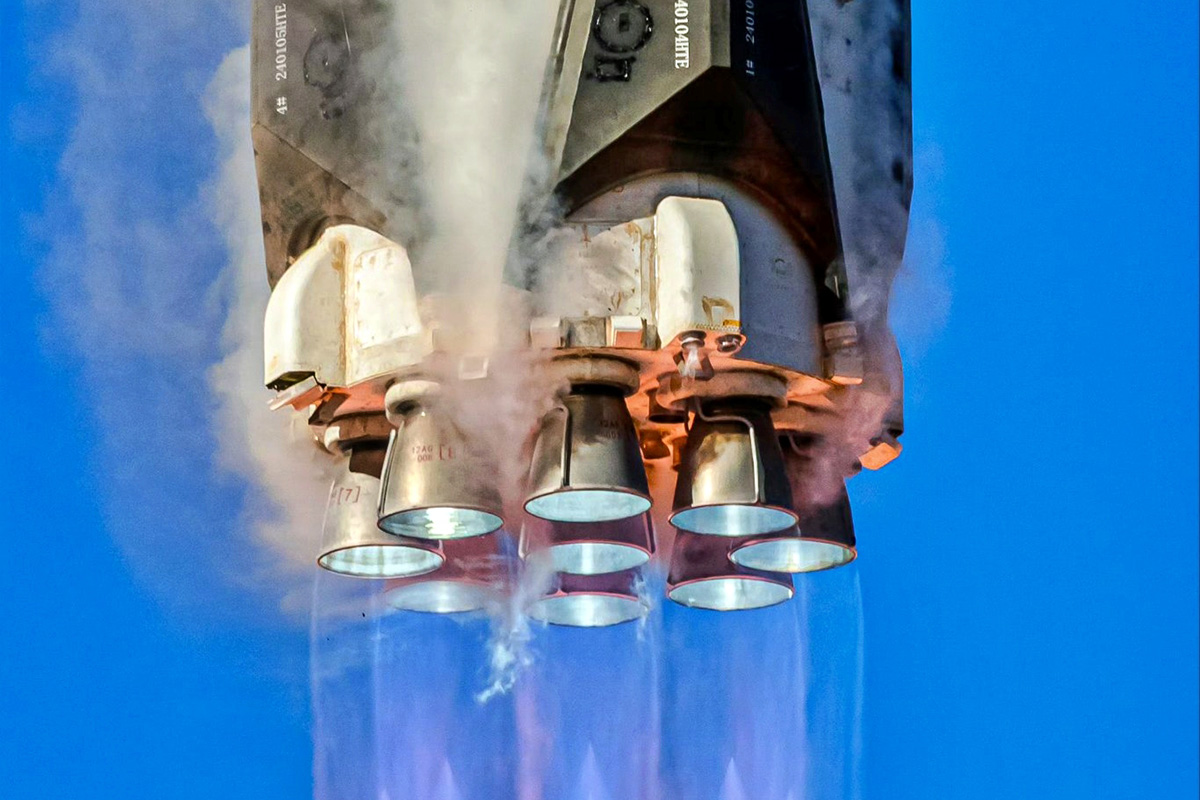
Last year was a busy one for the space industry, and the quest to explore the cosmos is not slowing down any time soon. RICHARD LOWE FRAeS from the RAeS Space Group reports on what is to come in 2026.
Who fought at the Battle of Geostationary Orbit 25° East?
Many in the space sector still do not consider themselves to be working on dual-use technology – but space is now being openly discussed as a warfighting domain in its own right. The German government recently announced an investment of $41bn in space defence capability. France followed suit, with a lesser figure – but from a higher starting point. The European Space Agency (ESA) has historically been staunchly ‘civil’ in its outlook. Even the mention of ‘dual-use’ would have drawn a frown – but ESA has now openly recognised its own relevance to defence. Last November’s ESA Council of Ministers (CMIN) meeting, held every three years, made unambiguous connections to supporting the security of Europe.
Space has always been driven from national security needs. For launchers, see missiles; for Earth observation, see intelligence, surveillance and reconnaissance (ISR); for navigation, see weapons guidance; for communications, see command and control. So, what, if anything, has changed?
The Russian invasion of Ukraine has clearly focused minds – but it highlights a change that was coming anyway. There are now more actors, and more assets, in space, so orbit is more crowded, filled with things that nations critically depend on. Their national interests are weakened without those things. In times of conflict, that is called a target. Something your opponent needs, which you can take away from them. Expect shooting to follow, unless you can defend or retaliate.
The industry is at an inflection point. Aeronautics went through its own, early in its development. Aircraft moved from a means of observation and communication to active participants in the war. The sky itself became contested. That same transition is inevitable for space – but it is harder to see. Did a battle take place in geostationary orbit last month? How would you know? What does a ‘shot fired’ even look like? We can – and should – all hope for peaceful coexistence in orbit, but hope is not a strategy.
More congested
China’s commercial space operator launched its first Zhuque-3 mission on 3 December. (Landspace)
The US (mostly SpaceX) launched something into orbit every two days on average in 2025 – that is more than everyone else combined. 2025 has been a record year for global launch.
After a challenging 2024, France is now back in action with the Ariane 62 which has put in a good show of successful launches, alongside Italy’s Vega-C launcher, from French Guiana. An attempted German launch from Norway would have become the first orbital launch from European soil – but it was not to be. The unproven light launcher did not reach orbit, leaving the door open for an attempt from Shetland’s SaxaVord spaceport in 2026.
The incredible pace of US launches has been boosted by reusability. Out of more than 150 Falcon 9 launches flown in 2025, only eight used new launchers. Reused launchers are now the dominant form of American launch by a large margin, and close to outnumbering single-use launchers globally. It is a field that has been monopolised by SpaceX – but no longer. Blue Origin, the launch company of Amazon’s Jeff Bezos, has now successfully flown its own reusable launch system called New Glenn. It promises some much-needed competition in the sector, even if reusability remains an ‘American-only’ success story so far. Finally convinced that launcher reuse is real, other companies and nations are now giving it a go. Look out for lots of rapid unscheduled disassemblies yet to come! China’s Zhuque-3 launcher made a first attempt in early December. The payload reached orbit, but the first stage recovery landing failed. Chalk that up as success with learning on top.
The global average failure rate for space launch has remained stubbornly high over the last 25 years, at around 5%. New launcher types (and there are LOTS of those lined up in 2026) always bring failures – but even established launcher families continue to fail on a regular basis, except SpaceX Falcons. Incredibly, they have had just two failures out of 580 launches across 14 years. In 2025 alone, they have achieved 155 with no fireworks, while the ‘rest of the world’ has actually become worse at launching since 2000.
In a lifting class of its own, the huge SpaceX Starship launcher is now close to becoming operational, following a series of increasingly successful trial flights. Designed to put 200t into orbit in one shot, it opens up new potential, and the rest of the space sector needs to get creative about what can be done with such huge lifting power.
At the other extreme, Blue Origin is now your best ticket for a personal ride into space and back. The New Shepard launcher took more people (36) into space in 2025 than all other crewed space programmes combined. Katy Perry was one of them, as a member of a fully female crew. Shockingly, that has only happened once before in the whole history of human spaceflight. Valentina Tereshkova’s 1963 solo flight, dubbed Vostok 6, held that distinction. Until now she had the honour of orbiting closer to the Earth’s poles than any other astronaut (or cosmonaut). Manned (yes, ‘manned’) flights have always flown nearer to the equator, but her flight took her as far north as Reykjavik and as far south as the tip of Antarctica, with an orbital inclination of 65°. That record has now been broken by a SpaceX private flight, dubbed Fram2, and its paying passengers have become the first ever humans to orbit directly over the Earth’s poles.
With so much heading into space, it is good to know that two Active Debris Removal (ADR) missions are due to launch in 2026 – one by ClearSpace (ClearSpace-1) and one by Astroscale (ELSA-M). A welcome start to cleaning up some of the hypervelocity hazards that the Space Age continues to generate.
More multipolar
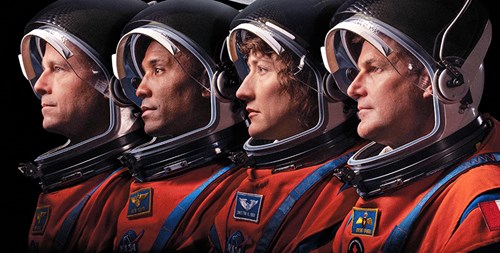
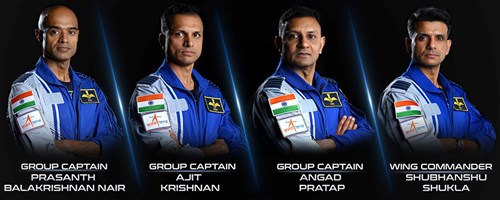
The Artemis II crew will include the first woman, the first person of colour, and the first non-American (Canadian) to travel to the Moon. From L-R: Jeremy Hansen (mission specialist) Victor Glover (pilot), Christina Hammock Koch (mission specialist), and mission commander, Reid Wiseman. The first crewed Indian Gaganyaan mission is expected no earlier than 2027. (NASA & ISPO)
India’s space programme is preparing to take a big step into the top tier, as it aims for its first home-grown human spaceflight. With other nations unwilling to share key technologies, India has pushed ahead to develop life support systems of its own, along with a host of other critical elements. Early in 2026, an uncrewed test launch will take place in the form of Gaganyaan-1 (Celestial Craft). There is a lot to test. A human flight into orbit sets a range of different engineering challenges compared to ‘simple’ robotic probes. The launcher must limit its acceleration to avoid harm to the human passengers. A pressurised crew capsule must keep a crew alive in vacuum, through freezing darkness and roasting sunlight. It has to manoeuvre in orbit and make it back through the atmosphere at hypersonic speeds, then touch down with at most a thump and not a crump. With all that to prove, it is very sensible that the G-1 flight will be the first of three tests before a person goes up. All will use a version of the earlier GSLV Mk 3 launcher, now known as LVM-3, in the H(uman)LVM-3 configuration. The first crewed flight will be no sooner than 2027 as Gaganyaan-4.
The number ‘50’ features strongly in Indian ambitions. The Indian Prime Minister, Narendra Modi, has set an ambition to be launching 50 times per year by 2029. Along the way, its space programme is targeting 50 new spacecraft to be launched over the next five years (as well as creating 50 new airports in the same period!).
NASA is pressing on with a return to boots on the Moon. Arch-rival, China has declared an ambition to put its own citizens on the Moon by 2030, giving the US a renewed sense of urgency to get back first. While the US often talks in terms of a renewed space race, and ‘getting there first’, China works on longer-range planning. There is some advantage to being the first to lay out the lunar picnic blanket – but better to view this as an enduring competition than a first-past-the-post sprint. While a human landing is still a few years away for either nation, the US’ Artemis II mission is scheduled to take astronauts for a flight around the back of the Moon in February. That will be the first human return to near-lunar space since the Apollo programme. The crew will include the first woman, the first person of colour, and the first non-American (Canadian) to travel there. Later in the year, China’s Chang’e 7 promises a tour de force of robotic exploration at the Moon’s south pole.
The US government has appointed Jared Isaacman to the role of NASA administrator. Isaacman is a departure from earlier NASA administrators. He is an entrepreneur from ‘outside the system’, with a personal fortune built as an entrepreneur in the finance and aviation sectors. He also has spaceflight experience – as a paying customer and crew commander on board SpaceX Crew Dragon missions. Expect a re-energised shift towards commercial contracting for government-set requirements if his appointment is confirmed.
Russia, as you might expect, has a challenge on its hands to maintain its historically strong position in orbit. Funding has become more opaque, and the nation clearly has some big bills to cover in pursuit of a bloody effort at territorial expansion.
A new Russian space station remains a declared intent – but an aircraft carrier upgrade has also been on the cards for a long time, and that is still rusting in drydock while its crew has been reassigned to a trench in Ukraine. A new space station is best viewed as ‘aspirational’ for the time being. A need to refresh its ageing satellite navigation system, GLONASS, may require a cost-saving new strategy for different orbits and substituted components. Russian launches now take place at around half the rate that they used to. China out-launched Russia by a ratio of almost 6:1 in 2025.
Do not underestimate what can be done with cheaper components and new approaches though. That’s a core tenet of the New Space wave which was pioneered by companies, such as Surrey Satellite Technologies ltd (SSTL). Necessity is, as they say, the mother of invention. Expect Russian space activity to become more ‘disruptive’ – in whatever way you read that word.
China might launch its new astronomical telescope, Xuntian, late in 2026. With a 2-metre diameter mirror and a design for serviceability, it will undoubtedly draw many comparisons to the Hubble Space Telescope. It will be placed in an orbit that allows it to dock with the Chinese space station, Tiangong, akin to the Shuttle servicing concepts of the 1990s and 2000s. It is a quite distinct mission though. Among many other differences, one clear sign of technological progress in the intervening years is the size of the detector: Hubble had 16m pixels in its camera, and Xuntian has 2.5bn . Just like Hubble and the much newer (and more complicated) James Webb Space Telescope (JWST), such missions serve as technology drivers, as pioneers of new science, and as showcases of national prestige – “If I can make a telescope like this, pointing upwards, then imagine what my classified satellites can see, pointing downwards.”
Still inspiring collaboration
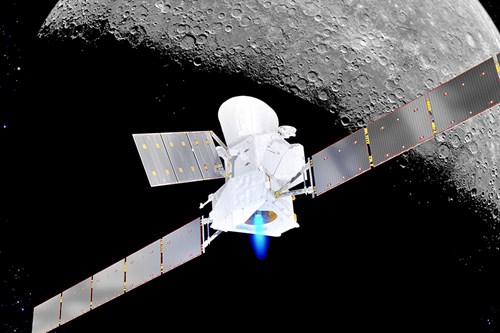
The joint ESA/JAXA Bepi Colombo mission is scheduled to reach Mercury later in 2026. (ESA)
The planet Mercury is, by Solar System standards, not very far away – but it is still a very difficult place to get to. After eight years of travel, involving one gravity slingshot around Earth, two around Venus and six around Mercury itself, ESA and JAXA’s Bepi Colombo mission will finally pull into orbit late in 2026. If all goes to plan, it will become only the second spacecraft ever to do so, after NASA’s MESSENGER mission, which ended in 2015. Actually, it will become both the second and the third spacecraft to orbit Mercury. The Bepi Colombo mission is a double satellite which will separate in orbit. One part has been developed by JAXA and the other by ESA.
Meanwhile, China’s Tianwen-2 probe will collect a physical sample from an asteroid, ready to return it to Earth by 2027. The mission is already on its way and will anchor itself to the target comet for sample drilling in mid-2026. If that sounds like the start of ‘asteroid mining’, then take a moment. The sample will be just 100g and, while still a mighty achievement, but it is certainly not industrial supply. A later mission, Tianwen-3, has the much more challenging goal of Martian sample return, and it might launch in 2028.
Take a moment as well to recall some intrepid explorers elsewhere in the Solar System. The Mars rover, Curiosity arrived in 2012 and was joined by Perseverance in 2021. Both NASA rovers have now trundled about 20 miles since their arrivals, as they continue to explore the Red Planet. ESA’s Jupiter Icy Moons Explorer, or JUICE, has another five years in flight before it will reach its goal. NASA’s Europa Clipper is heading for the same neck of the woods but with a different mission, and will get there a year earlier, in 2030. In a decade-long collaboration, the two missions have been co-operatively designed to complement each other, collecting data together in the Jovian system.
Space exploration has always driven both competition and co-operation. It is remarkable that Western astronauts continue to share a ride to the International Space Station (ISS) with their Russian cosmonaut colleagues – even while both sides pour weapons, satellite signals and jammers into opposing sides of the Ukraine war.
In increasingly congested and contested space, it is prudent to plan for trouble, but we can still hope for the best, in orbit, as on Earth.