
AIAA SCITECH FORUM, ORLANDO, Fla. — Former NASA chief scientist Jim Green today delivered a warning and a proposed solution about the growing number of fast-moving, erratic comets being identified by astronomers.
“The problem is we’ve assumed they won’t hit Earth,” he said during an afternoon session here. “And that is a mistake!”
Of chief concern is the Oort Cloud, a field of debris, rocks and ice at the edge of the solar system. Occasionally, a large chunk of debris gets knocked off course by gravity disturbances, sending a comet toward the sun — and potentially Earth. One of the biggest risks posed by comets is they move much faster than asteroids, Green said.
“The theme here is these comets could pose a Black Swan event, something very bad but not predicted, like the 9/11 terror attacks or covid pandemic,” he said. “We might get a year or so warning, and that’s not enough to design and build and launch” a spacecraft that could intercept a comet and hopefully knock it out of Earth’s path.
“If we don’t already have something in orbit ready to go, it’s too late.”
In a paper titled “Planetary Defense: How to Become Armed and Ready,” Green and his coauthors recommend that NASA begin developing a kinetic impactor spacecraft that would be launched toward the L2 Lagrange Point, a gravitationally stable spot about 1.5 kilometers from Earth where the spacecraft could loiter without expending large amounts of fuel. If a comet or other object were on a trajectory to collide with Earth, the craft would depart L2 “on a rapid intercept trajectory designed to achieve high closing velocity with the minimum practical warning time,” reads the paper, which Green authored with Arthur Beckman, director of NASA programs at Boeing; consultant Douglas Cooke, a former head of NASA’s Exploration Systems Missions Directorate; and consultant Chris Andrews, formerly of United Launch Alliance.
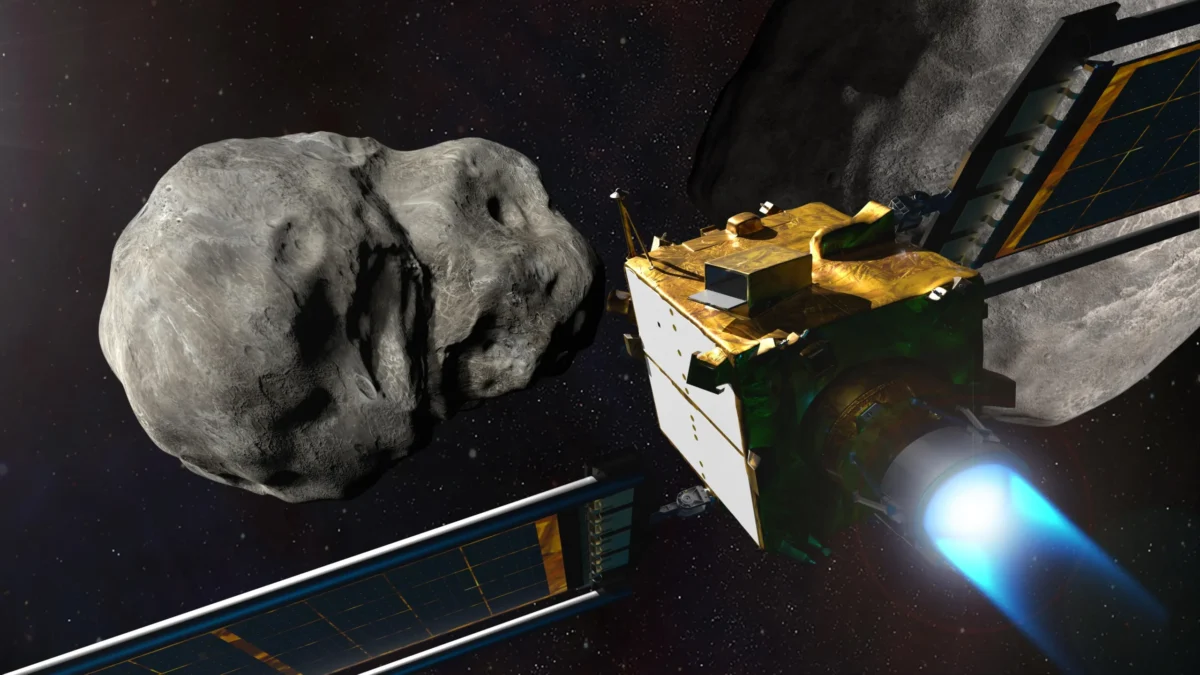
There’s evidence such an approach could work, based on the results of NASA’s DART, short for Double Asteroid Redirect Mission. The spacecraft in 2022 smashed into the asteroid moonlet Dimorphos, altering its orbit around another asteroid.
To “provide the largest impactor mass with the greatest possible velocity in space ready to go,” the paper reads, this new kinetic impactor spacecraft must be launched by a NASA Space Launch System rocket.
NASA’s Near Earth Object (NEO) observation program has been finding and tracking asteroids and other bodies, the paper notes, and the agency estimates that it has identified about 40% of them. The largest object detected is around 100 kilometers across, which Green said can vaporize much of Earth’s oceans and atmosphere, including objects in low-Earth orbit. Smaller objects closer to 100 meters in diameter could wipe out entire cities.
And advance notice isn’t guaranteed. Green pointed to the comet Siding Spring, which in 2014 passed within 140,000 km of Mars. That comet, which was half a kilometer wide and moving at 56 km per second, was “first spotted only 22 months before its near miss of Mars. It was a complete surprise to scientists worldwide,” the paper reads.
“I think we’re ignoring our biggest problem,” Green said. “And our biggest problem no longer is the asteroid population that we now call NEOs, but it’s the comets.”