
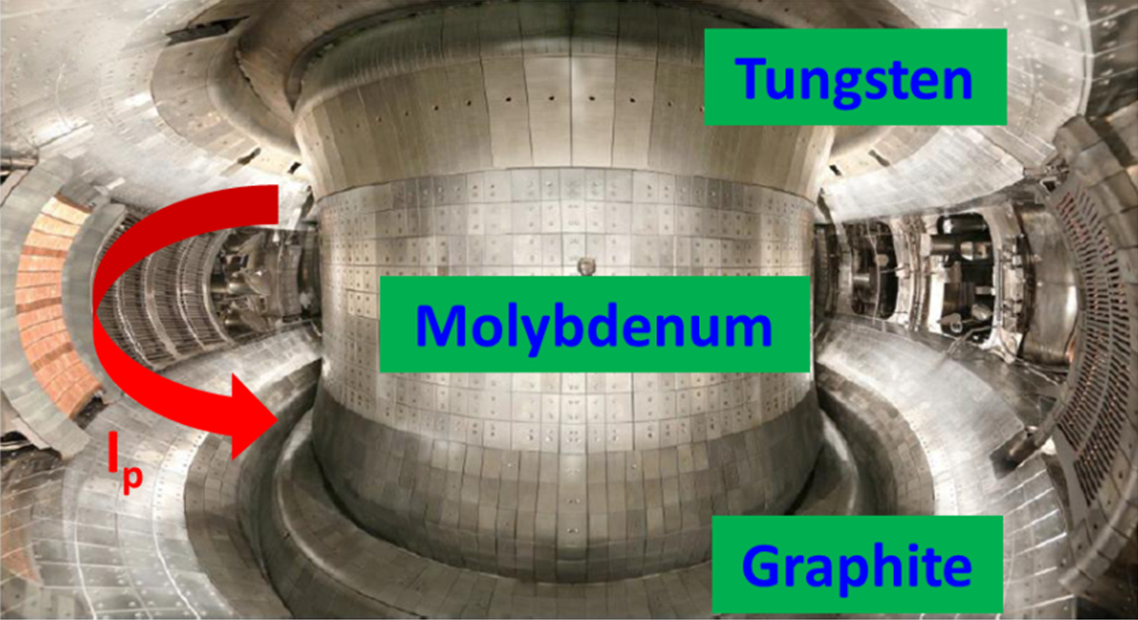
Getting a significant energy return from tokamak-based nuclear fusion reactors depends for a large part on plasma density, but increasing said density is tricky, as beyond a certain point the plasma transitions back from the much more stable high-confinement mode (H-mode) into L-mode. Recently Chinese researchers have reported that they managed to increase the plasma density in the EAST tokamak beyond the previously known upper Greenwald Density Limit (GDL), as this phenomenon is known.
We covered these details with nuclear fusion reactors in great detail last year, noting the importance of plasma edge stability, as this causes tokamak wall erosion as well as loss of energy. The EAST tokamak (HT-7U) is a superconducting tokamak that was upgraded and resumed operations in 2014, featuring a 1.85 meter major radius and 7.5 MW heating power. As a tokamak the issue of plasma and edge stability are major concerns, even in H-mode, requiring constant intervention.
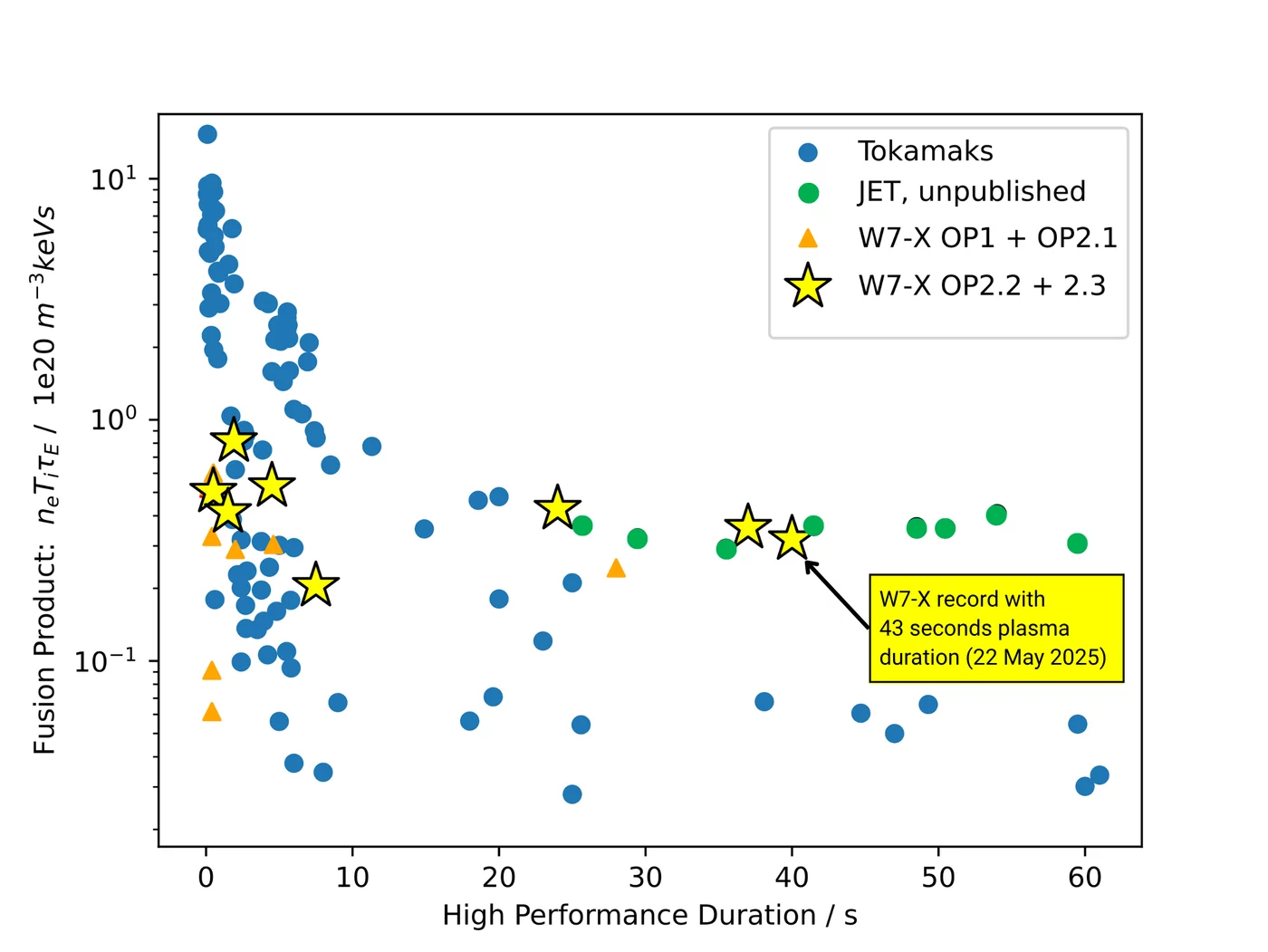 Fusion product against duration, showing the Lawson criterion progress. (Credit: Dinklage et al., 2024, MPI for Plasma Physics)
In the recent EAST findings, the real news appears to be more confirmation of the plasma-wall self-organization (PWSO) theory that postulates that one of the causes behind plasma wall (edge) instability is due to the interaction between plasma dynamics and wall conditions through impurity radiation. By using electron cyclotron resonance heating (ECRH) and/or pre-filled gas pressure this impurity level might be reduced, enabling higher densities and thus exceeding the empirical GDL.
What’s interesting is that the paper also compares EAST and the Wendelstein 7-X (W7-X) stellarator, making the argument that tokamaks can operate in a way that’s more similar to stellarators, though W7-X is of course gifted with the same advantages as every current stellarator, such as no real GDL or the necessity of dealing with H- or L-mode. It’s therefore not surprising that W7-X is so far the most efficient fusion reactor to achieve the highest triple product.