
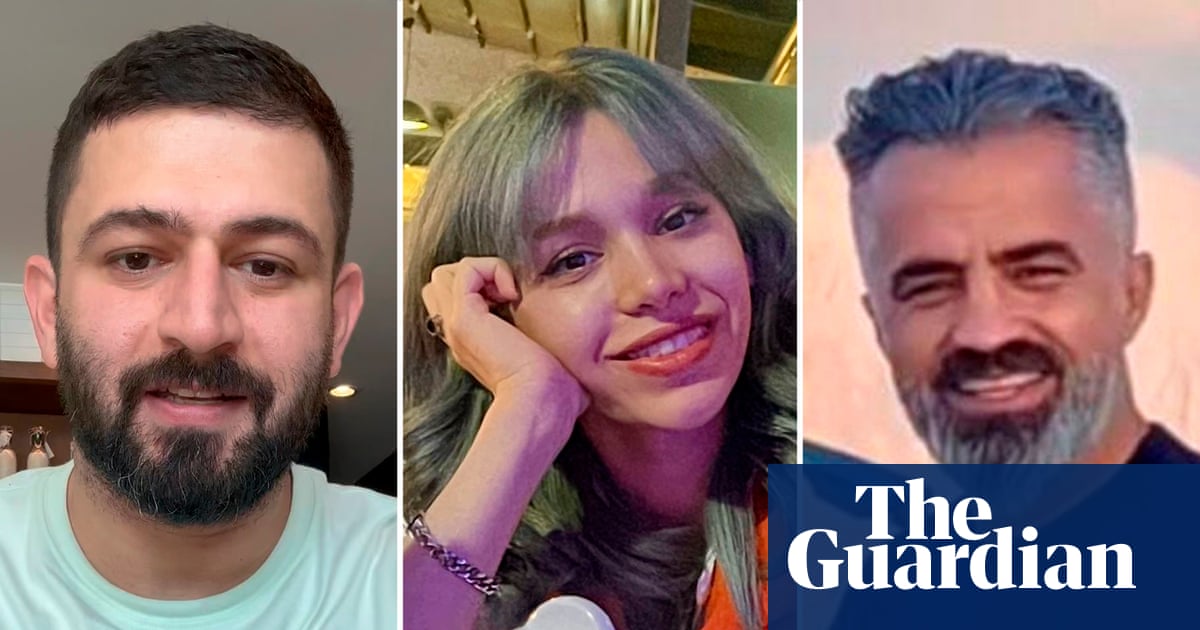
The families of Iranians killed by the regime in its crackdown on anti-government protests over the past week have told the Guardian of their devastation on learning of their relatives’ deaths.
More than 2,500 people have been killed so far, according to the US-based Human Rights Activists News Agency, but the death toll is expected to rise substantially as the regime eases a communications blackout imposed since 8 January.
Iran has one of the largest diasporas in the world, many of whom fled the country after the Iranian revolution in 1979, and at least half a million live in Europe. But with the internet shut down, relatives based overseas have been slow to discover the fate of family members in Iran.
Hali Norei, 40, says she fell to her knees when she received a call telling her that her 23-year-old niece, Robina Aminian, had been killed by a shot to the head from behind after joining university friends at a protest in Tehran on 8 January. The news only came after relatives in Iran travelled to the Iraqi border to get enough of an internet connection to call abroad.
Robina Aminian, a fashion student who died after being shot in the head by security forces at an anti-regime protest on 8 January
“It’s a tragedy for my family,” says Norei. “I don’t know what I can do for them, but I want to be Robina’s voice and don’t want this regime to silence the voices of our children.”
Norei says her family in Iran had travelled to Tehran to identify Aminian and saw “hundreds of bodies of young people shot and killed”. She says they were then forced to take Aminian’s body surreptitiously after the authorities refused permission to take it home.
“Amene [Aminian’s mother], who is one of the bravest members of our family, wailed loudly, but was determined to bring her baby home,” Norei says.
“She picked her up in her arms and was forced to steal her own child’s body; she drove back home with her on her lap.”
But after leaving, Aminian’s family were followed home by the security forces, who remained stationed outside their house. After approaching several mosques, the family say they were denied a funeral ceremony and “forced to bury her along the road, digging the ground themselves to bury their child”, says Norei.
Norei’s husband, Nezar Minoei, says: “Our Robina was full of energy and dreams. She was full of love. Each time she would come back from university, she would sneak into her parents’ bed and sleep in. She was the baby of the family.
Ebrahim Yousefi, who had posted a message on Instagram before going to the protest where he died
“She wanted to travel to Milan and pursue a master’s in fashion design. She wanted to bring her culture to the world in a unique way – like, Persian, Kurdish, Baluchi designs. I always told my wife: ‘Robina will be very famous.’”
Several Iranians living abroad told the Guardian that almost every person they knew was protesting on the streets and they were worried about whether they were still alive.
Sara Rasuli, 39, fled Iran after the Women, Life, Freedom protests of 2022 and is now a refugee in Germany. After finally speaking to her family still in Iran, she says she discovered that her cousin Ebrahim Yousefi, a 42-year-old Kurdish father of three, had been killed after being shot by security forces.
Hours before attending the protest, Yousefi had posted a message on his social media, saying: ‘We ourselves never had any luck, nor did our children … We grew up with war and hunger, our children with sanctions, power cuts, water shortage, and pollution … God, in the end, what will become of our children.’
Rasuli says she received the news of his death when relatives contacted her after travelling to the Iraqi border.
“My cousin went out to fight for freedom and the rights of their people. He was kind and just the nicest person you would meet. The economy has worsened so much that even buying meat has become a luxury,” says Rasuli, who says one other cousin had been wounded and another arrested at a protest.
“The last I know is that two of my relatives went to retrieve Yousefi’s body. Not only were they denied [the corpse], they were both arrested as well. We don’t have an update on anything else that’s happening to my family members due to the blackout.”
Akbar Sarbaz, left, with his friend and bodybuilder coach Mehdi Zatparvar, who was shot and killed at a protest on 9 January
“The whole world needs to know what’s happening to the children of Iran, especially the Kurds [a sizeable ethnic minority in western Iran],” she says.
Another Iranian living in Canada, Akbar Sarbaz, 36, a world champion bodybuilder, could not believe it when he found out his idol, coach and friend of more than 15 years, Mahdi (Masoud) Zatparvar, had been shot and killed at a protest on 9 January.
Sarbaz says Zatparvar, a two-time bodybuilding champion and coach, had also shared a post on Instagram just hours before his death, saying: “I just want my rights. A voice that has been silenced in me for over 40 years must scream.
“You took away our youth, hopes, dreams,” he says. “I am here so that tomorrow I won’t look at myself in the mirror and say that I had no vein, no honour … I will pay anything for it.”
Siavash Shirzad, who was shot at by security forces after joining other protesters who were dancing around a fire to Kurdish songs
“Just hours before he was killed,” says Sarbaz, “he asked me to share this Instagram post and be the voice of the protesting people of Iran. He was fearless and the kindest.
“He also managed two charity organisations. I can’t believe I won’t see him again. I am still in shock,” says Sarbaz. “He wanted to fight for the rights and freedom of our compatriots and despite the crackdown, he joined the others on the streets. He was the bravest.
“We had some wonderful memories together and my favourite one is the moment he placed the gold medal around my neck. I can’t believe it and don’t want to believe he’s gone.”
Siavash Shirzad, a 38-year-old father of one, was told by his family not to join the protests in Tehran’s Punak Square on 8 January because of the dangers. On Tuesday, one of his cousins living in the US says he found out Shirzad had joined a group of protesters who gathered around a fire and danced to Kurdish songs. They were shot at by security forces.
Shirzad was still alive when he was taken to Tehran’s al-Ghadir hospital, but it was overwhelmed with wounded protesters and so he was taken instead to the Rasoul Akram hospital. Hospital staff there called his family at about 4am on 9 January to tell them: “Your son is alive, please come.” But by the time they arrived, he had died.
Shirzad’s body was among hundreds at the Kahrizak forensic medicine centre in Tehran, a video of which showed distressed families looking for loved ones among body bags on the floor. His cousin says he was told all the bodies were numbered and Shirzad’s number was 12,647. “My family was forced to pay a large sum of money just to be shown his body in the morgue,” he says.
His cousin says the family were refused permission to take the body for burial unless they kept the ceremony private and was told: “Otherwise, we will bury him ourselves, in a place where there are 12,000 mass graves. Then he will disappear among the bodies, and you will never find him.”
They were then followed by military vehicles and warned: “If even a single slogan is shouted, we will take the body back.”