
 Street sign of Hugo Chávez and Hassan Nasrallah (Newsalist, January 4, 2026)
 Wanted notice issued by United States Immigration and Customs Enforcement against El Aissami (ICE website, March 27, 2020)
 Trump versus Maduro in court in a cartoon by Kamal Sharaf, a Yemeni cartoonist who supports the “resistance axis” (Instagram account of Kamal Sharaf, January 7, 2026) Dror Doron
Overview[1]
For decades Latin America has been an arena of significant activity for Hezbollah, based on a broad Shi’ite Lebanese diaspora residing in various countries across the continent. Venezuela, particularly under the socialist regime led by Hugo Chávez and his successor Nicolás Maduro, became an ally of Hezbollah and Iran because of their shared ideological and anti-American positions, and enabled the organization to turn the country into a logistical, financial and operational center.
American sanctions and indictments exposed how Hezbollah operatives, at times with the assistance of senior figures in the Venezuelan regime, established money-laundering and drug-trafficking networks that helped finance the organization’s terrorist activity. Hezbollah also brought thousands of operatives into Venezuela and established military training facilities which enabled it to promote terrorist activity against Western and Israeli targets in Latin America.
In early January 2026, Venezuelan President Maduro was arrested in a raid carried out by American special forces and transferred for trial in the United States. The administration said it would control Venezuela for the foreseeable future and emphasized that it would no longer allow a Hezbollah and Iranian presence in the country.
Hezbollah condemned the American operation in Venezuela, while in the opinion of Lebanese media outlets, the developments would have a negative effect on Hezbollah’s funding routes and on its operational capabilities in Latin America.
In ITIC assessment, the American action will be a blow to Hezbollah and curtail its freedom of action in Venezuela, adding to the series of unprecedented challenges with which Hezbollah has been dealing since the end of the war against Israel in November 2024. Closing sources of funding in Venezuela, which were based on drug trafficking and money laundering, will most likely exacerbate the organization’s financial crisis as it seeks to reconstruct its military and civilian capabilities and is also required to respond to the demands of its supporters, who are waiting their homes, damaged in the war, to be rebuilt. Meanwhile, American control of Venezuela will most likely neutralize the terrorist facilities and networks established by Hezbollah and Iran in the country, thereby weakening their ability to use them for terrorist attacks in Latin America.
Background[2]
Latin America has been known as an arena of Hezbollah activity for decades. The organization exploited the existence of Lebanese-Shi’ite communities in various countries across the continent to establish operational and logistical facilities and infrastructure alongside its recruitment and money laundering. The attacks on Israeli targets in Argentina in the early 1990s and the exposure of attempted attacks by the organization throughout the 2000s in Peru, Bolivia and Colombia reflected the operational capabilities which had Hezbollah constructed in the region.[3]
The socialist regime in Venezuela, first under President Hugo Chávez, who came to power in 1999, and later under Nicolás Maduro, who replaced Chávez after his death in 2013, built strategic relations with Iran and Hezbollah, fostered by ideological affinity and anti-American and anti-Israeli policies. That was also reflected in mutual declarations of support. For example:
At a pro-Palestinian rally in late September 2024, Maduro condemned the killing of Hezbollah secretary general Hassan Nasrallah as “a crime,” while expressing solidarity with Hezbollah and the Lebanese people in the name of the “historic revolutionary bloc.” He added that “the cowards of the world were silent, but the revolutionary peoples will not be silent” (al-Mayadeen, September 29, 2024).
After the American administration announced the doubling of the reward for information leading to Maduro’s arrest to $50 million in August 2025, Hezbollah’s unit for Arab and international relations condemned the United States and accused it of using “harassment and threats” against those who did not submit to its “hegemony.” It called the decision “an attempt to destabilize a sovereign state which firmly opposes American dictates and adheres to its national and historical principles” (al-Manar, August 11, 2025).
The position of the Venezuelan regime, and large Lebanese diaspora of about 300,000 people, many of them Shi’ites, helped turn Venezuela into a logistical, financial and operational center for Hezbollah.
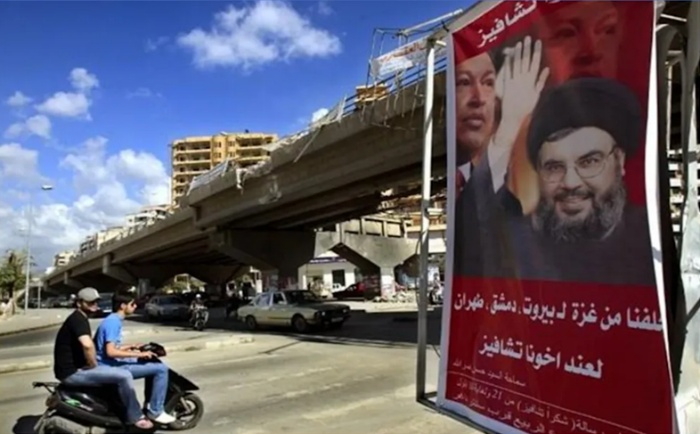
Street sign of Hugo Chávez and Hassan Nasrallah (Newsalist, January 4, 2026)
Establishing a Financial Infrastructure to Fund Hezbollah
Hezbollah’s activity in Venezuela centers on its financial infrastructure. Over the years a long list of facilities, shell companies, and money-laundering channels operated by the organization and its affiliates were exposed, involving significant participation by individuals and groups involved in drug trafficking and the laundering of drug money which was transferred to Hezbollah and added to its budget. Although there are no reliable data on the scope of revenues Hezbollah accumulated, estimates indicate tens of millions of dollars a year.
A window into Hezbollah’s clandestine criminal activity was opened by sanctions imposed by the United States Treasury Department and indictments filed by American law enforcement authorities against Hezbollah operatives in Venezuela involved in drug trafficking and money laundering on behalf of the organization. For example:
In 2008, an extensive network in Venezuela was exposed. One of its heads was Ghazi Nasr al-Din, a Lebanon-born individual holding Venezuelan citizenship, who served in Venezuela’s ministry of foreign affairs and was considered close to Hezbollah. According to the United States Treasury Department, he exploited his diplomatic status as a member of the Venezuelan embassy in Damascus to promote fundraising and the transfer of funds to Hezbollah, coordinate operational moves with Hezbollah’s senior leadership and transfer Hezbollah operatives from Lebanon to Venezuela. His partner in managing the network was Fawzi Knaan, also a Shi’ite born in Lebanon who obtained Venezuelan citizenship, who raised funds for transfer to Hezbollah (United States Treasury Department, June 18, 2008).
Hezbollah operative Ayman Joumaa, a Shi’ite born in Lebanon who operated for years in Venezuela, was accused by American authorities of heading an extensive network of operatives, among them Ali Hussein Harb and Qassem Mohammed Salah, Lebanese nationals with Venezuelan citizenship. The network laundered drug money for Hezbollah and transferred funds to Lebanon by smuggling cash and through money-exchange networks (United States Drug Enforcement Administration, January 26, 2011; United States Treasury Department, June 27, 2012).
In 2023, the American administration imposed sanctions on another group of Hezbollah operatives involved in money laundering for the organization. One was Samer Aqil Ridha, the owner of BCI Technologies C.A., operating out of Venezuela, which according to the Americans laundered drug-trafficking money for Hezbollah (United States Treasury Department, September 12, 2023).
Hezbollah also exploited its presence in Venezuela to profit from the country’s extensive gold deposits. In 2019 Venezuelan opposition member Américo De Grazia revealed that the Maduro regime allowed Hezbollah to operate Venezuelan gold mines, providing the organization with an independent income (al-Arabiya, January 14, 2019). It was subsequently revealed that Iranian businessman Badr al-Din Naimi Mousavi smuggled gold from Venezuela to finance Hezbollah’s activity. The smuggling operations also involved Muhammad Qasir (killed in October 2024), head of Hezbollah’s Unit Logistic4400, which transferred weapons from Iran, and his nephew Ali Qasir, the representative of Hezbollah’s office for economic affairs in Tehran, for whom the Americans offered a reward of $10 million dollars (National Bureau for Counterterrorist Financing, Ministry of Defense, June 13, 2023).
The connections between Hezbollah and Venezuela in drug trafficking and money laundering reached the highest echelons of power in Caracas:
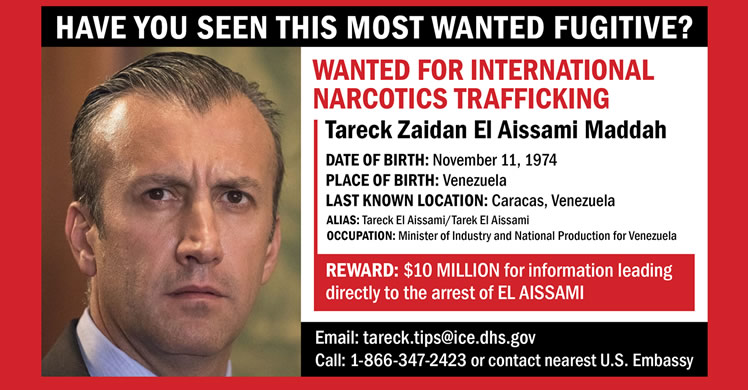
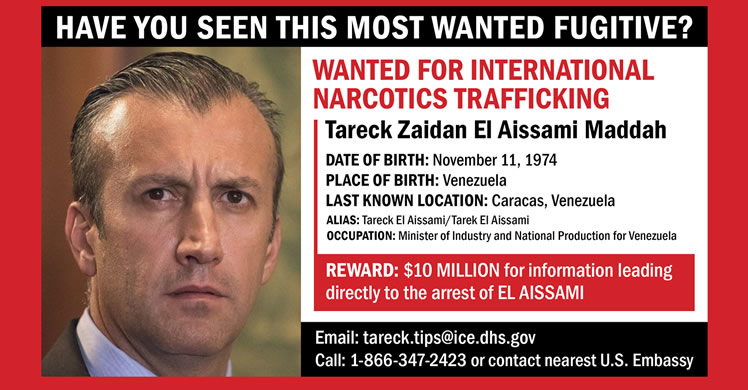
A covert investigation by Venezuelan intelligence services found that Tareck El Aissami Maddah, former minister of justice and vice president of Venezuela, had infiltrated Hezbollah agents into the country, helped by his father, a Syrian-Druze who was head of the Iraqi Baath Party in Venezuela, with the objective of expanding espionage networks in Latin America and promoting drug trafficking. The investigation further alleged that El Aissami exploited his position to grant official documents to operatives, thereby enabling them to remain in the country. The American administration imposed sanctions on El Aissami for his drug trafficking and filed an indictment against him, and placed a $10 million reward on his head (CNN, February 14, 2017; New York Times, May 2, 2019; United States State Department website, March 26, 2020). El Aissami was arrested by Venezuelan law enforcement authorities in April 2024 on suspicion of “corruption” (AP, April 10, 2024).
Wanted notice issued by United States Immigration and Customs Enforcement against El Aissami (ICE website, March 27, 2020)
Hugo Carvajal, former head of Venezuelan military intelligence, who is standing trial in a United States federal court on charges of smuggling drugs into the United States, claimed that the cooperation between the Venezuelan regime, first under Chávez and later under Maduro, and Hezbollah was part of a planned campaign to flood the United States market with drugs. In a letter published in the American media and addressed to the American president, Carvajal claimed that the Venezuelan government acted with Hezbollah, separatist terrorist organizations in Colombia and Cuban operatives to promote the plan, and provided them with weapons, passports and immunity so they could operate freely from Venezuela against the United States (Dallas Express, December 3, 2025).
Hezbollah’s Operational Infrastructure in Venezuela
Testimonies by senior American administration officials and official documents revealed that Hezbollah exploited its freedom of action in Venezuela to build operational facilities which could be used to carry out attacks in Latin America and beyond:
Roger Noriega, who served as assistant secretary of state for Western Hemisphere affairs, testified to the House Foreign Affairs Committee that Hezbollah operated training camps on Venezuela’s Margarita Island in the Caribbean Sea, where it trained terrorist operatives (United States House of Representatives website, March 20, 2013).
In October 2025, a Senate committee overseeing the fight against international drug trafficking held a session on Hezbollah’s drug activity in Latin America, with the participation of experts and former government officials. Marshall Billingslea, former assistant secretary for terrorist financing at the United States Treasury Department, testified that President Chávez opened his country to Hezbollah and allowed the organization to establish a presence, including the training camp on Margarita Island. He said that as early as 2002–2003 there were signs on the island of passport forgery, whose objective was to enable the movement of terrorist operatives. He also cited reports in Saudi media from April 2025 stating that about 400 Hezbollah commanders were required to move from Lebanon to Latin America, including Venezuela, because of Lebanese government activity against the organization. Nathan Sales, former coordinator for counterterrorism at the State Department, testified that under the Maduro regime, Venezuela became a key location for enabling Hezbollah’s hostile activity in the Western Hemisphere and provided the organization with official documents which allowed operatives to move freely throughout Latin America. He stated that individuals connected to Venezuela established themselves in the country to smuggle drugs, weapons, cash and counterfeit items, and to launder money (Senate Committee website, October 21, 2025).
The United States federal prosecution filed an indictment against Adel El Zabayar, a Venezuelan drug baron of Syrian origin who was deputy speaker of the country’s parliament, for his ties to Hezbollah, arms smuggling and involvement in promoting terrorist activity against American targets. According to the indictment, El Zabayar received weapons shipments from Lebanon and was involved in recruiting Hezbollah operatives to promote terrorist activity against American targets and in providing military training to local operatives on Venezuelan soil (United States Department of Justice, May 27, 2020).
The Implications of Maduro’s Arrest for Hezbollah
During the night of January 2, 2026, American special forces arrested Venezuelan President Maduro and his wife in a raid in Caracas. The two were taken to New York, where indictments were filed against them for conspiring with drug cartels to bring drugs into the United States and for weapons offenses. The American president said the United States would manage Venezuela in the foreseeable future (New York Times, January 3, 2026). United States Secretary of State Marco Rubio said an Iranian and Hezbollah presence in Venezuela was unacceptable (NBC, January 4, 2026).
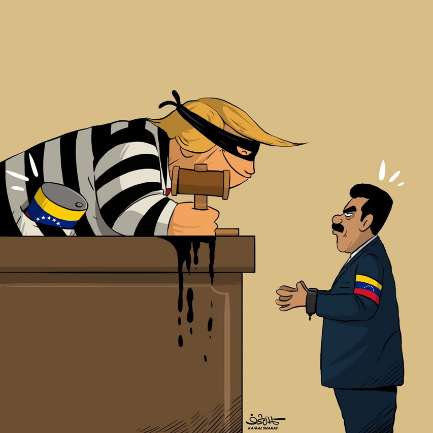
Trump versus Maduro in court in a cartoon by Kamal Sharaf, a Yemeni cartoonist who supports the “resistance axis”[4] (Instagram account of Kamal Sharaf, January 7, 2026)
Hezbollah condemned the “terrorist aggression and American bullying” of Venezuela and the “abduction” of Maduro and his wife, calling it a “blatant and unprecedented violation” of the national sovereignty of an independent state, international law and the UN Charter. The organization expressed solidarity with Venezuela, its people, presidency and government, accused the international community of “shameful silence” and warned that “the aggression against Venezuela is a direct threat to every independent and sovereign state which opposes hegemony and submission” (al-‘Ahed, January 3, 2026).
An article in Hezbollah’s daily al-Akhbar claimed that the American allegations of a Hezbollah presence in Venezuela were baseless and a pre-packaged political product designed to serve multiple goals simultaneously, from demonizing leftist regimes in Latin America as a prelude to overthrowing them and plundering their resources, to projecting the image of a universal enemy that justified everything Israel did in the Middle East. It further claimed that the allegations were based on testimony by pro-Israeli elements and were intended to serve an American political narrative, and that the effort to prove a link between the Venezuelan regime and Hezbollah resembled past attempts to create a link between Saddam Hussein’s regime in Iraq and al-Qaeda (al-Akhbar, January 8, 2026).
Attempts were made in Lebanese media to assess the possible effects of the developments in Venezuela on Hezbollah’s future there in general and on its financial future in particular:
An op-ed piece on the opposition al-Siyasa news site claimed that Maduro’s arrest shattered the “financial illusion” on which Hezbollah has relied in recent years. According to the site, with Iran’s internal weakening and its reduced ability to finance its proxies, the organization turned to alternative networks based on drug trafficking and money laundering via Venezuela under the protection of the Maduro regime. It claimed that the channel had now effectively been closed, and without a political and security umbrella, one of Hezbollah’s main pillars of funding had collapsed, allegedly increasing the danger of a severe financial crisis and possibly bankruptcy (al-Siyasa, January 3, 2026).
According to reports, in diplomatic circles it was understood that the American action in Venezuela was part of a broader approach that also affected the Lebanese arena. “Sources” said that “American officials” had informed Hezbollah that serious regional changes were expected and the organization was required to adopt a pragmatic approach and consider relinquishing its weapons as part of an internal political settlement (al-Madan, January 4, 2026).
It was also reported that thousands of Hezbollah operatives and their family members currently in Venezuela were expected to return to Lebanon because of concern that the new authorities in Caracas would move to dismantle the organization’s infrastructure as part of understandings with the United States, following the statements of Secretary of State Rubio (al-Nahar, January 7, 2026).
“Sources in Lebanon” also said the freedom of action enjoyed by Hezbollah in Venezuela over recent years would most probably be significantly limited in the near future. As a result, the organization is expected to face growing difficulties in using the country for fundraising and money laundering, and as a logistical rear for regional terrorist activity (MTV Lebanon, January 11, 2026).
[1] Click https://www.terrorism-info.org.il/en to subscribe and receive the ITIC’s daily updates as well as its other publications.
[2] See the April 2012 ITIC report, Latin America as a Terrorist, Subversive, Criminal Arena for Iran and Hezbollah and the April 2009 report, Iran increases its political and economic presence in Latin America, defying the United States and attempting to undermine American hegemony.
[3] On March 17, 1992, a suicide bomber detonated himself near the entrance of the Israeli Embassy building in Buenos Aires. Twenty-nine people were killed, including four Israelis, and more than 220 were wounded. On July 18, 1994, a suicide bomber detonated a car bomb near the building of the Jewish community in Buenos Aires. Eighty-five people were killed and more than 300 were wounded. Investigations in Argentina determined that the attacks were carried out by Hezbollah operatives under the direction of the Iranian regime. For further information, see the January 2015 ITIC report, Alberto Nisman, Federal Prosecutor Who Accused Argentina’s President of Conspiring to Sabotage Inquiry Linking Bombings at Israeli Embassy and the AMIA Building to Iran, Found Dead.
[4] Iran, Hezbollah, the Palestinian terrorist organizations, the Houthis in Yemen and the Shi’ite militias in Iraq.
Related Articles