
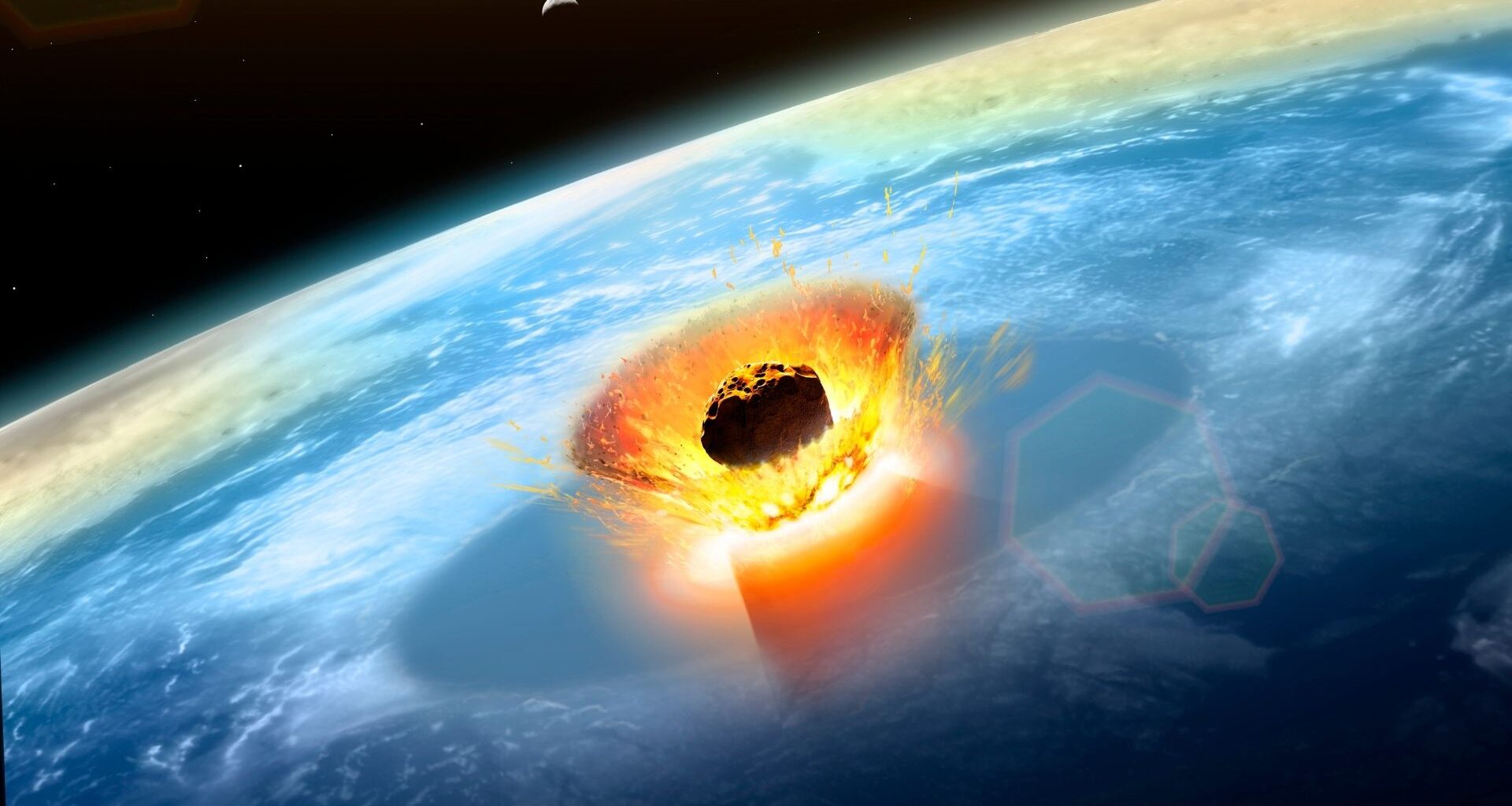
NASA’s DART mission, the first-ever planetary defense test in space, sent a spacecraft to crash into an asteroid in 2022.
That mission was a success. It showed that, in a hypothetical scenario where a massive asteroid was hurtling towards Earth, NASA could send a spacecraft to slam into it and alter its trajectory.
Scientists see this as a much more favorable alternative to nuclear deflection, which would use a powerful nuclear bomb to destroy the asteroid. This method would still pose a serious risk to Earth, as the space rock could fragment into many smaller pieces that could still make their way towards our planet.
Though nuclear deflection is a last resort, a team at CERN’s Super Proton Synchrotron (SPS) has carried out a new investigation, showing that some asteroid materials could be more resilient against nuclear explosions than previously thought.
A unique planetary defense test
One of the most important variables when it comes to any planetary defense mission is the materials properties of the asteroid. Whether it’s smashed by a spacecraft or blown up by a nuclear weapon, the composition of a space rock plays a huge role in its eventual state or trajectory.
The new paper by the CERN SPS team, published in the journal Nature Communications, details how the team used advanced models to determine the effectiveness of nuclear deflection.
“Planetary defence represents a scientific challenge,” Karl-Georg Schlesinger, co-founder of OuSoCo, said, according to a report from CERN Courier. OuSoCo is a startup developing advanced material-response models the scientists used to benchmark large-scale nuclear deflection simulations.
“The world must be able to execute a nuclear deflection mission with high confidence, yet cannot conduct a real-world test in advance,” Schlesinger continued. “This places extraordinary demands on material and physics data.”
Using a proton beam to simulate a nuclear detonation
To address this uncertainty, the team performed experiments at CERN’s HiRadMat facility, as a part of the Fireball collaboration with the University of Oxford. They shot 27 successive short, intense pulses of the facility’s 440 GeV SPS proton beam at a sample of the Campo del Cielo meteorite. These experiments simulated some of the effects of a nuclear blast within a lab setting, without having to detonate a weapon of mass destruction.
“The material became stronger, exhibiting an increase in yield strength, and displayed a self-stabilising damping behaviour,” Melanie Bochmann, co-founder and co-team lead, explained in the CERN Courier report. “Our experiments indicate that – at least for metal-rich asteroid material – a larger device than previously thought can be used without catastrophically breaking the asteroid.”
According to the researchers, this is actually a good thing. It suggests that a powerful nuclear weapon could be used to deflect an asteroid, without fragmenting it into many smaller pieces.
“This keeps open an emergency option for situations involving very large objects or very short warning times,” Bochmann explained, “where non-nuclear methods are insufficient and where current models might assume fragmentation would limit the usable device size.”