
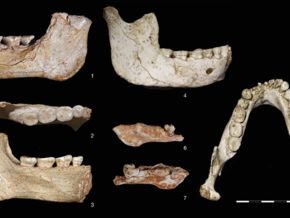
Nature study examines hominin fossils from Thomas Quarry I, Casablanca
Fossils show mixed archaic and derived traits, securely dated
Findings highlight North Africa’s key role in human evolution
Morocco’s Ministry of Youth, Culture and Communication said on Friday, Dec. 9, that a study published in Nature examined hominin fossils discovered in the “Grotte à Hominidés” at the Thomas Quarry I site in Casablanca.
The remains include several mandibles, teeth and vertebrae. Researchers said the fossils show a mix of archaic and more derived features, not previously documented in such detail for this period of human evolution.
The ministry said the fossils were found in a secure stratigraphic context, confirmed by dating of the surrounding sediments.
The work is part of the Prehistory of Casablanca program, a collaboration between Moroccan institutions and international partners aimed at documenting and dating human remains in the region. The team used systematic excavations and paleomagnetic analysis to estimate the fossils’ age.
The traits observed suggest these ancient African populations were already evolving along separate lines, before the split between the lineages that led to modern humans and other hominins.
Lead author Jean-Jacques Hublin, of the Collège de France and the Max Planck Institute, urged caution about describing the fossils as the last common ancestor. However, he said they may be close to the populations from which Homo sapiens and Eurasian lineages such as Neanderthals and Denisovans emerged.
The fossils fill a major gap in Africa’s record and help researchers better place morphological variation among ancient populations around the time the ancestors of Homo sapiens diverged from their closest relatives.
The remains complement discoveries at Jebel Irhoud, where early Homo sapiens fossils were dated older than previously thought, reinforcing the case for an African origin for modern humans. Some similarities with ancient European fossils may also point to links between North African and European populations.
The findings come amid ongoing debate over human origins and add to evidence that North Africa played a key role in human evolution, alongside sites in East and southern Africa.
In August 2025, researchers in Ethiopia announced the discovery of fossil teeth dated to about 2.65 million years ago, attributed to a previously unknown Australopithecus species and an early form of the genus Homo. The discovery follows other recent work, including a digital reconstruction published in December 2025 of a roughly 1.5-million-year-old Homo erectus skull, which showed more archaic traits than expected and highlighted the complexity of human evolutionary paths.
Félicien Houindo Lokossou