
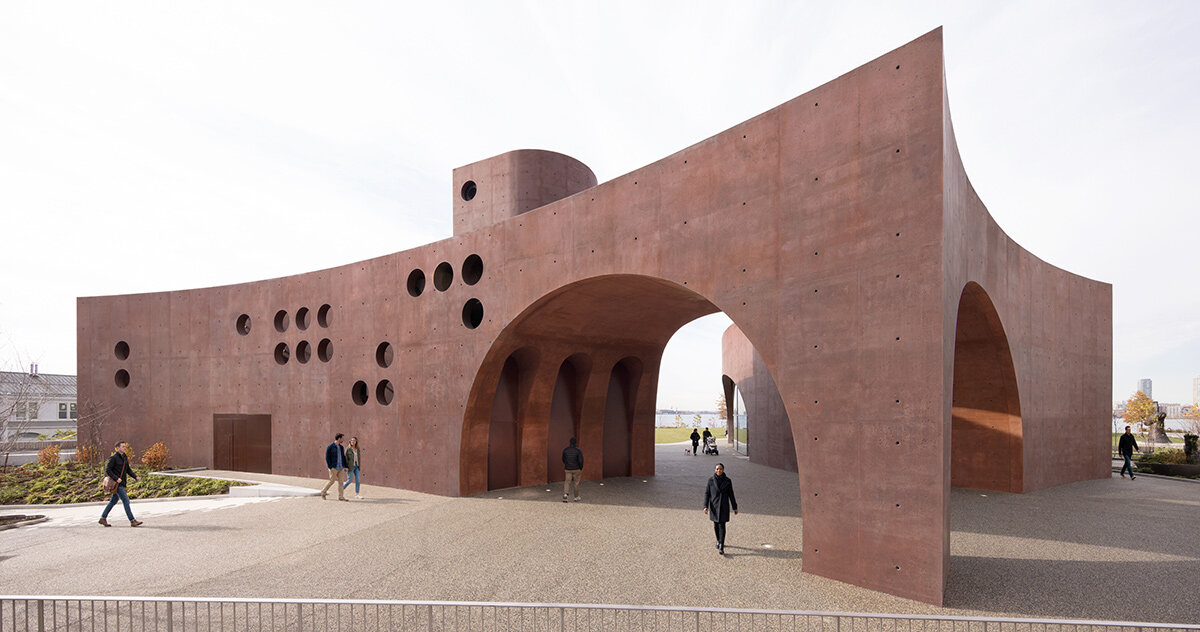
wagner park and pavilion opens in battery park city
Robert F. Wagner Jr. Park and Pavilion is a new waterfront landscape and civic structure in New York‘s Battery Park City designed by Thomas Phifer and Partners with AECOM.
Set along the southern edge of Lower Manhattan, the project reimagines a familiar public space as an elevated terrain shaped by coastal protection and long views across the harbor.
The work forms a central component of the South Battery Park City Resiliency Project, where flood defense is designed as civic infrastructure. The park rises nearly ten feet above its previous elevation in a calibrated shift that responds to projections for future storms and rising sea levels, all while preserving public access to the water’s edge.
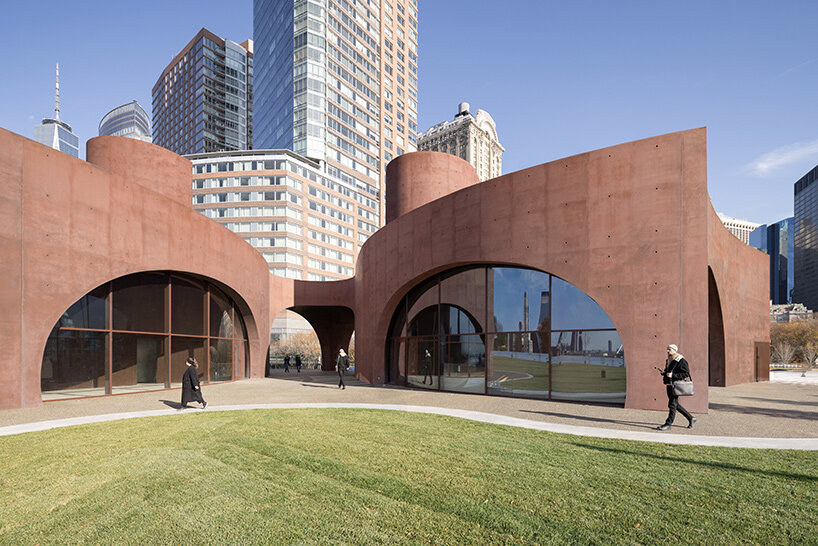
images © Scott Frances
an ascending landscape as resilient infrastructure
Visitors and residents of New York’s Battery Park City approach the new Wagner Pavilion through gently sloping gardens dotted with trees and plantings. The gradual ascent creates a slow reveal of the vast waterfront, with footpaths oriented to maintain sightlines toward the Statue of Liberty and Ellis Island.
The elevated landscape conceals a continuous flood protection system beneath lawns and planting beds. A sheet pile floodwall is driven to bedrock below the central lawn, linking to exposed segments that connect with defenses to the north and south. The team at AECOM and the architects at Thomas Phifer and Partners embed this infrastructure within the park’s topography so that public space remains at once uninterrupted and protected from rising water levels.
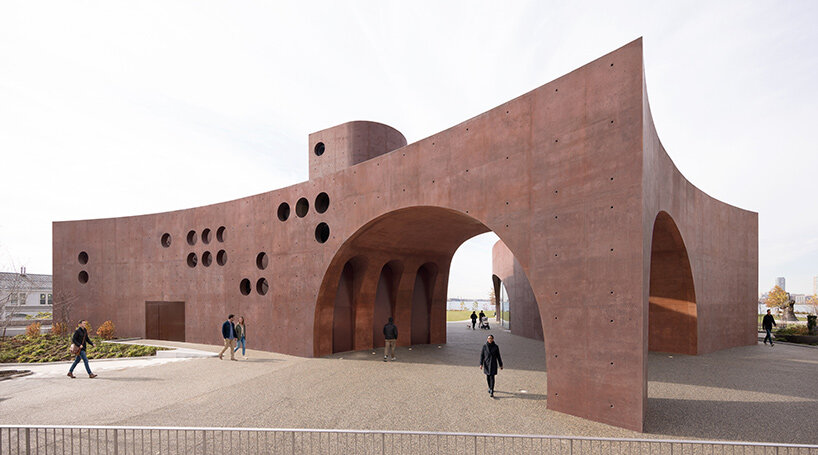
the Robert F. Wagner Jr. Park reshapes the southern edge of Battery Park City
design informed by stormwater strategies
The organization of Wagner Park follows the legacy layout of lawns, gardens, and pavilion spaces, translated into resilient a new section of Battery Park City. The surface reads as a vast green plane, yet its grading guides stormwater toward planted areas and filtration zones with precision. This balance between openness and performance defines much of the park’s character.
Stormwater strategies are split across wet and dry sides of the flood line. On the water-facing side, rain moves through performative gardens and into an underground infiltration gallery before releasing gradually into the soil. Landward areas channel water to a reuse cistern for irrigation and maintenance. Materials reinforce this system, with high albedo pavers, pervious surfaces, and salvaged stone and wood contributing to durability and environmental performance.
flood protection infrastructure is embedded beneath lawns to preserve open waterfront access
Ecology at the Water’s Edge
Along the harbor, the park introduces a living shoreline that supports habitat and public education. Terraced edges, habitat shelves, and tide pools create varied conditions for native plantings and marine life, while engineered pile wraps and textured concrete expand surfaces for invertebrates. A marine habitat education zone near Pier A brings these systems into view, linking ecological processes with everyday experience.
Planting across the site emphasizes seasonal change and regional ecologies, from tidal estuary to upland woodland. Path widths are kept tight to increase green coverage, and tree canopies temper summer heat with shade and filtered light. The park has earned Gold certification under the Waterfront Alliance’s Waterfront Edge Design Guidelines, reflecting an integrated approach to resilience, ecology, and access.
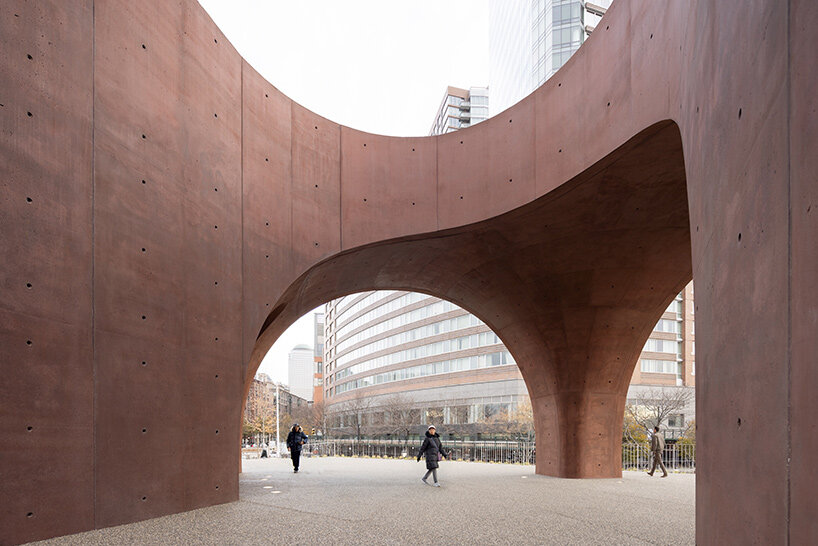
the Wagner Pavilion marks the transition between city, park, and water
the sculpted pavilion by thomas phifer and partners
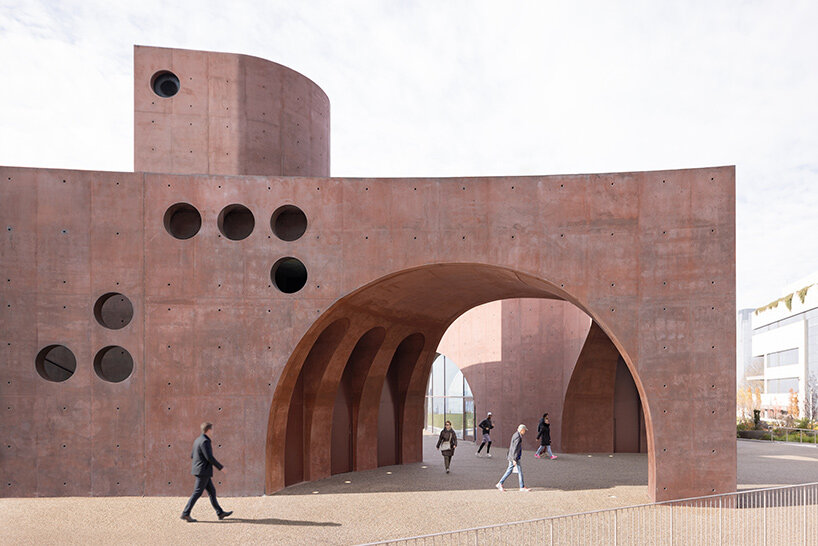
Approaching from within the park, the Wagner Pavilion appears as a low, sculpted form aligned with the terrain. Its deep red concrete carries a warmth that resonates with nearby historic masonry, including Castle Clinton and other harbor fortifications. A sequence of arched vaults defines the entry piazza, framing the passage from garden to open harbor.
Moving through the central vault, the landscape opens toward the water, with the Statue of Liberty and Ellis Island precisely framed. The pavilion acts as a threshold rather than a destination alone, marking the transition between city, park, and harbor. Access from the esplanade below is equally considered, with ramps and stairs offering multiple paths upward.
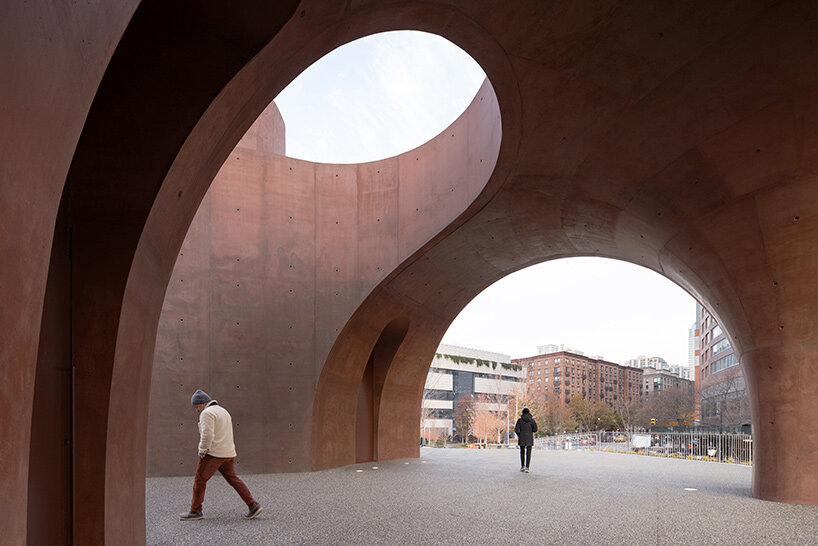
warm red concrete vaults frame views toward the Statue of Liberty
inside new york’s wagner pavilion
Inside, the Wagner Pavilion accommodates a restaurant and a classroom, extending the park’s public life into sheltered spaces. Outdoor seating spills into the piazza, encouraging overlap between interior activity and the surrounding gardens. Circulation continues upward via broad stairs and an elevator to an observation deck that offers panoramic views across New York Harbor, The Battery, and inland toward downtown Manhattan.
The roof edge is softened by planting that echoes nearby landscapes. Curved walls mirror the contours of the park, reinforcing a sense of continuity between building and landscape. Within the broader framework of Battery Park City, the pavilion reads as a carefully tuned civic room shaped by its resilient and enduring relationship with the waterfront.