
The post These Tiny Moths Navigate Hundreds of Miles Using the Stars appeared first on A-Z Animals.
Quick Take
1-inch bogong moths must complete a 600-mile migration to survive.
Relying on a random array of stars causes these insects to lose their flight path.
These insects utilize a dual-compass system that rivals the navigational capabilities of migrating birds.
Moths reach the Australian Alps specifically to begin a critical period of summer aestivation.
Humans have used the stars for navigation for centuries, relying on them as maps for long journeys. But did you know that insects might also use the stars for a similar reason? Specifically, there is evidence that bogong moths use the Milky Way and star patterns for navigation.
This post by @futuregennews discusses this amazing ability and how they use the stars for their 600-mile-long migration. Read here to learn more about how bogong moths use the stars for navigation.
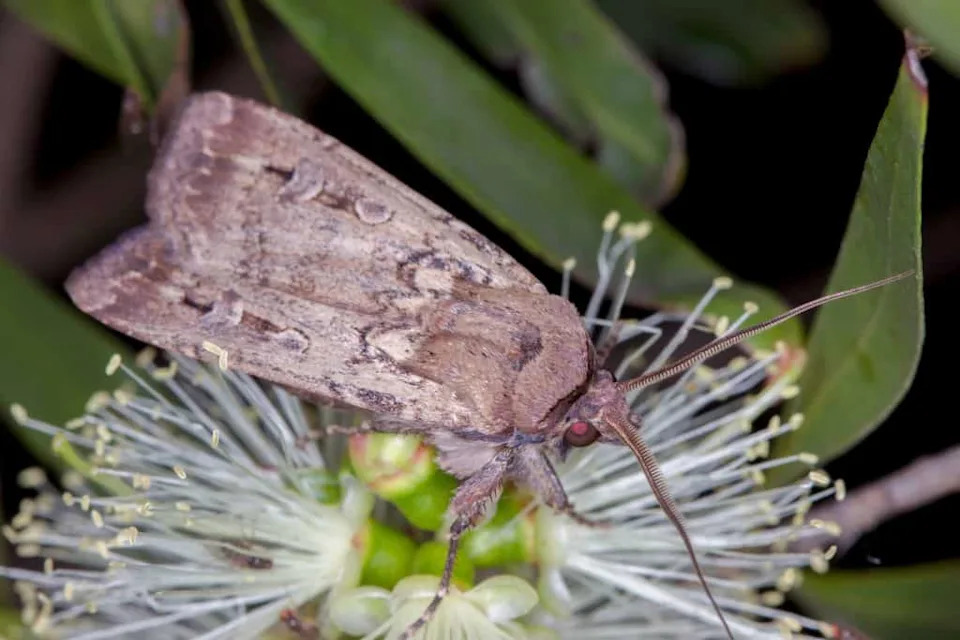
A bogong moth (
Agrotis infusa
) rests on a native blossom. It uses the Milky Way to navigate.
©Andrew Allen Photography/Shutterstock.com
(Andrew Allen Photography/Shutterstock.com)What Are Bogong Moths?
Bogong moths (Agrotis infusa) are Australian moths that are famous for their long migrations. They are a dark brown color and grow to around an inch long. Although small, they travel hundreds of miles during their summer migration. Bogong moths are primarily found in southern Australia.
These moths lay their eggs in New South Wales, Queensland, and Victoria, where the larvae hatch and grow into adulthood. In the spring, they migrate towards the Australian Alps for summer aestivation. Aestivation is a period of dormancy during hot or dry conditions, which helps the moths survive the summer. To reach the Alps, the moths rely on a dual navigation system that uses both star patterns and magnetic fields.
The use of both the stars and the magnetic fields of Earth is known as a dual-compass system. While it may seem unlikely that bogong moths can see stars as clearly as humans, they possess remarkable vision that allows them to recognize patterns in the night sky. Using this ability, they can navigate by the light of the stars toward their destination.
Studies have shown that when presented with a random array of stars that does not resemble the Milky Way, the moths often fly in random directions. This highlights their usage of the stars in navigation. Similar to birds, bogong moths also use Earth’s magnetic field for orientation. They rely on this as a backup when star navigation is not possible, demonstrating their remarkable navigational abilities.
The post These Tiny Moths Navigate Hundreds of Miles Using the Stars appeared first on A-Z Animals.