
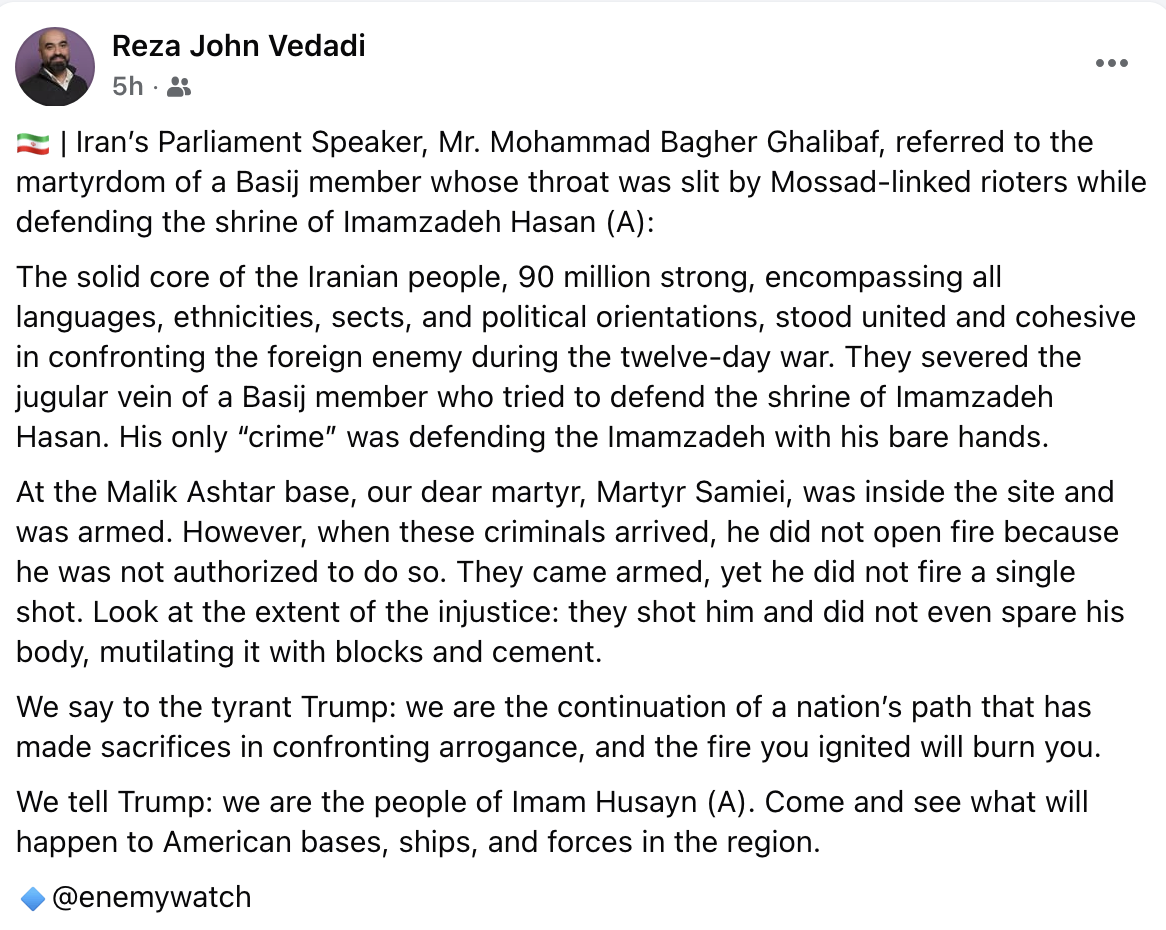
Reza and I were really good friends until October 7. After that, something important changed—not just between us, but also in how I thought about the political language he had always defended. People didn’t just disagree with me because I supported Israel; it also showed me how corrupted their worldview was. When I saw Reza spread statements like this one, I realized how wrong I was about how bad the Iranian regime’s story-telling machinery could be. What used to sound like “anti-imperialism” now looks like something much worse. It is a system that thrives on lies, glorifies violence, and calls it resistance. It didn’t all come to me at once, but once it did, but after Oct 7, I couldn’t get it out of my head.
This statement doesn’t show confidence; it shows panic that looks like certainty. When governments say things like “90 million” Iranians stood together despite their differences, it means that unity has already broken down. This isn’t a description; it’s a command. The state isn’t saying it speaks for the people; it’s telling everyone to act like it does. After that, disagreement is no longer a political disagreement; it’s a kind of heresy.
After that, the propaganda does what it always does: it goes straight to conspiracy. It’s not true that the protesters are just regular Iranians; that would ruin the story. This has nothing to do with Israel and everything to do with not fixing the problem. It’s easier to yell “foreign agents” than to explain why people don’t get paid, why wages go down because of inflation, or why women die in police custody. The conspiracy isn’t a debate; it’s a way to escape.
The Basij member, on the other hand, is stripped of his identity and turned into a moral cudgel. His death is described in graphic detail not to clarify what happened, but to produce fear and emotional compliance. The claim that he did not fire back because he was not authorized is especially revealing. Obedience is treated as sacred, while responsibility thins out the higher one moves up the chain of command. This is the logic of the filing cabinet: no one decides, no one is guilty, and violence simply “happens.” It is a system designed to produce brutality without accountability.
The worst thing that can happen is when religion is taken over. The story uses the shrine of Imamzadeh Hasan and Shi’i symbols to stop all moral judgment. The history of Shi’ism isn’t the same as the history of the state, and Karbala wasn’t about keeping power; it was about fighting it. Imam Husayn was important because he fought against unfair authority, not because he kept things in order. Using his legacy to justify repression is not only hypocritical, but it is also a sin. It uses a long-standing tradition of standing up for what’s right to make people do things.
The threats to Trump and the US at the end of the show bring it to a close. When a government can’t be honest with its own people anymore, it makes up for it by yelling at enemies outside of its borders. Defiance turns into theater, and noise takes the place of truth. And this is the hard part. People say, share, and act like this language is serious political speech, which is the only reason it works. People who used to be friends and do what they’re told help keep the machine going. That’s how propaganda stays alive. It’s not just through power; it’s also through being involved.
Tim Orr is a religious studies scholar who has been teaching and doing research for almost 20 years. He focuses on Shia Islam and working with people of other faiths. He has six degrees, including an M.A. in Islamic Studies from the Islamic College in London. He is also working on a Ph.D. in Interreligious Studies at Hartford International University. He served as a Research Associate with both Hartford International University and the Center for Religion and American Culture, and has spoken widely in Shia institutions in the UK.