
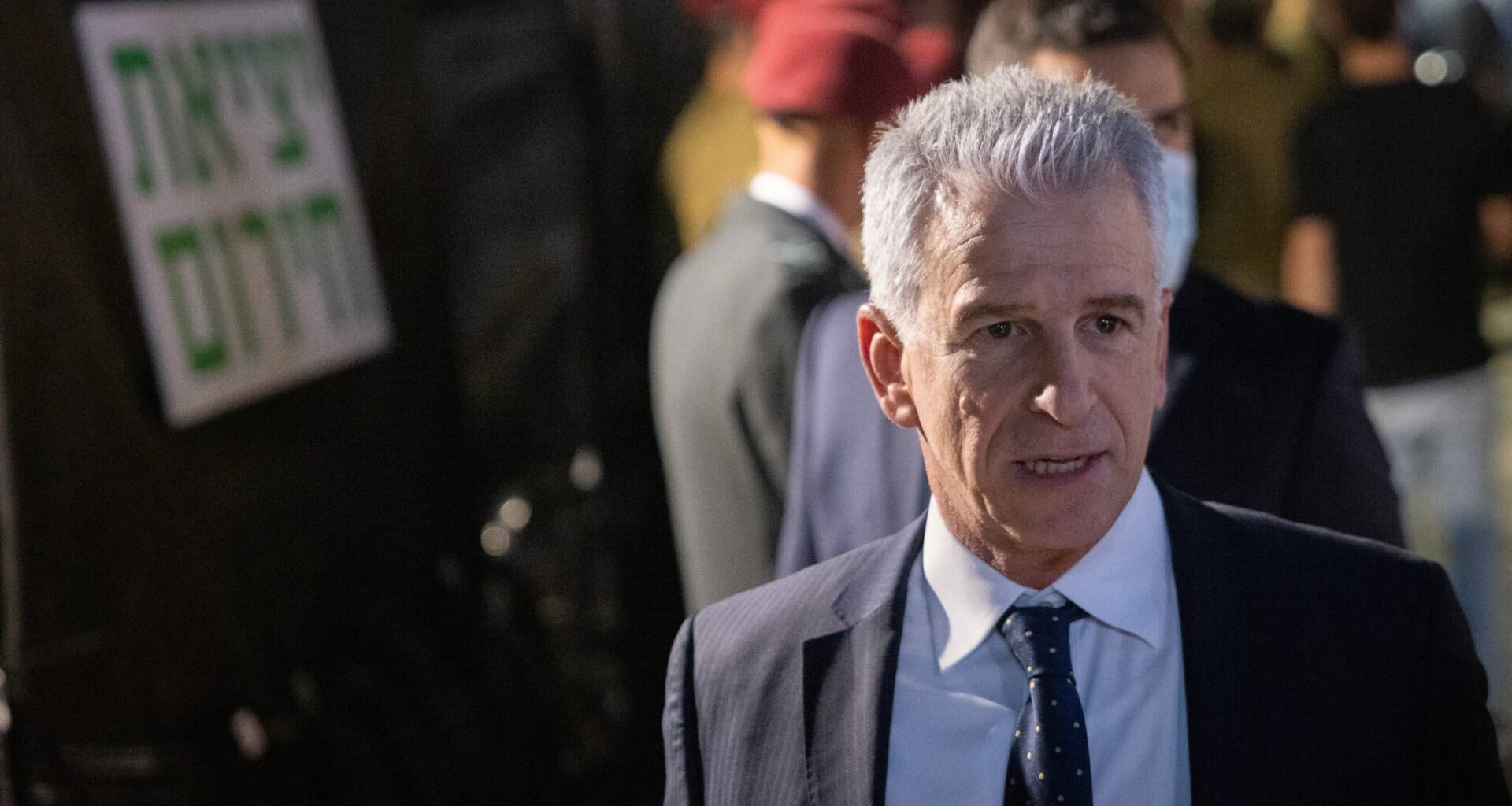
Mossad director David Barnea was reported to arrive Friday in the US for consultations on Iran’s deadly crackdown on protests and a potential American military response.
The protest movement in Iran has subsided after the crackdown that has killed thousands under an internet blackout, monitors said Friday, one week after the start of the largest protests in years challenging the Islamic Republic’s theocratic system.
Israel’s spy chief is expected to meet with White House envoy Steve Witkoff in Miami, the Axios news site reported, adding that the latter was managing direct communications between the US and Iran.
The report said it was unclear whether Barnea will meet with US President Donald Trump, who is expected to be at his Mar-a-Lago golf club in Florida over the weekend.
The threat of military action by the US against Iran also appeared to recede for the time being, with a Saudi official saying Gulf allies had persuaded Trump to give the Iranian leadership a “chance.”
Israel is reported to have also asked Trump to delay any military action against Iran, as the Jewish state is expected to come under fire in retaliation for any major US action there.
Israeli officials believe, however, that the US may still strike in the coming days, according to Axios.
The news outlet also cited US sources as saying the US military was sending additional defensive and offensive capabilities to the region to be ready in case Trump orders a strike.
The US military’s Central Command didn’t immediately respond to an emailed request for comment.
Meanwhile, Prime Minister Benjamin Netanyahu and Russian President Vladimir Putin discussed the situation in the Middle East and Iran by phone on Friday, the Kremlin said
Putin offered Russia’s help in mediating with regard to Iran, and told the Israeli leader he was “in favor of intensifying political and diplomatic efforts to ensure stability and security in the region,” the Kremlin added.
Putin also spoke by phone with Iranian President Masoud Pezeshkian, the Kremlin stated. Putin will continue efforts to de-escalate the situation in the region, his spokesman Dmitry Peskov told reporters.
Pezeshkian’s office said he thanked Putin for “Russia’s position,” adding that “the role and direct involvement of the United States and the Zionist regime in recent events in Iran is evident.”
Protests sparked by economic grievances started with a shutdown in the Tehran bazaar on December 28 but turned into a mass movement demanding the removal of the clerical system that has ruled Iran since the 1979 revolution.
People started pouring into the streets in big cities from January 8, but authorities immediately enforced a shutdown of the internet that has lasted over a week, and which activists say is aimed at masking the scale of the crackdown.
The repression has “likely suppressed the protest movement for now,” said the US-based Institute for the Study of War, which has monitored the protest activity.
But it added: “The regime’s widespread mobilization of security forces is unsustainable… which makes it possible that protests could resume.”
With information flows from Iran obstructed by the internet blackout, several residents of Tehran said the capital had been quiet since Sunday. They said drones were flying over the city, where they’d seen no sign of protests on Thursday or Friday.
Iranian-Kurdish rights group Hengaw said that there had been no protest gatherings since Sunday, but “the security environment remains highly restrictive.”
“Our independent sources confirm a heavy military and security presence in cities and towns where protests previously took place, as well as in several locations that did not experience major demonstrations,” Norway-based Hengaw said in comments to Reuters.
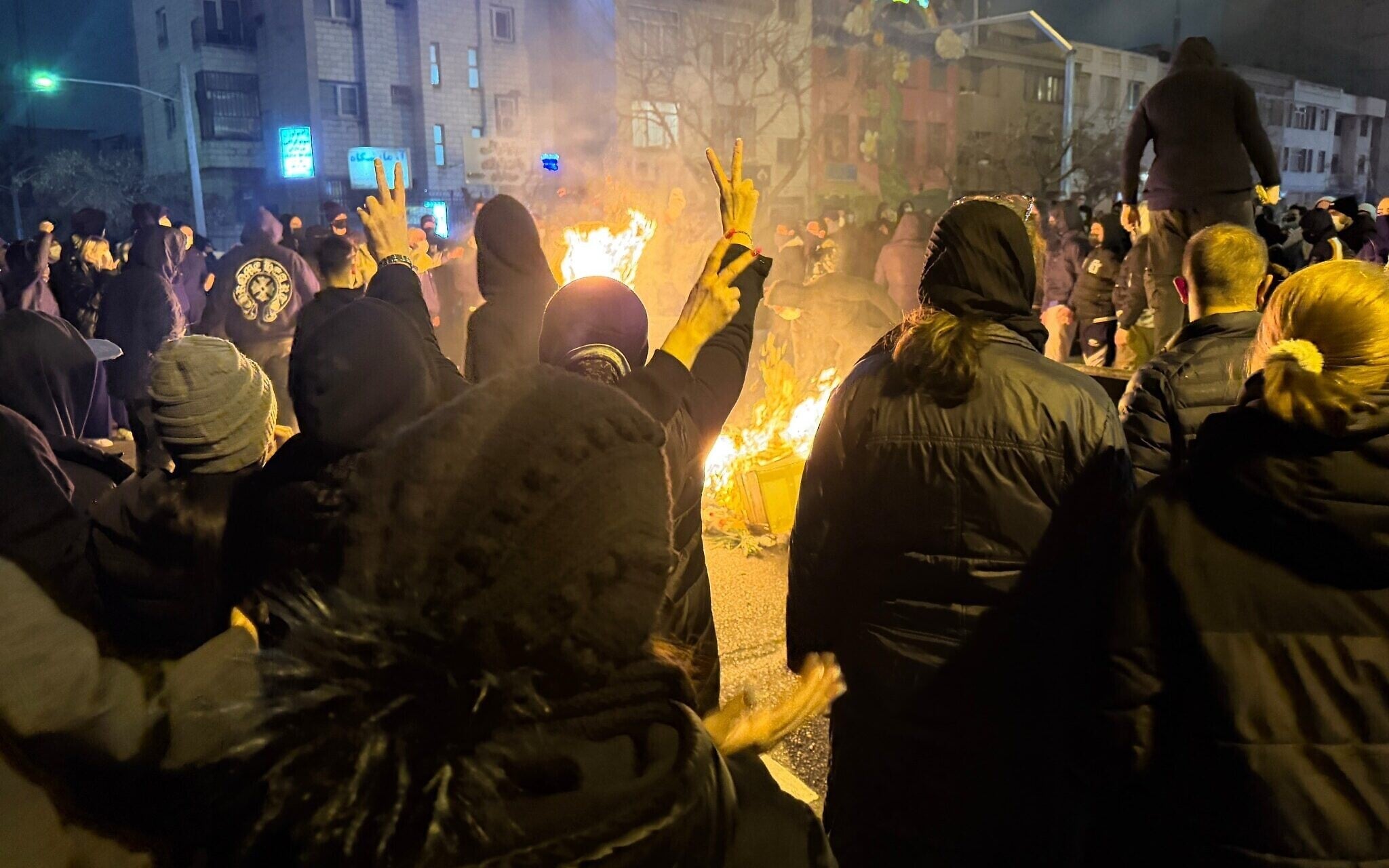
In this photo obtained by The Associated Press, Iranians attend an anti-government protest in Tehran, Iran, January 9, 2026. (UGC via AP)
Another resident in a northern city on the Caspian Sea said the streets also appeared calm.
The residents declined to be identified for their safety.
There were, however, indications of unrest in some areas.
Hengaw reported that a female nurse was killed by direct gunfire from government forces during protests in Karaj, west of Iran. Reuters was not able to independently verify the report.
The state-affiliated Tasnim news outlet reported that rioters set fire to a local education office in Falavarjan County, in central Isfahan Province, on Thursday.
An elderly resident of a town in Iran’s northwestern region, where many Kurdish Iranians live and which has been the focus for many of the biggest flare-ups, said sporadic protests had continued, though not as intensely.
Describing violence earlier in the protests, she said: “I have not seen scenes like that before.”
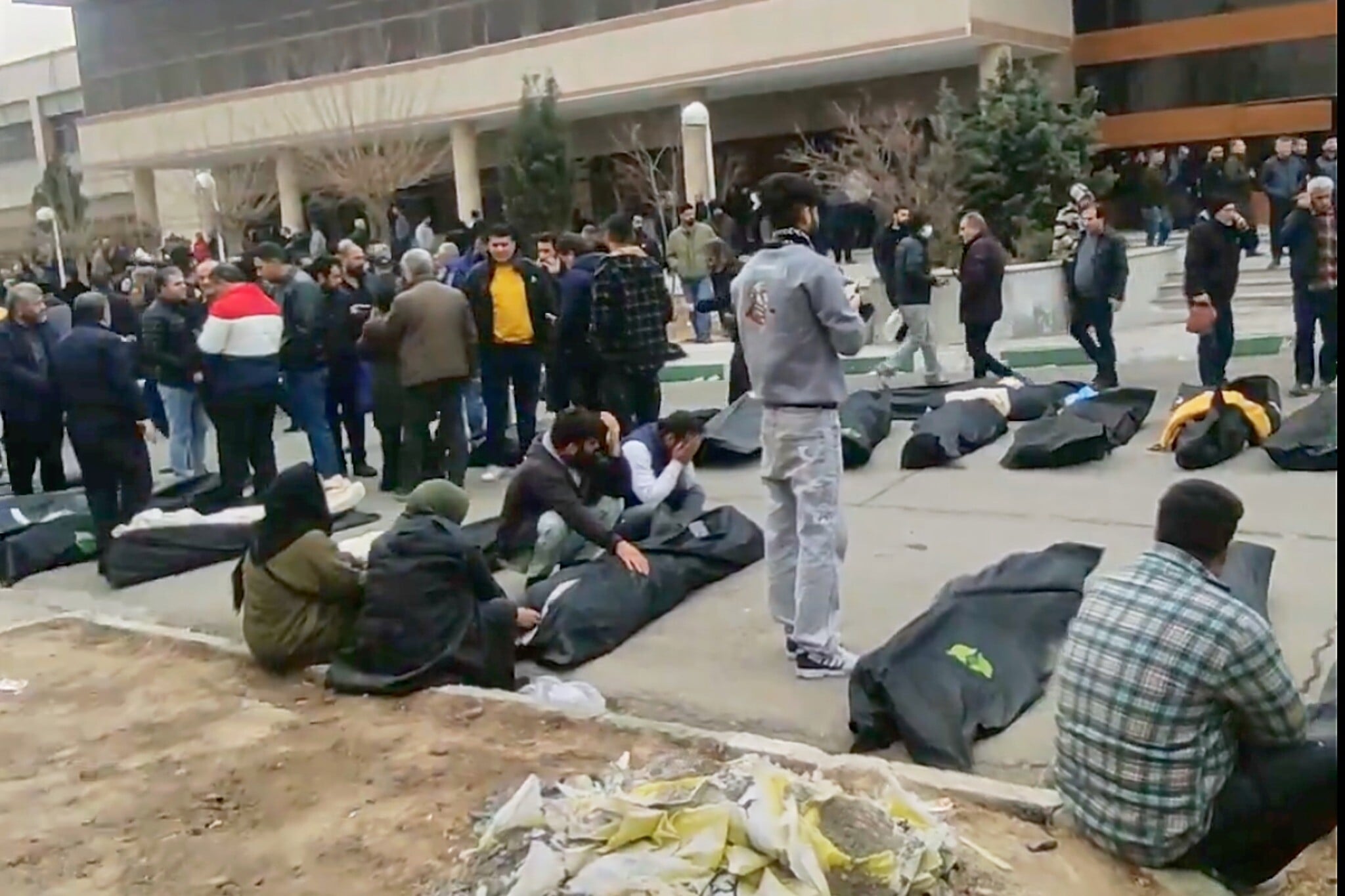
This frame grab from videos taken between Jan. 9 and Jan. 11, 2026, and circulating on social media purportedly shows images from a morgue with dozens of bodies and mourners after crackdown on the outskirts of Iran’s capital, in Kahrizak, Tehran Province. (UGC via AP)
The state-owned Press TV cited Iran’s police chief as saying calm had been restored across the country.
Norway-based rights group Iran Human Rights (IHR) says 3,428 protesters have been verified to have been killed by security forces, but warns this could be a fraction of the actual toll.
Its director, Mahmood Amiry-Moghaddam, said authorities under Supreme Leader Ayatollah Ali Khamenei have “committed one of the gravest crimes of our time.”
He cited “horrifying eyewitness accounts” received by IHR of “protesters being shot dead while trying to flee, the use of military-grade weapons and the street execution of wounded protesters.”
Lama Fakih, program director at Human Rights Watch, said the killings since last week “are unprecedented in the country.”
Monitor Netblocks said that the “total internet blackout” in Iran had now lasted over 180 hours, longer than a similar measure that was imposed during the 2019 protests.
Around 3,000 people were arrested, according to security officials cited by the country’s Tasnim news agency.
The 3,000 people detained included “armed individuals and rioters” and “members of terrorist organizations,” according to Tasnim, which is considered close to security forces in Iran.
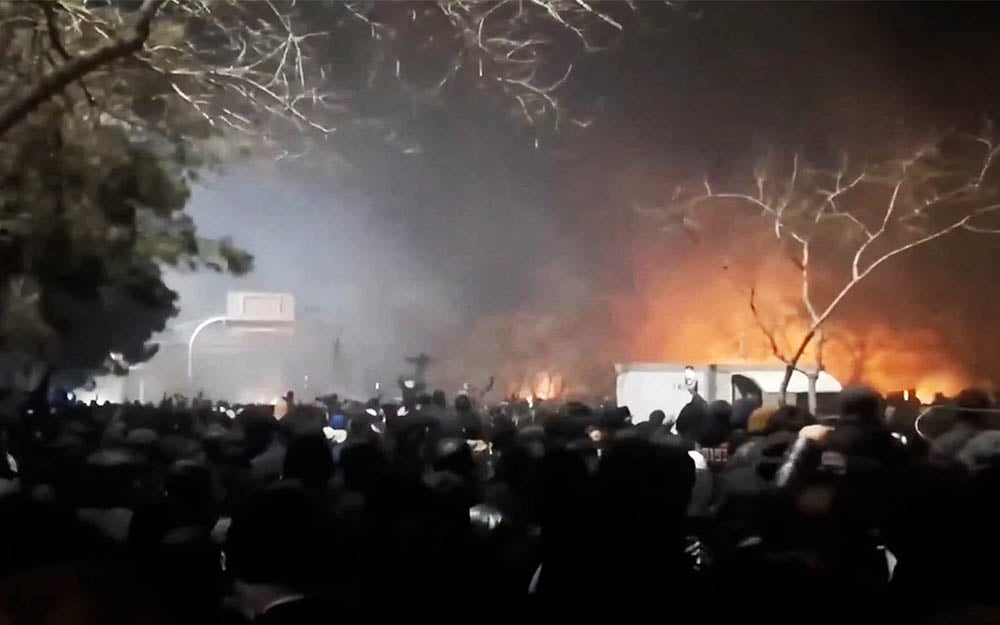
Smoke rises as protesters gather amid evolving anti-government unrest at Vakilabad highway in Mashhad, Razavi Khorasan province, Iran, January 10, 2026, in this screen grab obtained from a social media video. (SOCIAL MEDIA/via REUTERS)
Rights groups have estimated that up to 20,000 people have been arrested.
White House Press Secretary Karoline Leavitt told reporters Thursday that “the president understands today that 800 executions that were scheduled and supposed to take place yesterday were halted.”
Iran is the most prolific user of capital punishment after China. But there has been no suggestion from Iranian authorities — or rights activists who have repeatedly condemned a recent surge in hangings before the protest wave — that so many people were due to be executed in a single day.
Attention had focused on the fate of a single protester, Erfan Soltani, a 26-year-old who rights activists and Washington said was set to be executed as early as Wednesday.
The Iranian judiciary confirmed Soltani was under arrest but said he had not been sentenced to death and his charges meant he did not risk capital punishment.
‘All Iranians united’
Asked about a New York Times report that Netanyahu had warned Trump against strikes, Leavitt said: “It’s true that the president spoke with [him], but I would never give details about their conversation without… the express approval by the president himself.”
The US Treasury also announced new sanctions targeting Iranian officials on Thursday, including Ali Larijani, secretary of Iran’s Supreme Council for National Security.
Despite the internet shutdown, new videos from the height of the protests, with locations verified by AFP, showed bodies lined up in the Kahrizak morgue south of Tehran, as distraught relatives searched for loved ones.
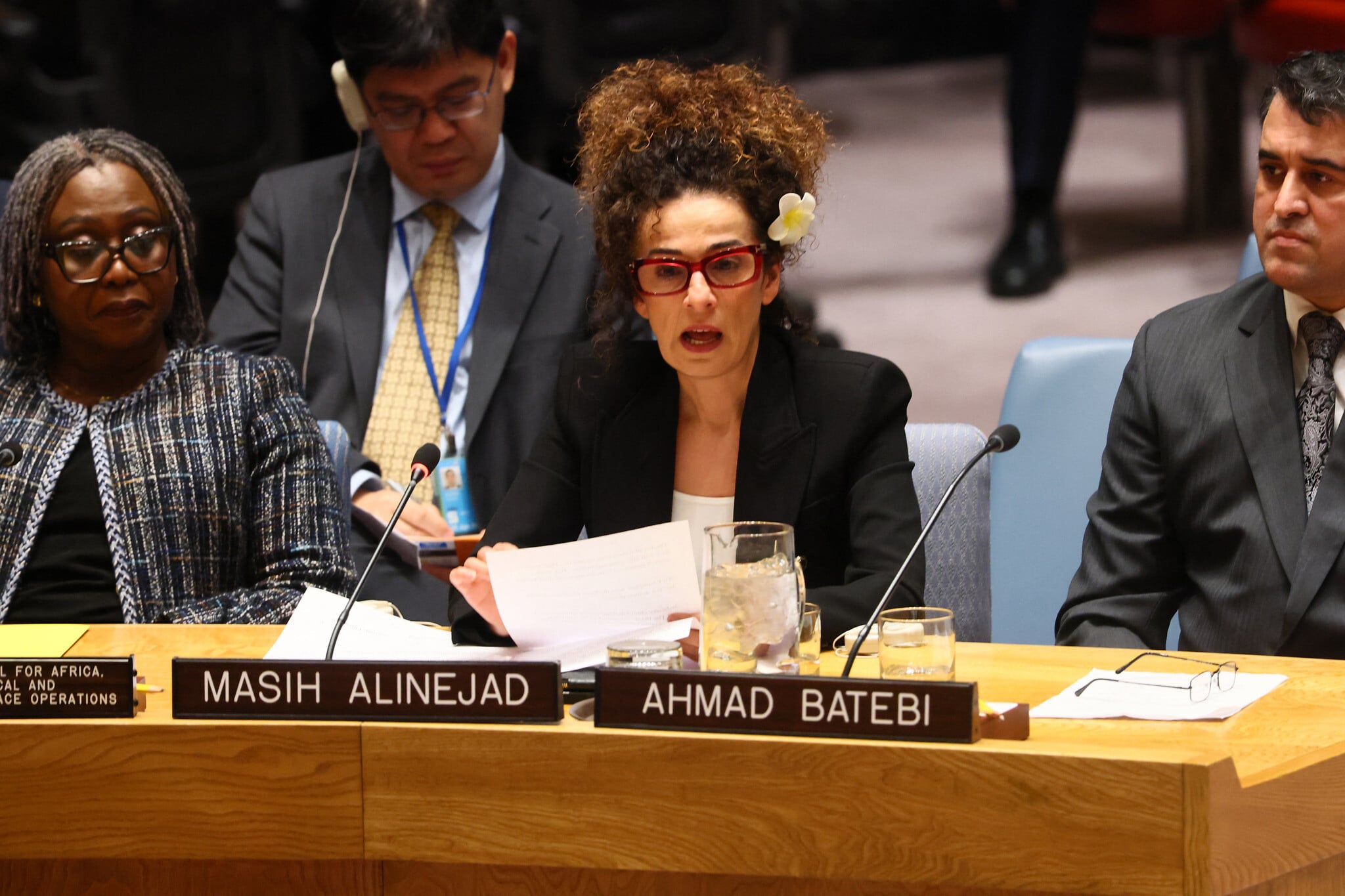
Masih Alinejad, journalist and political dissident, speaks during a United Nations Security Council meeting on the situation in Iran at the United Nations headquarters on January 15, 2026, in New York City. (Michael M. Santiago/Getty Images/AFP)
At the UN Security Council in New York, Iranian-American journalist Masih Alinejad, invited to address the body by Washington, said “all Iranians are united” against the clerical system in Iran.
Iran’s representative at the meeting, Gholamhossein Darzi, accused Washington of “exploitation of peaceful protests for geopolitical purposes.”
Prayer leader calls for executions over protests
A hardline cleric leading Friday prayers in Iran’s capital demanded the death penalty for protesters detained in the nationwide crackdown and directly threatened Trump, showing the hard-line rage gripping the Islamic Republic after the demonstrations.
Ayatollah Ahmad Khatami’s sermon, carried by Iranian state radio, sparked chants from those gathered for prayers, including: “Armed hypocrites should be put to death!” Executions, as well as the killing of peaceful protesters, had been two of the red lines laid down by Trump for possible military action against Iran over the protests.
Khatami, appointed by Khamenei and a member of both the country’s Assembly of Experts and Guardian Council, described the protesters at the time as the “butlers” of Netanyahu and “Trump’s soldiers.” He insisted their plans “had imagined disintegrating the country.”
“They should wait for hard revenge from the system,” Khatami said of Netanyahu and Trump. “Americans and Zionists should not expect peace.”
Khatami has long been known for his hard-line views, including in 2007 when he said a fatwa calling for the death of writer Salman Rushdie remained in effect. He also threatened Israel in a 2018 speech by saying Iran could “raze Tel Aviv and Haifa to the ground” with its missile arsenal.
Khatami also provided the first overall statistics on damage from the protests, claiming 350 mosques, 126 prayer halls and 20 other holy places had sustained damage. Another 80 homes of Friday prayer leaders — an important position within Iran’s theocracy — also had been damaged, likely underlining the anger demonstrators felt toward symbols of the country’s government.
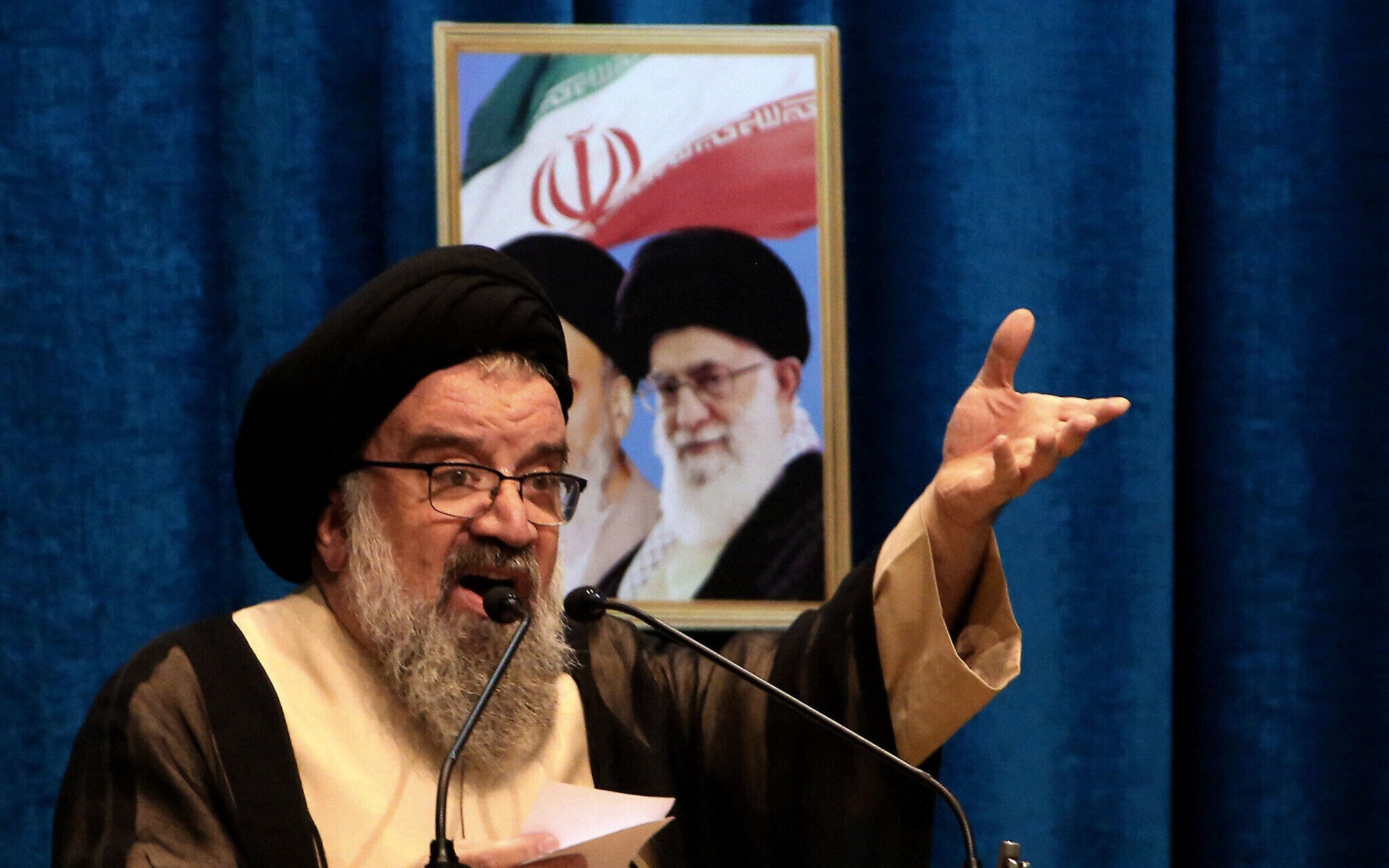
Iranian senior cleric Ahmad Khatami delivers a sermon during a mourning prayer for slain IRGC Major General Qasem Soleimani in Tehran, Iran, on January 3, 2020. (ATTA KENARE / AFP)
Khatami said 400 hospitals, 106 ambulances, 71 fire department vehicles, and another 50 emergency vehicles sustained damage, showing the scale of the protests.
“They want you to withdraw from religion,” Khatami said. “They planned these crimes a long time ago.”
He also issued a call for the arrest of “individuals who supported the rioters in any way.”