
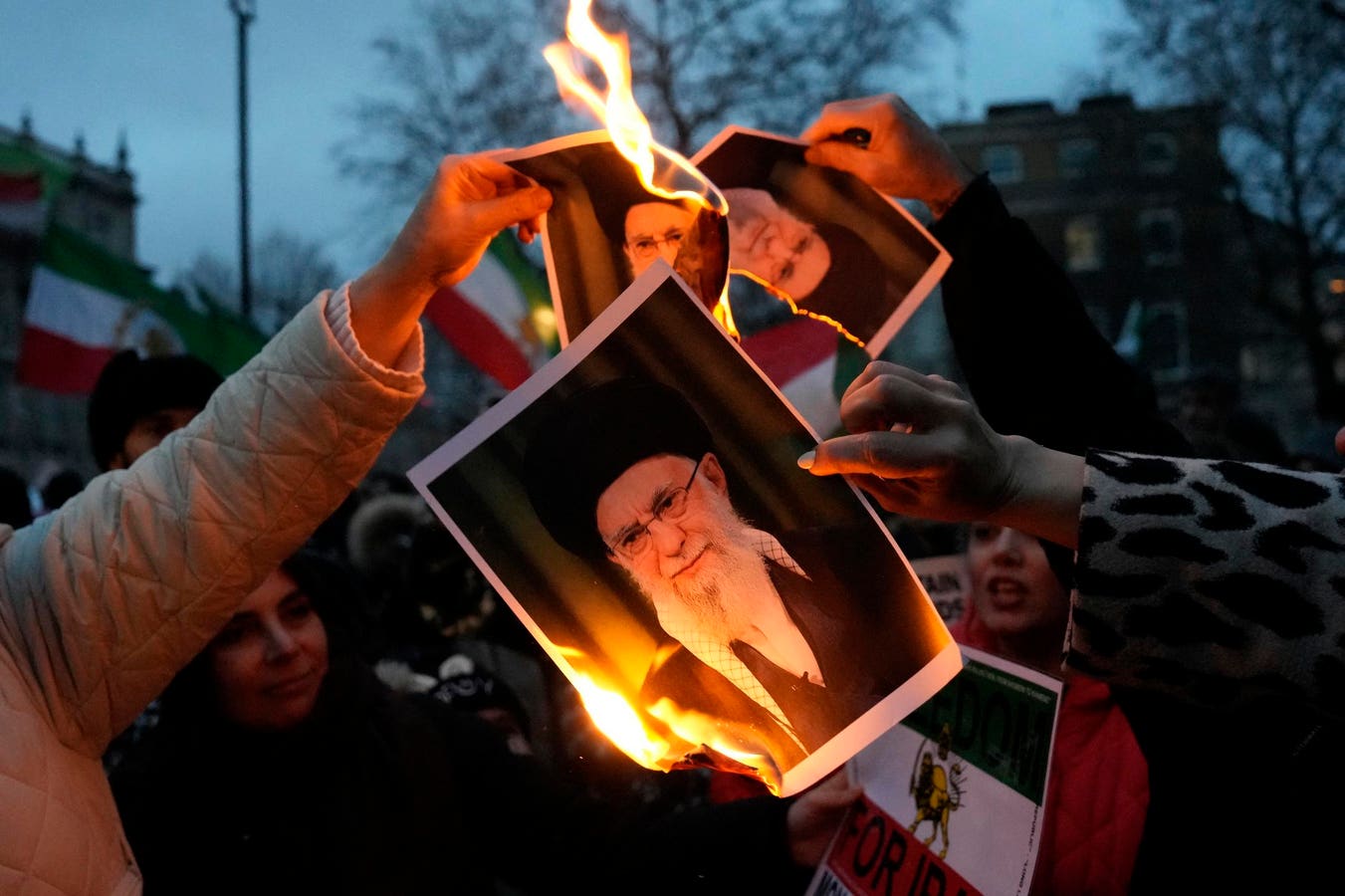
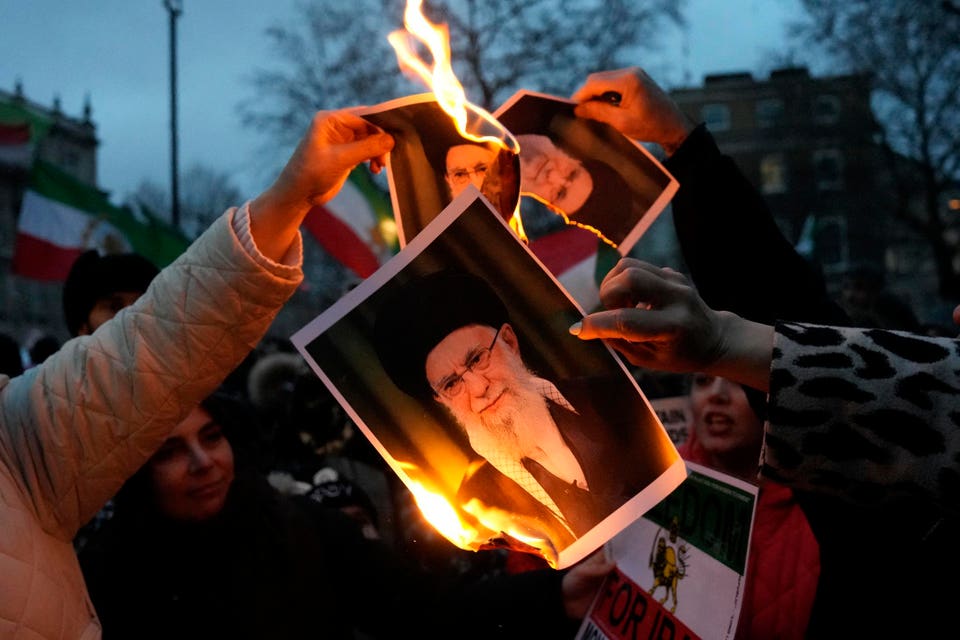
Protestors burn images of Ayatollah Ali Khamenei during a rally held in Solidarity with Iran’s Uprising, organised by The national Council of Resistance of Iran, on Whitehall in central London on January 11, 2026, to protest against the Iranian regime’s crackdown on internet access and “recognise their right to self-defence against the regime’s forces”. At least 192 people have been killed in two weeks of protests against the government and economic strain in Iran, a rights group said on Sunday, in a sharp rise from an earlier death toll of 51. (Photo by CARLOS JASSO / AFP via Getty Images)
AFP via Getty Images
Iran’s environmental crisis is now inseparable from its political and economic failures, with water scarcity sitting at its core. Iran’s environmental decline has also been shaped by the growing concentration of economic power in institutions whose priorities lie far from sustainability. Under sanctions, large segments of the economy—particularly strategic infrastructure—have increasingly fallen under the control of entities linked to the Islamic Revolutionary Guard Corps, including its powerful construction arm, Khatam al-Anbiya Construction Headquarters.
Iranian families are struggling to acquire the basic necessities they need to survive, including both food and water, a situation exacerbated by local inflation and government policies. When Iranian leaders moved to cut spending on subsidies that help Iranians afford basic essentials, thousands of protesters already dissatisfied with Iran’s political leadership finally took to the streets. This is one of the primary reasons so many people are protesting in the streets of Tehran today. And, even if the protests fizzle out, water scarcity is only projected to get even worse.
The History Of Protests In Iran
Over the past five decades multiple uprisings have rattled Iranian leadership. Iran’s 1979 revolution overthrew the Pahlavi monarchy and established the Islamic Republic, which has since been widely criticised around the world. What was meant to expand political freedom instead ushered in decades of repression, tighter political controls and the steady erosion of social and personal freedoms. Resistance began almost immediately: in March 1979, tens of thousands of women marched on International Women’s Day against compulsory hijab, forcing the new authorities to temporarily retreat. In 2009, the Green Movement saw millions protest alleged election fraud that returned Mahmoud Ahmadinejad to power, shaking the system from within. A decade later, nationwide protests erupted in November 2019 after a sudden fuel-price hike; the unrest—known as “Bloody Aban”—was met with a near-total internet shutdown and the killing of hundreds of protesters. In 2022, the death of 22-year-old Mahsa Amini in morality police custody ignited the “Women, Life, Freedom” uprising, with months of unrest, widespread arrests and hundreds killed.
More recently, mounting economic hardship, environmental collapse and political repression have again fueled nationwide unrest challenging the Islamic Republic’s legitimacy nearly five decades on. Global policy experts are still unsure what the outcome of the current protests in 2026 may be.
Iran’s Water Bankruptcy And Environmental Collapse
Academic researchers increasingly describe the situation as “water bankruptcy”, the result of decades of over-extraction, poor governance and policies that encouraged water-intensive farming and heavy industry in one of the world’s most arid regions. Today, water for agriculture is drying out rivers, lakes and wetlands and draining over 90% of Iran’s aquifers all of which once sustained both communities and wildlife. The ecological fallout has been severe; iconic species such as the Asiatic cheetahs face imminent extinction and the Siberian crane has now disappeared entirely from Iran’s wetlands. Yet efforts to protect what remains have faced political obstruction.
A female Asiatic Cheetah named ‘Dalbar’ walks in an enclosure at the Pardisan Park in Tehran on October 10, 2017. Iranian environmentalists have mobilised to protect the world’s last Asiatic cheetahs, estimated to number just 50 and faced with the threats of becoming roadkill, a shortage of prey and farmers’ dogs. / AFP PHOTO / ATTA KENARE (Photo credit should read ATTA KENARE/AFP via Getty Images)
AFP via Getty Images
A series of arrests in 2018 targeting Persian Wildlife Heritage Foundation conservationists on charges of espionage allegedly prompted international concern and severely constrained environmental work domestically. As reservoirs fall to record lows and experts warn that major cities like Tehran could soon face severe rationing, Iran’s water crisis is no longer just an environmental issue—it is a structural threat to everyday life, economic resilience and long-term national stability.
Sanctions, War And The Politics Of Self-Sufficiency
Iran’s water crisis cannot be understood without considering the combined legacy of war, rapid population growth and decades of international isolation. The eight-year Iran–Iraq war, followed by prolonged sanctions from the 1980s onward, reinforced a political ideology centred on survival, security and food self-sufficiency. As Iran’s population expanded rapidly—placing growing pressure on cities and food systems—the state prioritized domestic production to reduce reliance on global markets. This led to the aggressive expansion of water-intensive crops such as wheat and rice, despite their poor suitability for Iran’s arid climate.
Agriculture consequently became the backbone of food and employment policy, research shows it consumes up to 92% of the country’s water. Sanctions further entrenched this model by restricting access to technology, finance and international cooperation, pushing the economy toward greater dependence on natural resources. What began as a rational response to war and isolation has evolved into a structural vulnerability—one that has drained aquifers, degraded land and left the country increasingly exposed to climate stress and social unrest.
Abandoned boats in Sikh Sar village at Hamoon wetland near the Zabol town, in southeastern province of Sistan-Baluchistan bordering Afghanistan on February 2, 2015. AFP PHOTO/BEHROUZ MEHRI (Photo credit should read BEHROUZ MEHRI/AFP via Getty Images)
AFP via Getty Images
Corruption, Power And Iran’s Environmental Legacy
Originally established during wartime reconstruction, Khatam has since become a dominant contractor across dams, water-transfer projects, energy infrastructure and heavy industry. Johns Hopkins University research shows that while sanctions limited access to technology and cooperation, they did not impede Iran’s advancement in strategically prioritized sectors such as missiles, satellites, and defence manufacturing. Environmental protection was sidelined, leading to weakened regulation and escalating pollution, water depletion, deforestation, and biodiversity loss.
This imbalance has produced a paradox in Iran’s sanctions economy, where the state demonstrates advanced military capability while neglecting relatively low-cost environmental solutions, steadily eroding environmental resilience, public health, and long-term national security.
In less than a week, over 12,000 protesters have reportedly been killed during Iran’s 2026 uprising. Human rights groups inside the country suggest the true figure may exceed 20,000, CBS News reported, though an ongoing internet blackout has made independent verification difficult. This is clearly the last effort of a waning regime to retain control over 90 million people in Iran. Years of prioritizing ideology and militarization over international cooperation and environmental protection have left millions facing severe hardship.
Yet collapse does not have to mean chaos. As political change approaches, there are initiatives such as the Iran Prosperity Project which have engaged experts to planning for a post-Islamic Republic. These plans outline potential pathways to economic recovery and a more democratic and stable governance. Among the most urgent priorities will be reversing decades of water mismanagement and environmental decline – this will be central to the recovery of Iran’s economy.