
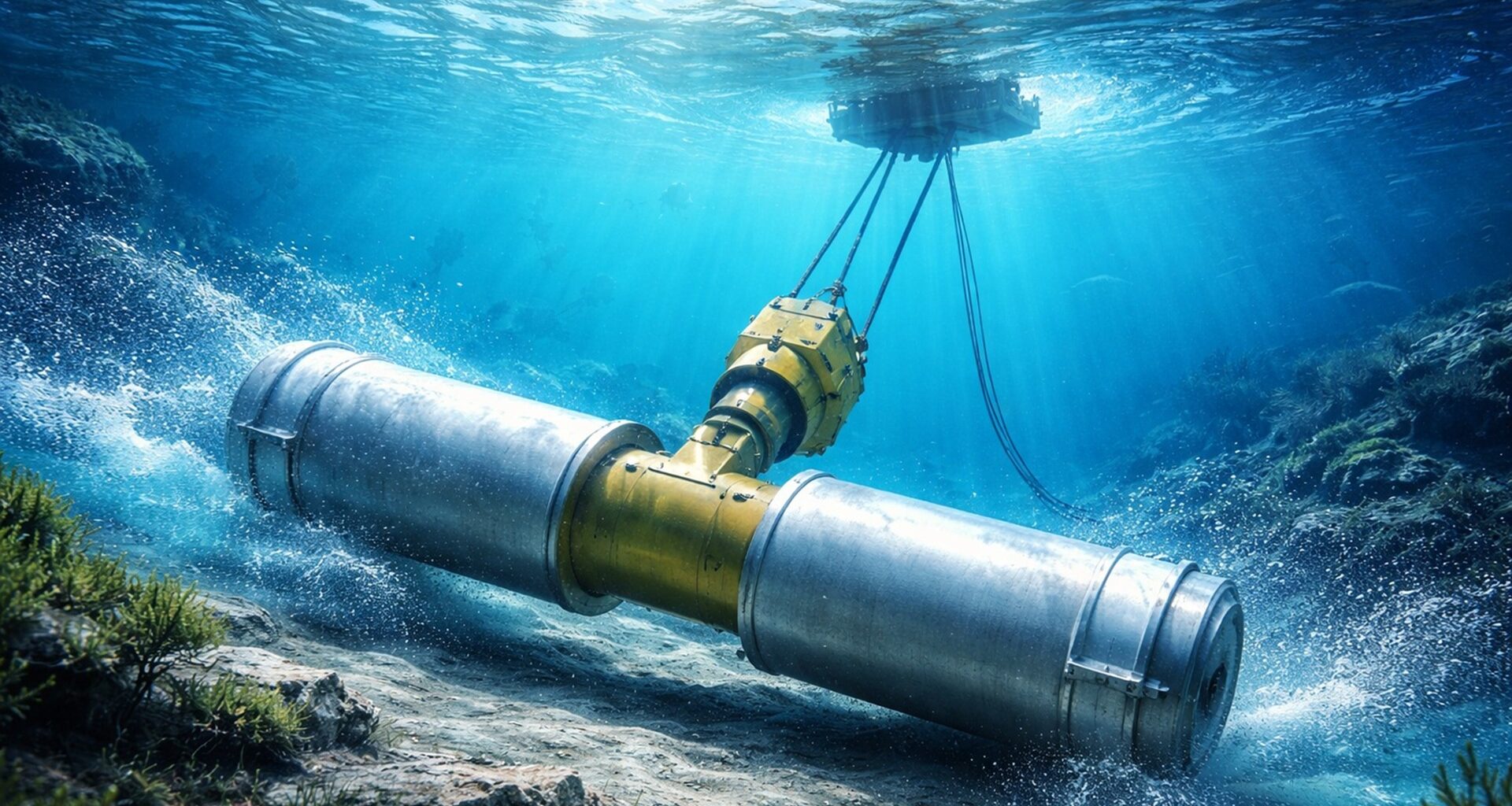
The Spanish researcher Francisco Huera, Universitat Rovira i Virgili, the Catalonia, in southern Spain, developed a pendulum-based energy system that uses vibrations induced by ocean currents to generate electricity.
The invention can achieve approximately 15% efficiency in laboratory tests and drastically reducing the complexity of submerged equipment.
A known physical principle applied in an unprecedented way.
The extraction of ocean energy It is usually associated with large turbines installed underwater, with rotors, blades and complex structures.
— ARTICLE CONTINUES BELOW —
See also other features
Discover the oldest and most durable stone tools ever found, produced 2,75 million years ago and reused for almost 300.000 years.

Wild horses, extinct for millennia, are galloping freely again in Spain for the first time, reigniting entire ecosystems, changing the landscape of the Iberian Plateau, and marking a historic chapter in European rewilding.

Brazil creates a “green radar” that reveals who is restoring native forests, maps more than 150 hectares restored, exposes silent progress against degradation, transforms restoration into a climate asset, and redesigns environmental power in the country.

Millions of concrete blocks are being dumped into the sea to withstand waves capable of destroying entire cities, in a desperate race of coastal engineering against storms, tsunamis, and rising sea levels that already threaten trillions of dollars in global infrastructure.
The system proposed by Huera takes a different approach by exploring a widely known physical phenomenon, but one that is rarely used as an energy source: flux-induced vibrations.
When a stream of water flows around a cylindrical body, alternating vortices are formed, generating periodic oscillations. Historically, this effect has always been treated as a problem in naval and offshore engineering, as it causes structural fatigue. In the new system, it becomes the central element of energy generation.
The device consists of a submerged cylindrical tube, suspended by an axis, which oscillates like a pendulum when interacting with the ocean current. This mechanical oscillation is then converted into energy through a transmission and generation system located outside the water.
Only one submerged component, reducing maintenance.
One of the key aspects of the proposal is that only the cylinder remains in direct contact with the water. The shaft, mechanical transmission, and generator can be positioned externally, including on floating platforms.
This configuration significantly reduces problems associated with corrosion, biofouling, and wear of critical components.
Structural simplification represents a significant difference compared to conventional turbines. Systems with multiple submerged moving elements require frequent, expensive, and technically complex maintenance, as well as long periods of downtime.
In the oscillating model, most interventions can occur outside the underwater environment.
According to the researcher, it is essentially about “just a pipe hanging from an axle””A simple description that summarizes the proposal to minimize components and points of failure without abandoning energy conversion.”
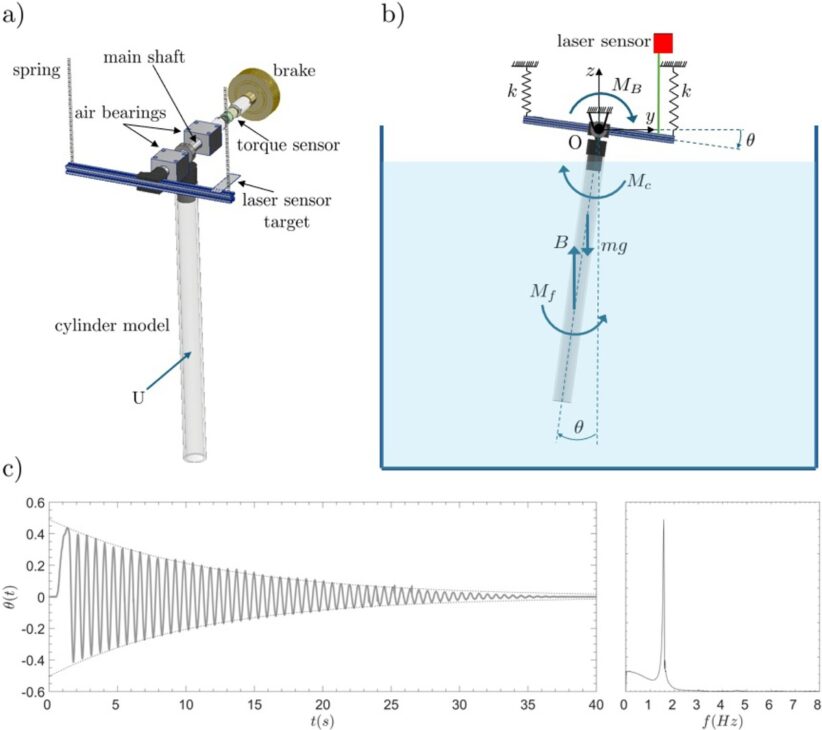 In part (a), the actual equipment is shown, with shaft, spring, brake and laser sensors that measure small movements and rotations of the system. The cylinder is suspended and can oscillate freely.
In part (b), there is a schematic drawing that explains how the system works: the cylinder oscillates inside a container, subjected to the action of weight, the resistance of the medium and forces that brake the movement. Sensors record the angle and rotation over time.
In part (c), the results of the air test are shown. The graph on the left indicates that the oscillations start large and gradually decrease until they stop, following a regular pattern of energy loss. The graph on the right shows the main frequency of this oscillation, which was about 1,6 oscillations per second.
Controlled testing and scientific validation
The study results were obtained from tests conducted in a hydraulic channel at the fluid-structure interaction laboratory of the Spanish university.
During the experiments, an electromagnetic brake was coupled to the system to measure the amount of mechanical energy extracted as a function of the intensity of the oscillations.
The data were subsequently published in the scientific journal. Journal of Fluids and Structures, validating the device’s performance under controlled conditions.
Tests showed power coefficients close to 15%, a value consistent with other systems based on flow-induced vibrations.
Although lower than the maximum potential of ocean turbines, this level of efficiency was achieved with a structurally simpler system, without rotors or blades, and with less exposure of components sensitive to the marine environment.
Direct comparison with traditional ocean turbines.
Axial or transverse flow turbines are currently the standard for harnessing energy from ocean currents. Under ideal conditions, they can exceed 50% theoretical efficiency, but in practice they rarely surpass 25% to 35%.
In addition to real performance limitations, these turbines present significant operational challenges. They are large structures with multiple submerged moving components, subject to continuous wear and high maintenance costs. Many projects remain in the pilot phase, without large-scale commercial deployment.
The pendulum system does not seek to compete directly with these maximum levels of efficiency.
The proposal is based on accepting a more discreet, yet constant, generation method, with gains in simplicity, reliability, and operational viability in locations where conventional turbines would be impractical or economically unfeasible.
 Francisco Huera, a researcher in the Department of Mechanical Engineering, led the study.
Moderate efficiency and contextual advantages
The experimental results themselves indicate that the efficiency of the oscillating system is about half that obtained by a well-designed turbine. However, the application context alters the performance evaluation.
These devices take up less space, have a less complex construction, and can be installed in environments where large rotors are not suitable.
Moving the most complex part of the system out of the water also allows for faster interventions, less downtime, and a potentially longer lifespan.
From an engineering perspective, this approach shifts the focus from maximizing absolute efficiency to optimizing the overall efficiency-operability-maintenance process, a balance that is particularly relevant in distributed applications.
Potential applications and new lines of research.
The system is of particular interest for tidal currents, where water movement is predictable and continuous. It can also be adapted for rivers with sufficient flow, without the need for dams or diversions, reducing environmental impacts on the river ecosystem.
The research also explores the application of the same principle to wind, expanding the concept to other fluids and energy contexts.
This versatility reinforces the modular nature of the technology, which can be combined with other renewable sources.
The current study focuses on analyzing the dynamic behavior of the pendulum and quantifying the available mechanical power. It does not, at this time, include the complete design of a commercial generator nor a detailed economic evaluation, which is still lacking.
Next steps and conceptual change in engineering
The next steps involve optimizing the extraction of energy, adjusting the braking torque according to the hydrodynamic load and studying the interaction between multiple devices to increase the energy generated per unit area.
There is also a relevant conceptual shift. For decades, flow-induced vibrations were treated as a silent enemy of engineering, responsible for structural failures and fatigue. Huera, in fact, has already developed solutions to mitigate them and holds a European patent in this area.
Now, the same phenomenon is being viewed as an energy resource.
While not a standalone solution to the climate crisis, the system offers a low-impact technical alternative capable of providing local energy for oceanographic buoys, monitoring stations, and small coastal installations, helping to diversify the portfolio of renewable energy sources in a pragmatic and efficient way.