
Title: Hunting for the First Explosions at the High-Redshift Frontier
Authors: Junehyoung Jeon, Volker Bromm, Alessandra Venditti, Steven L. Finkelstein, Tiger Yu-Yang Hsiao
First Author’s Institution: Department of Astronomy, University of Texas, Austin, TX 78712, USA
Status: Submitted to ApJL [open access]
Back in the 1920s, astronomers first discovered that we live within just one of many, many galaxies in the big, wide Universe. Since then, we’ve been racing to search for the most distant galaxy that can be observed. In other words, searching for the oldest starlight we can see, since the light from these distant sources has been travelling towards us for most of the age of the Universe (remember: more distant = higher redshift = longer lookback time).
This race to the redshift frontier has had a pretty eventful history (see a great overview video here), which became even more eventful with the launch of the James Webb Space Telescope (JWST). JWST rapidly smashed the previous redshift (z) record of z = 10.6 by discovering a galaxy at z = 13.2, and then broke its own record twice more. The current title-holder sits at z = 14.4, observed less than 300 million years after the Big Bang.
Several galaxy candidates (to-date unconfirmed) have now even been proposed at z ~ 25-32 (e.g. Capotauro); only 100 million years after the Big Bang! If real, these sources would pose a serious challenge to our understanding of the formation of the first galaxies, as galaxies shouldn’t really be observable at such early times. In today’s paper, the authors put forward an intriguing alternative: what if some of these ultra-high-redshift candidates aren’t galaxies at all, but transient explosions from the Universe’s first stars?
The First Stars and Their Explosive Endings
The earliest generation of stars (Population III; see my previous bite on these here) formed from pristine hydrogen and helium gas. Without metals to cool the gas efficiently, theory predicts that these stars were extremely massive, often exceeding 100 solar masses. While such stars would be rare and short-lived, their deaths could be spectacular.
Population III stars of sufficient mass are predicted to end their lives as hyper-energetic pair-instability supernovae (PISNe); a long winded name for a rapid, intensely hot explosion that leaves no remnant behind – not even a trace of the pre-existing star. Whilst nothing would remain of the star, the light emitted in that explosion could be bright enough to masquerade as a high-redshift galaxy candidate in current JWST surveys, but only if three key conditions are met:
JWST must observe a sufficiently overdense region, where lots of Population III stars can form very early
A PISN must occur while JWST is “watching”
The explosion must be bright enough to rise above JWST’s detection limits.
Simulating a (Biased) Universe
To address the likelihood of these conditions having already been met by existing JWST observations, the authors turn to cosmological simulations. Rather than simulating an “average” patch of the Universe, they focus on an extremely overdense region (Fig. 1). This creates a rare but important environment where structures collapse earlier than usual. These regions are exactly where large numbers of Population III stars are expected to form at the highest redshifts.
In their simulations, star formation begins as early as z ~ 30-40 (within the first hundred million years after the Big Bang), producing Population III stars and, by extension, potential PISNe very shortly afterwards. While such overdense regions are rare, the authors show that the total area already surveyed by JWST (including large surveys such as CEERS, JADES, PRIMER, and COSMOS-Web) is large enough that it is plausible JWST has already observed at least one such region.
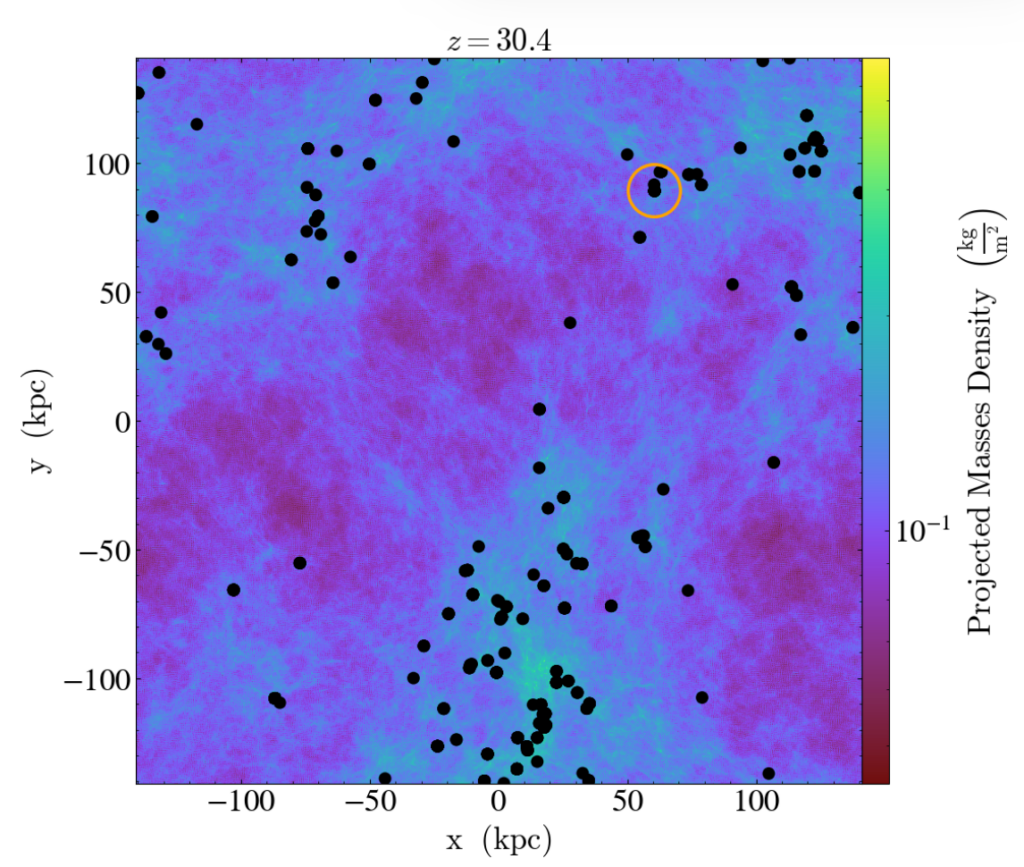 Figure 1: A projection of the gas density in the simulated overdense region at z = 30.4. The densest structures stand out clearly, tracing the locations where the first stars are able to form. Black dots mark newly formed groups of stars, while the most massive dark matter halo in the region is highlighted with an orange circle. The figure illustrates that, in such an unusually dense patch of the early Universe, star formation can already be underway just 100 million years after the Big Bang, creating the conditions needed for early Population III stars and their explosive deaths. This is adapted from Figure 1 in the paper.
Catching a Cosmic Explosion in the Act
So, we can tick off condition #1: it’s possible that a sufficiently overdense region has already been observed by JWST. Next up, how lucky do we have to be to catch an explosion in the act (#2), so to speak? For this condition, cosmic time dilation actually works in our favour. A PISN explosion that lasts only months in its own rest frame can last for decades in the observed frame at z > 20 (this whole time-being-relative-thing sounds whacky because it is – please join me, Neil deGrasse Tyson, and countless others in struggling to imagine this).
But would any such explosion be bright enough (#3)? Using theoretical PISN spectra, the authors show that these explosions could reach observed magnitudes of ~ 28-29 at z ~ 30 – right at the depth of current JWST deep surveys (Fig. 2). In fact, the predicted brightness and colors are somewhat comparable to those of some proposed z ~ 30 candidates (Fig. 3), raising the possibility that these objects could be PISNe rather than galaxies.
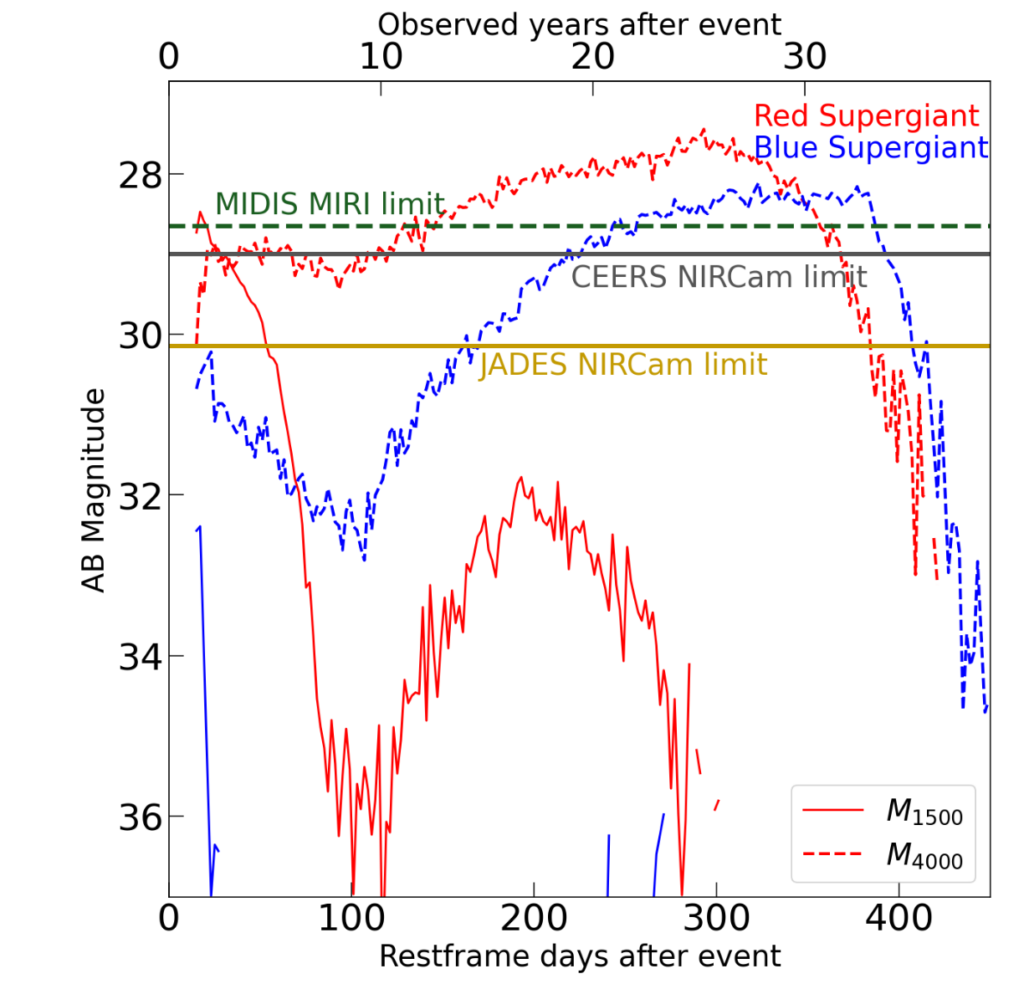 Figure 2: This plot compares the predicted brightness of PISNe originating from different types of extremely massive stars to the depth reached by existing JWST surveys, showing that these explosions could remain detectable for ~20 years at peak brightness in the observed frame. This is Figure 4 from the paper.
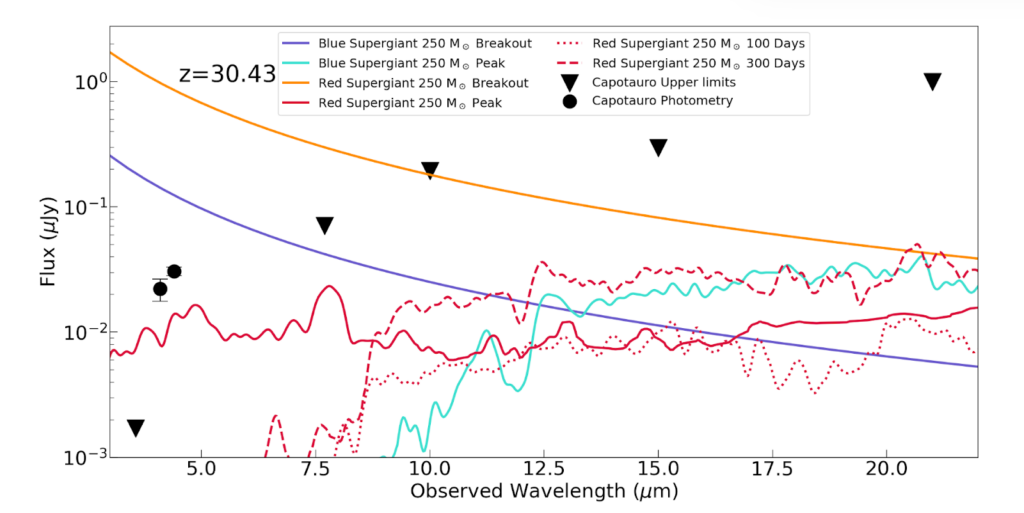 Figure 3: A comparison of theoretical PISNe spectra with the observed photometry of one proposed z ≈ 32 source (Capotauro). The coloured curves show model spectra for PISNe originating from extremely massive stars, at different stages of the explosion, while the data points represent the observed brightness of the high-redshift candidate across multiple JWST filters. This is Figure 3 from the paper.
So… Are We Seeing the First Stars Die?
It’s not time to throw a party just yet. The authors note there are several caveats and uncertainties. The nature of Population III stars is still highly uncertain, JWST does not continuously monitor the same patch of sky, and identifying a PISN at such high redshift would be extremely challenging. Thanks to time dilation, these explosions would fade very slowly, making them hard to distinguish from steady sources using photometry alone. Alternatively, there are other plausible explanations for these ultra-high-redshift candidates: lower-redshift interlopers (a rather infamous example is CEERS-93316), local brown dwarf stars, or even nearby exoplanets.
Still, the idea is exciting. If JWST were to detect a genuine PISN at z > 20, it would represent a direct glimpse of the very first stars, pushing observational astronomy into truly uncharted territory. For now, the most distant explosions in the Universe may already be hiding in JWST images; we just have to learn how to recognise them.
Astrobite edited by Nathalie Korhonen Cuestas
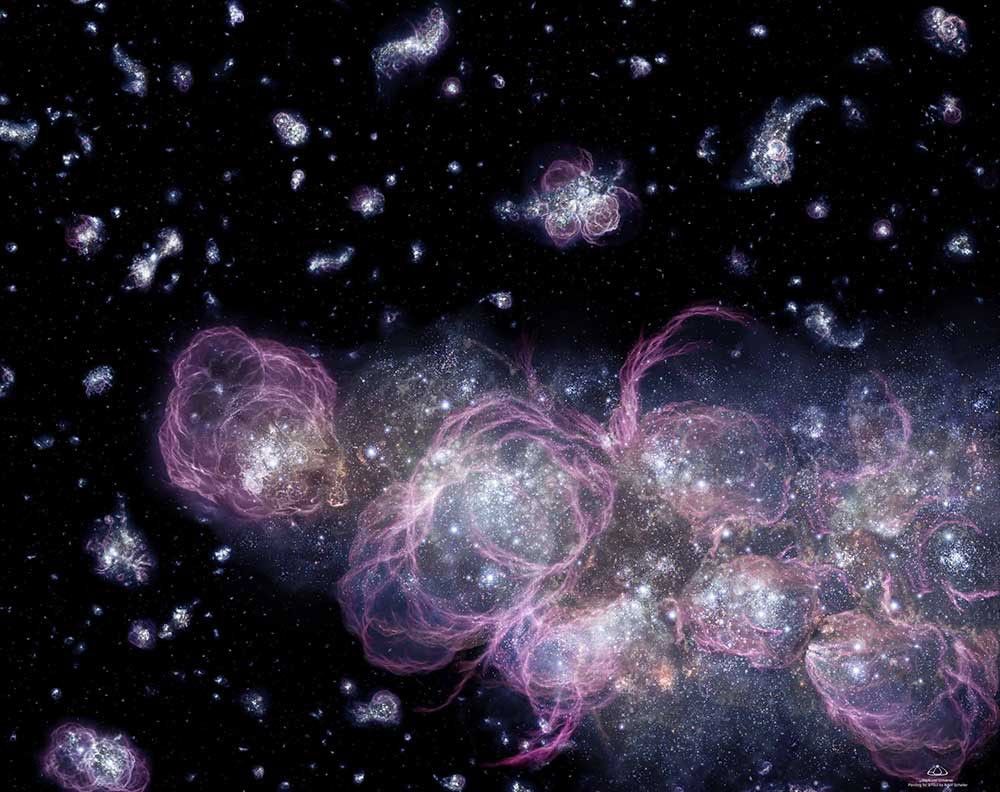
Featured image credit: NASA, STScI A. Schaller

I’m a fourth (and final!) year PhD student at Leiden Observatory in the Netherlands, studying massive, star forming galaxies in the early Universe with ALMA and JWST. It’s a really exciting time to be interested in astronomy, so I hope to make groundbreaking new research more accessible!