


Listen to this article
Estimated 4 minutes
The audio version of this article is generated by AI-based technology. Mispronunciations can occur. We are working with our partners to continually review and improve the results.
Health-care workers’ unions in the Outaouais say Quebec Premier François Legault’s decision to resign comes as the region’s health-care system is in critical condition.
Legault announced his decision to step down as leader of Coalition Avenir Québec on Wednesday. He plans to remain in power until his party elects a new leader.
Geneviève Renaud, a vice-president of labour relations with FIQ-SPSO, a union representing nurses in the Outaouais, said while she’s relieved to see Legault go, the damage has been done.
He’s leaving the health-care system in one of the worst conditions it’s ever been.-
Overcrowding and a lack of personnel are crippling emergency rooms in the Outaouais, where ER occupancy rates are among the highest in the province at 200 per cent.
“Nurses are extremely overwhelmed by the work that they find themselves with,” Renaud said, adding that the situation is also unsafe for patients.
‘They need to listen to us’
Renaud said Legault’s replacement must take the situation seriously, and suggested elected officials see what’s happening for themselves.
“The next person that’s going to be in charge of CAQ needs to understand that health care needs to be a priority,” she said. “They need to go on the floor, they need to talk with people that are actually taking care of patients…. They need to listen to us.”
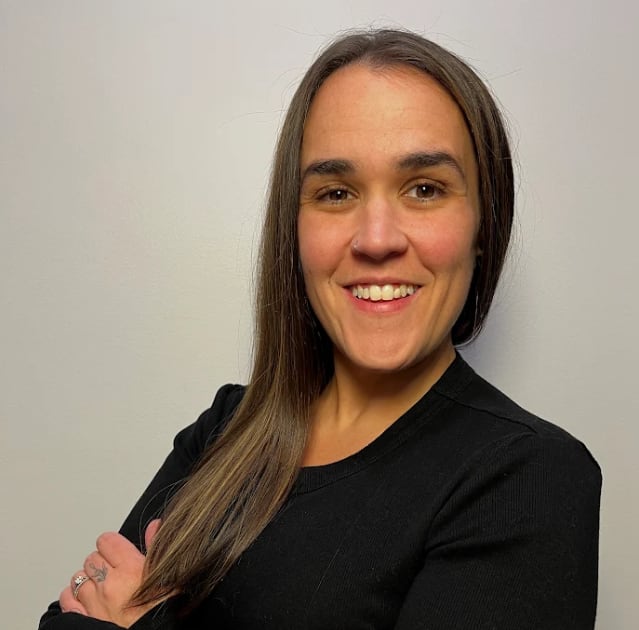 Geneviève Renaud is an executive with FIQ-SPSO, a union representing nurses in the Outaouais. (Jennifer Prescott)
Renaud said establishing safer nurse-to-patient ratios would make a notable difference, but when her union proposed that during the latest contract talks, she said the CAQ opted for bonuses instead.
“They need to stop thinking about just numbers and actually understand that there’s people on the other side of this,” she said.
Alain Smolynecky, president of STTSSSO-CSN, a union representing health and social services workers in the Outaouais, shares those concerns.

Advocates worry as Quebec premier exits amid health-care sector crisis
Some unions in the Outaouais are calling for urgent improvements to the region’s health-care sector following Quebec Premier François Legault’s resignation. CBC’s Mélina Lévesque has the story.
He said the Legault government paid scant attention to the region, and said efforts to centralize the health-care system through Santé Québec only made things worse.
The province introduced the Crown corporation in 2023 with the intention of making its health-care system more efficient by centralizing much of its management, but Smolynecky said it has left the Outaouais feeling left behind.
They don’t care really about us because we’re far from Montreal and Quebec.- Alain Smolynecky,
He said the government seems unaware of the specific challenges facing health care in the Outaouais, where workers often leave the province in search of better working conditions in Ontario.
Quebec’s controversial Bill 2, which would have linked doctors’ compensation to the number of patients under their care, prompted the departure of several physicians from the region. That led to fears over clinic closures and a loss of access to family doctors for thousands of patients.
The province reached an agreement in principle with family doctors in December, delaying the implementation of Bill 2 and removing some key aspects including penalties for doctors who fail to meet certain performance indicators.
Unique status, unique challenges
Reacting to the news of Legault’s resignation, Gatineau Mayor Maude Marquis-Bissonnette applauded the CAQ government’s adoption in 2019 of a motion recognizing the region’s unique status.
Mathieu Lacombe, the minister responsible for the Outaouais, asked the National Assembly to recognize “that the Outaouais region has accumulated a significant delay in recent years with regard to public funding in health, education, higher education and culture.”
Marquis-Bissonnette said that while that recognition was a necessary step forward, there’s still work to be done.
“There is certainly a catch-up that we need to do with the health-care system,” she said.
CBC News asked Lacombe’s office for an interview but did not receive a response in time for publication.