
Back to Article List
The ringed planet’s largest moon lingers nearby, making it easy to find. Several other fainter moons are on view as well.
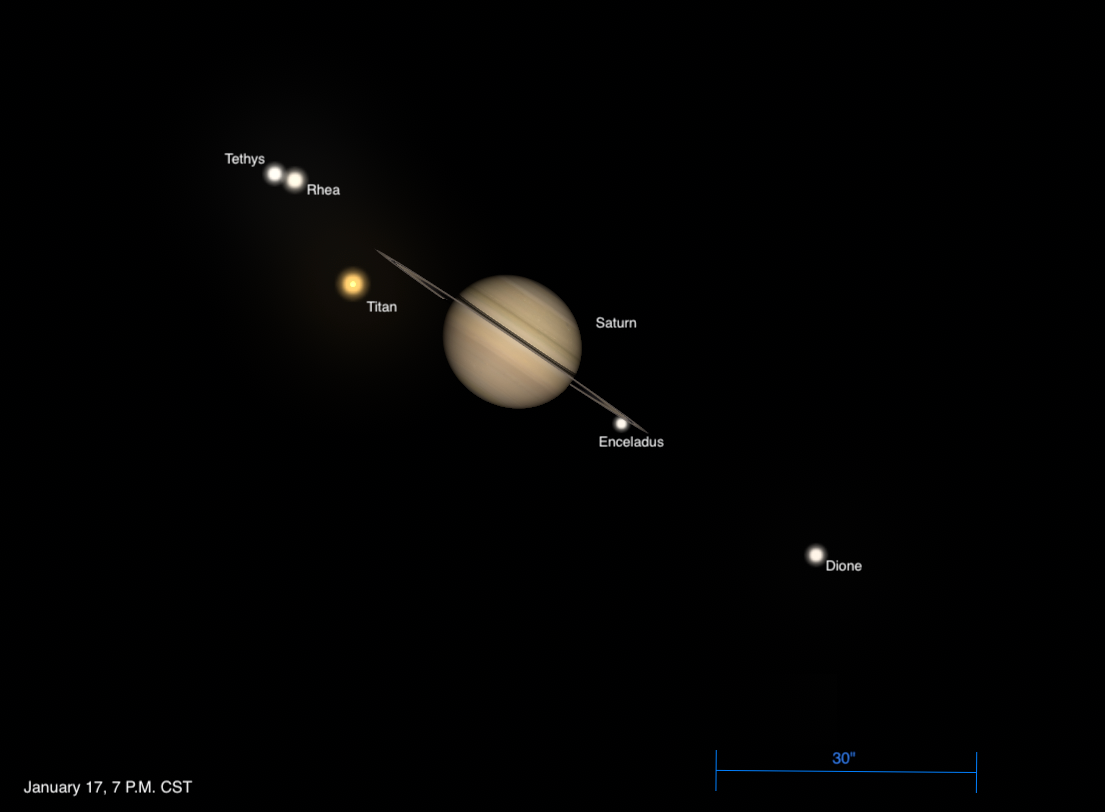
Titan is visible near Saturn on the evening of January 17, along with several other moons. Enceladus, around 12th magnitude, will only be visible in larger instruments. The time of night you look will also affect the fainter moons’ placement. Credit: Credit: Stellarium/Oleg Pluton
Looking for a sky event this week? Check out our full Sky This Week column.
January 16: Buzz the Beehive
Saturn’s largest moon, Titan, is also its brightest. Shining at mid-8th-magnitude, Titan is located near the disk of the ringed planet tonight, making it easy to find.
You can spot Saturn roughly 30° high in the southwestern sky two hours after sunset this evening. It’s an easy object to pick out, shining brighter than any stars in this region. To find Titan, turn a telescope on the ringed planet. Without our own moon in the evening sky, the background sky is dark enough that you may see several of Saturn’s satellites in the eyepiece.
The brightest is Titan, which today sits just southeast of the planet, about 20” from the center of the disk all night. A few fainter moons are also visible around Saturn, though their locations may change throughout the night. Around 7 P.M. CST, 10th-magnitude Tethys and Rhea lie close to each other off the eastern edge of the rings, while similarly bright Dione is west of the rings. The chart above shows the moons’ positions at this time.
Larger scopes may also be able to pick up 12th-magnitude Enceladus, which is just south of the rings on the western side of the planet at this time.
Sunrise: 7:19 A.M.
Sunset: 5:02 P.M.
Moonrise: 6:52 A.M.
Moonset: 3:49 P.M.
Moon Phase: Waning crescent (1%)
*Times for sunrise, sunset, moonrise, and moonset are given in local time from 40° N 90° W. The Moon’s illumination is given at 10 P.M. local time from the same location.