
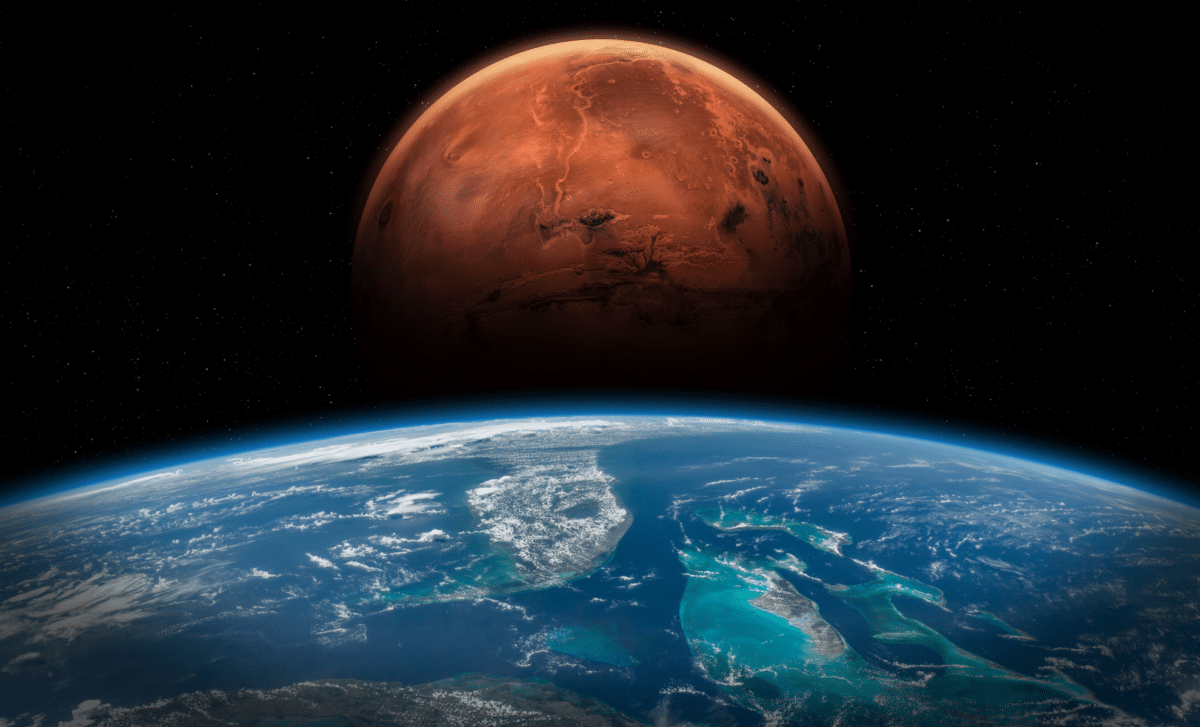
Mars, long admired for its rusty hue and alien deserts, may play a far greater role in shaping life on Earth than once believed. A new study published in the Publications of the Astronomical Society of the Pacific reveals that Mars’ gravitational influence subtly but significantly affects Earth’s climate cycles, planetary tilt, and even the evolution of life.
A Subtle Force With Massive Impact
In a discovery that surprised even the researchers, the team found that Mars may be “punching above its weight,” influencing Earth’s long-term climate stability far more than its modest size suggests.
“I knew Mars had some effect on Earth, but I assumed it was tiny,” said Stephen Kane of the University of California, Riverside, in a statement. “I’d thought its gravitational influence would be too small to easily observe within Earth’s geologic history. I kind of set out to check my own assumptions.”
Using complex orbital simulations, Kane’s team modeled how changes in Mars’ mass or orbital position would alter Earth’s axial tilt, a key factor driving global climate patterns. Their findings were clear: without Mars, Earth’s climate would be missing entire rhythmic cycles that shape ice ages, ocean currents, and possibly even evolutionary milestones.
“When you remove Mars, those cycles vanish,” said Kane. “And if you increase the mass of Mars, they get shorter and shorter because Mars is having a bigger effect.”
The study, detailed in the Publications of the Astronomical Society of the Pacific, underscores just how interconnected the solar system’s architecture is, how even a distant world like Mars can quietly modulate the heartbeat of our own planet.
How Mars Stabilizes Earth’s Tilt
The axial tilt, or obliquity, of a planet governs how sunlight distributes across its surface over time. On Earth, it’s the reason we experience seasons. But if the tilt shifted too wildly, the consequences could be catastrophic: ice sheets might melt or expand unpredictably, deserts could overtake fertile lands, and ecosystems would collapse.
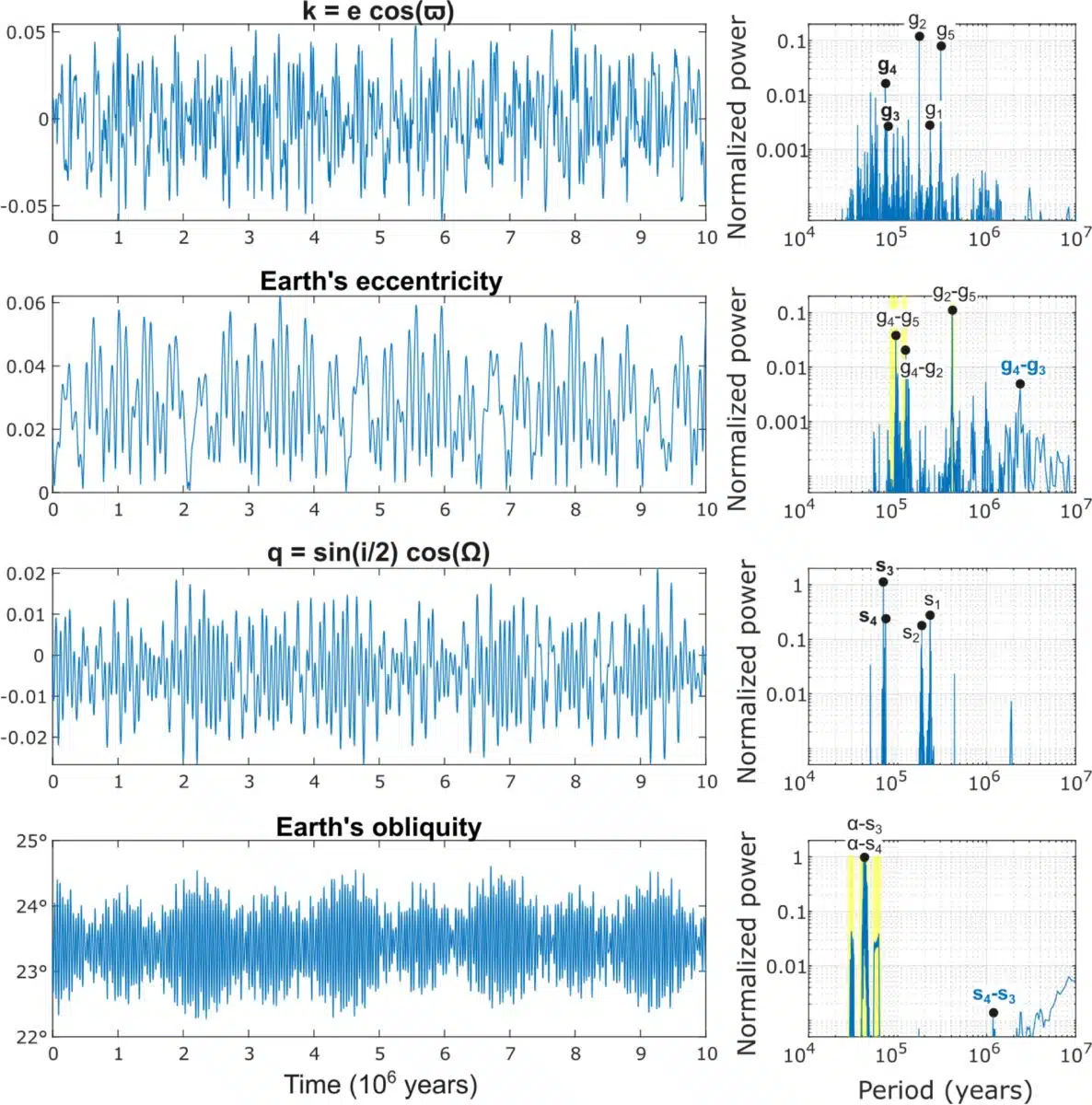 Earth orbital evolution results, where the mass of Mars is set to 100% of its present value. The panels show, from top to bottom, the longitude of perihelion in terms of the k parameter, the orbital eccentricity, the longitude of the ascending node in terms of the q parameter, and the obliquity of the axial tilt. The panels on the right shown the normalized Fourier power, with major peaks identified in terms of the gi and si nodes.
Kane’s simulations revealed that Mars’ gravitational tug acts as a kind of cosmic stabilizer, a balancing force that keeps Earth’s tilt from swinging too far in either direction.
“As the mass of Mars was increased in our simulations, the rate of change in Earth’s tilt goes down,” said Kane. “So increasing the mass of Mars has a kind of stabilizing effect on our tilt.”
In a delicate gravitational dance, Mars keeps Earth’s climate in check from over 140 million miles away. Its modest mass and orbital distance, it turns out, are perfectly placed to make a meaningful difference.
“Because Mars is further from the sun, it has a larger gravitational effect on Earth than it would if it was closer,” Kane explained. “It punches above its weight.”
Implications For Other Planetary Systems
The implications of this finding stretch far beyond our solar system. For astronomers searching for habitable exoplanets, Kane’s results suggest that planets like Mars could play a silent yet vital role in maintaining life-supporting conditions on neighboring worlds.
“When I look at other planetary systems and find an Earth-sized planet in the habitable zone, the planets further out in the system could have an effect on that Earth-like planet’s climate,” Kane said.
 Differences in the way Earth and Mars orbit the sun. (NASA)
This means that when scientists model potential habitability, they may need to consider not just the planet itself, but the gravitational choreography of the entire system.
“Without Mars, Earth’s orbit would be missing major climate cycles,” Kane noted. “What would humans and other animals even look like if Mars weren’t there?”
The study paints a striking image of the interconnectedness of planets, that our world’s stability, and possibly even our existence, owes a debt to its rusty red neighbor.