
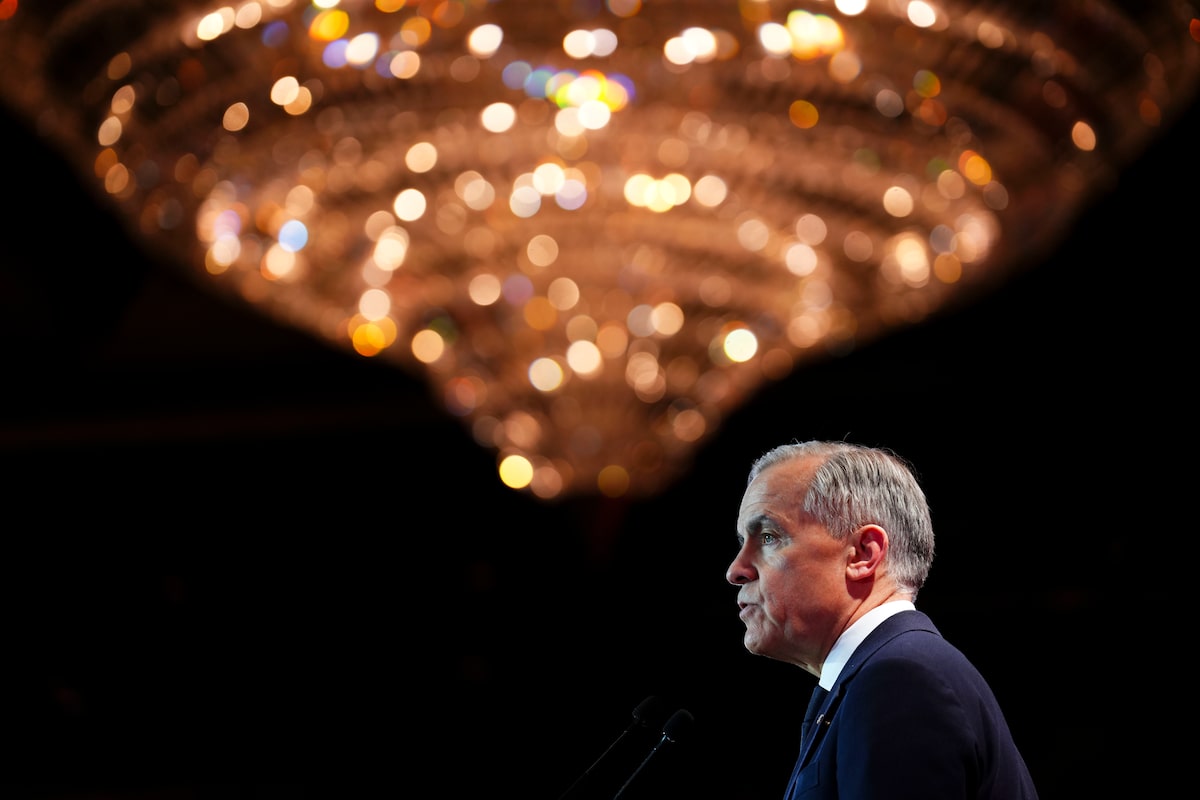
Prime Minister Mark Carney delivers remarks at dinner hosted by the Canada-China Business Council in Beijing, China on Friday.Sean Kilpatrick/The Canadian Press
Prime Minister Mark Carney’s press conference on Friday after his meeting with Chinese President Xi Jinping was chock-full of news, a strange surprise given that the PMO had been spinning everyone toward low expectations before the trip began.
The two countries had struck a deal in which Canada would dramatically lower its tariff rate on Chinese-made electric vehicles and China would slash its levies on canola seed, along with removing tariffs on certain other agriculture and food products, Mr. Carney announced in Beijing.
But it was an existential little scrap of found poetry Mr. Carney offered in response to one tricky question that encapsulates what just happened, and what seems certain to keep happening.
One reporter pointed out the perpetual concerns about human rights abuses and freedom of speech in China, and asked where those issues fit into Mr. Carney’s calculations – are these things Canada can’t afford to think about right now because we have to find new markets?
Mr. Carney deked lightly around the premise, saying that Canada “fundamentally” defends rights of all sorts, and as a result, it calibrates its engagement with other countries to work with overlapping interests and steer around issues of conflict.
“We take the world as it is, not as we wish it to be,” he said.
The world as it is, and not as we wish it to be. The year 2026 is still just a newborn thing, and yet those words feel like its epitaph and savage lesson in one.
It explains the strange, clench-jawed triumphalism of Mr. Carney’s announcement of a trade deal with a repressive behemoth of a country that’s a leading source of foreign interference in Canada. This is not 2016, when Justin Trudeau purred about exporting Canada’s many virtues to China; this is eyes-wide-open pragmatism.
What Jonathan Manthorpe, a former foreign correspondent and author of Claws of the Panda: Beijing’s Campaign of Influence and Intimidation in Canada, saw Mr. Carney outline was a limited, transactional relationship. In this arrangement, he says, Canada and China sell things to each other, cash the cheques and keep moving.
“I think we approach an expanded and restored relationship with China with much more sanity than we have in the past,” Mr. Manthorpe says.
It’s a profound shift from the history laid out in his book. Canada spent much of the 1960s, 1970s and 1980s believing – naively or smugly – that it could bring China around on nice ideas such as the rule of law and multiparty democracy.
Opinion: Quite the achievement for Mr. Carney in Beijing. Now what?
A hard reset came in 2018 with the imprisonment of the “two Michaels” in retaliation for Canada’s arrest of Huawei executive Meng Wanzhou, Mr. Manthorpe says. But it’s the overt aggression and capsizing of the postwar order of the second Trump administration that he believes will be the more lasting factor.
“We have to now deal with the world as it is,” he says. “And it’s a very, very different place from what it was 10 years ago.”
Any development Mr. Carney announced in Beijing that prompted a relieved exhale from one corner was bound to cause indignation in another. Saskatchewan Premier Scott Moe – along for the trip – was delighted by the tariff breakthrough that would rescue canola farmers in his province, while Ontario Premier Doug Ford was incensed on behalf of his own auto workers.
But as always, the reaction that would blot out the sun was that of the big orange toddler-king.
Canada first imposed its 100-per-cent EV tariffs in tandem with the U.S. in 2024 under then-president Joe Biden. But as Mr. Trump escalated into an all-out trade war with China, he made it clear that he expected allies to fall into line, or else.
Mr. Carney’s elbows-up posture long ago transformed into a delicate, strategic soft-shoe routine. But while that hasn’t paid off much for Canada in positive resolution, it was always possible for the hemispheric mob boss to break our other leg too, so the deal Mr. Carney announced with China carried real risk.
But later on Friday, the U.S. President offered up the only Trump response more classic than a tantrum: a bland non-reaction when everyone is braced for a freak-out.
Opinion: In seeking to deepen trade with China, Canada is hedging its bets
“Well, that’s okay. That’s what he should be doing. It’s a good thing for him to sign a trade deal,” Mr. Trump told reporters. “If you can get a deal with China, you should do that.”
Of course, the President also initially praised the Ontario ad that resurrected Ronald Reagan to warn about the evils of tariffs, then he thought about it a little more and went nuclear – so the next few days could prove exciting.
At one point in Beijing, a reporter asked Mr. Carney if he had concluded that China was a more reliable partner than the U.S. right now. He turned in rhetorical circles for a while like a cat deciding where to lie down, then said that he and Mr. Xi had discussed clear “guardrails” on where they could co-operate and where they differed, and that frankness helped.
“But yes, in terms of the way that our relationship has progressed in recent months with China, it is more predictable, and you see results coming from that,” Mr. Carney said.
The reporters asked all the sensible, pointy questions you’d expect about any sort of cozying up to China. What about national security threats, meddling in the affairs of other countries, free speech crackdowns, human-rights abuses, predatory economic policies?
To the immediate south of us, meanwhile, the land of the free and home of the brave is overrun by gangs of masked thugs shooting civilians, dragging people from their homes and cars, and tear-gassing children. Mr. Trump and his lackies offer their implicit blessing for all of this by insisting to any camera in their vicinity that those people got what they deserved and there’s plenty more where that came from, too.
The President has mused about deploying the military against protesters and punishing other countries if they don’t support his imperialist burglary of Greenland. And the roster of nations he’s openly threatened starts to look more like a shopping list with every day that goes by.
There are no good guys among the superpowers seeking to carve up the globe like so many pieces of pie. There are only the least-worst choices the smaller can make, hoping they don’t get swallowed whole.
This is the world as it is, no matter what we may wish it to be.