
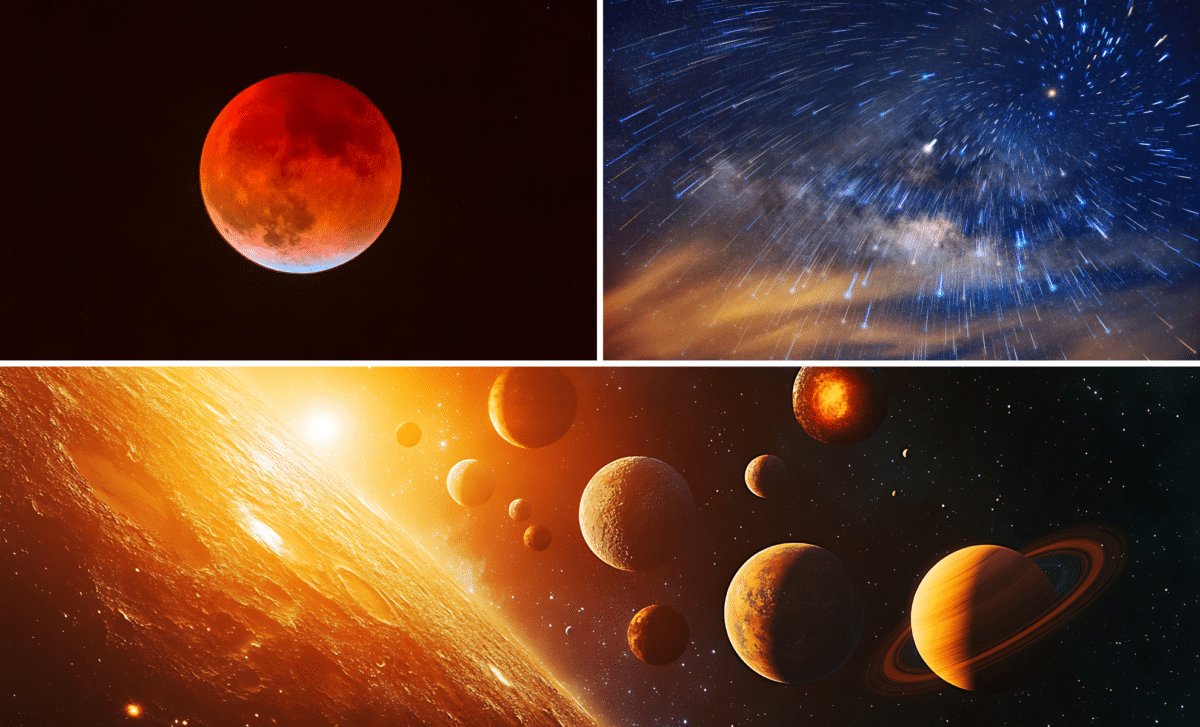
The year 2026 is shaping up to be one of the most visually thrilling for astronomy enthusiasts and casual stargazers alike. From planetary parades and total eclipses to brilliant meteor showers and supermoons, the heavens will be especially active and accessible to the naked eye. NASA’s Watch the Skies blog highlights a calendar full of rare alignments and radiant nights that will inspire both scientific curiosity and simple wonder.
February’s Planetary Parade: Six Worlds In One Sky
On February 28, stargazers will have the chance to witness one of the year’s most anticipated astronomical alignments. Mercury, Venus, Neptune, Saturn, Uranus, and Jupiter will all appear together in the evening sky shortly after sunset. For those with sharp eyes and clear weather, four of these worlds, Venus, Jupiter, Saturn, and Mercury, will be visible without telescopes. Observers equipped with binoculars or small telescopes may also catch faint glimpses of Uranus and Neptune, which remain just beyond naked-eye visibility.
Planetary alignments of this magnitude are relatively uncommon, making February’s parade a highlight for anyone interested in celestial mechanics. As the planets fan across the twilight, it’s a visual reminder of the delicate choreography that keeps our solar system in motion.
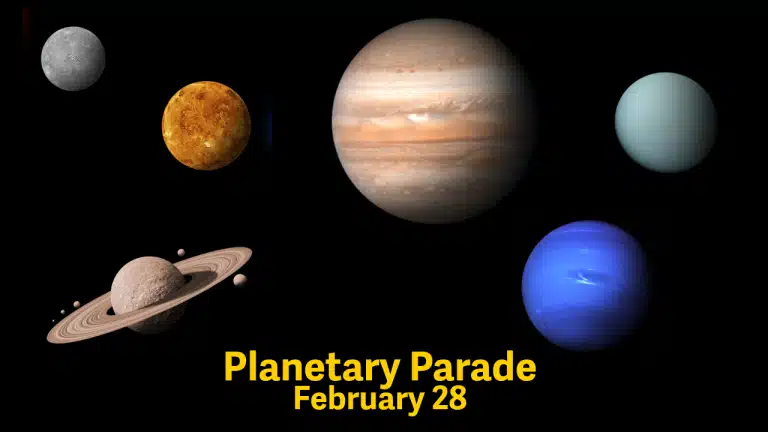 Mercury, Venus, Neptune, Saturn, Uranus, and Jupiter will appear in the sky shortly after sunset on February 28. This artist illustration features those six planets set against a black background.
NASA/Alyssa Lee
March’s Total Lunar Eclipse: A Shadow Over The West Coast
Just a few days later, on March 3, the skies will darken for a total lunar eclipse visible across North America, especially from the western regions. According to NASA, this event will unfold just before sunrise, casting the Moon in deep, coppery hues as it passes through Earth’s shadow. Lunar eclipses occur when Earth perfectly aligns between the Sun and the Moon, and each one offers scientists a chance to study how our atmosphere refracts sunlight.
For the public, it’s a chance to experience the sky’s quiet transformation, when the familiar Moon turns red and the stars grow brighter in its dimmed presence.
The Midyear Show: Blue Moon, Planetary Conjunctions, And Meteor Fireworks
Late spring and summer will bring a cascade of events that make 2026 one of the richest observational years of the decade. On May 31, a Full Blue Moon, the second full moon of the month—will grace the sky. Though its name implies color, this moon will shine its usual silvery hue, offering a rare 13th full moon for the year.
A few days later, on June 8, 9, Venus and Jupiter, the two brightest planets, will meet in a spectacular conjunction, appearing as if separated by the width of a pinky finger held at arm’s length. NASA notes that this event requires no telescopes, making it perfect for casual observers. Then, in August, the Perseids meteor shower will peak under ideal conditions, with a New Moon ensuring dark skies for an extraordinary display of shooting stars.
 This image was captured by former astronaut Scott Kelly during his year aboard the International Space Station. From bottom to top we can spot Earth’s Moon, Venus, Jupiter and the crescent of Earth.
NASA/Scott Kelly
The Grand Finale: December’s Supermoon And Geminids
As 2026 comes to a close, December will deliver two unforgettable spectacles. First, on December 13, 14, the Geminids meteor shower will streak through the sky, famous for its distinctive green-tinted meteors. Shortly after, on December 24, the year ends on a festive note with a Christmas Eve Supermoon, a full moon appearing larger and brighter because it occurs near its closest point to Earth.
NASA’s observatories will be tracking these events throughout the year, contributing valuable data for understanding the dynamics of Earth’s immediate cosmic neighborhood. For everyone else, it’s an invitation to look up and reconnect with the vastness that surrounds us.