
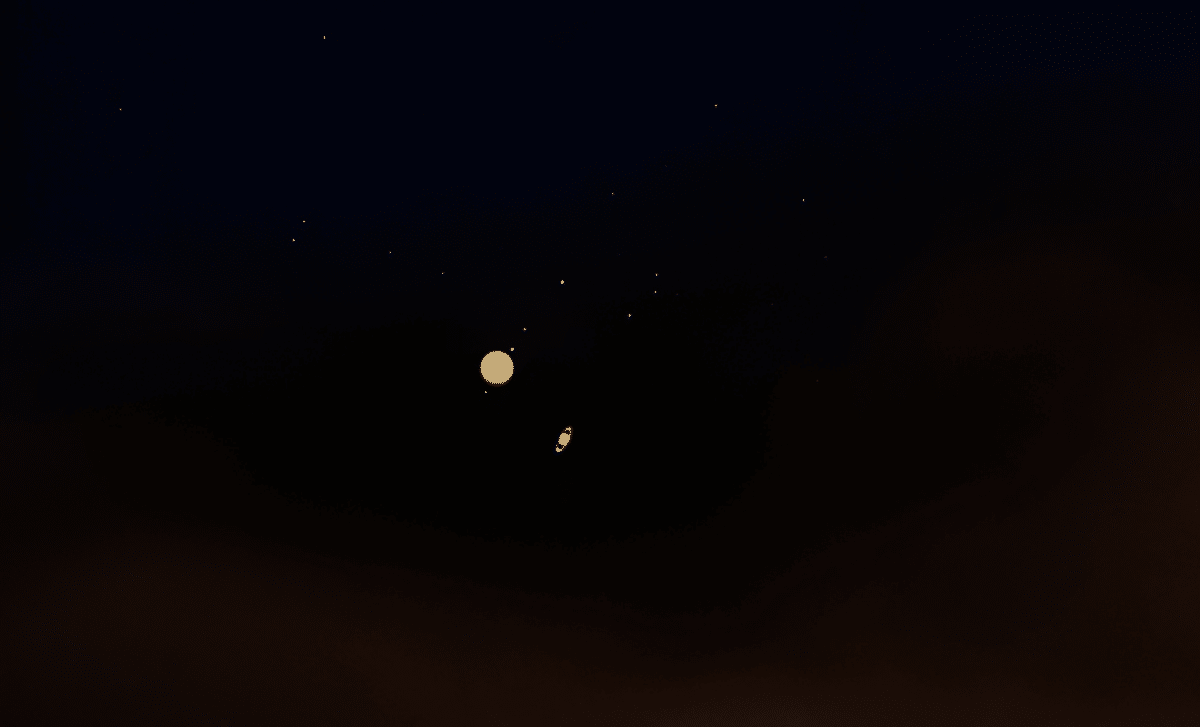
The new moon on January 18, 2026, will bring one of the darkest and clearest nights of the year, giving skywatchers an ideal opportunity to spot Jupiter, Saturn, and the brilliant winter constellations. As reported by Space.com, the absence of moonlight will make this night particularly favorable for both amateur and experienced astronomers to observe deep-sky objects, star clusters, and the glowing arms of our galaxy.
A Moonless Night For Planet Hunters
With the moon aligning perfectly with the sun in celestial longitude at 2:52 p.m. EST, the skies will darken more than usual, unveiling the true beauty of the cosmos. On this night, Jupiter and Saturn will dominate the sky from opposite horizons. Saturn will shine low in the southwestern sky just after sunset, while Jupiter, brighter and steadier, will rise in the east around the same time. The gas giant will remain visible almost all night, reaching its highest point around 11:23 p.m. EST, before setting near dawn.
Observers across North America, from New York to Denver, will enjoy similar views, though times vary slightly with longitude. In contrast, for stargazers in the Southern Hemisphere, such as in Santiago, Chile, longer daylight hours of the austral summer will delay visibility until later in the evening. By 10 p.m. local time, Jupiter will rise in the northeast, glowing against the backdrop of the southern constellations.
This night sky forecast, detailed by Space.com, provides precise coordinates and timing to help enthusiasts plan their celestial observations under one of the darkest skies of 2026.
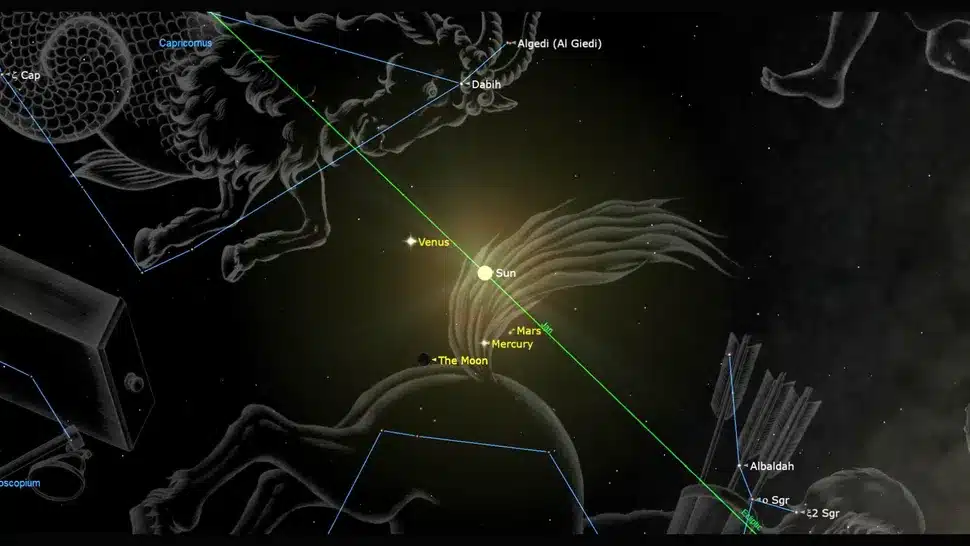 The new moon on Jan. 18 provides the perfect dark skies for deep sky observations. (Image credit: Starry Night/Chris Vaughan)
Winter Constellations Take Center Stage
The absence of moonlight also allows the winter constellations to stand out vividly. By early evening, Orion the Hunter, Gemini, Taurus, Canis Major, and Auriga dominate the sky, each holding a story in starlight. The bright star Sirius, part of Canis Major, gleams low in the southeast as the most luminous star in the night sky.
Above Orion’s famous three-star belt, the fiery-orange Betelgeuse and icy-blue Rigel mark the hunter’s shoulders and foot. A little lower, near Orion’s sword, the Orion Nebula, a cradle of young stars, glows faintly, visible to the naked eye from rural areas. High above, Aldebaran, the red eye of Taurus, and the delicate Pleiades cluster offer a rich tableau of stellar color.
For Northern Hemisphere observers, these constellations provide a window into our galaxy’s winter showcase. Meanwhile, Southern Hemisphere viewers can trace constellations like Carina, Vela, and Puppis, remnants of the mythic ship Argo, as well as the striking Southern Cross, or Crux, which never sets below the horizon from latitudes near Santiago.
Deep Sky Wonders Revealed
The new moon’s dark sky doesn’t just enhance planetary visibility. It opens the door to deep sky observation. Away from city lights, stargazers can spot faint nebulas, open clusters, and the Milky Way’s dust lanes with remarkable clarity. Using even modest binoculars, observers can pick out details in the Pleiades, trace the Hyades cluster, and spot the Orion Nebula’s glowing gas clouds.
Such conditions are rare and fleeting. With Mercury, Venus, and Mars too close to the Sun this month, the focus shifts entirely to Jupiter, Saturn, and the constellations that frame them. For beginners, this is the ideal time to learn how to navigate the night sky by connecting bright stars and planets into recognizable patterns before the moon’s return washes out the view.
A Global Skywatching Moment
Whether standing beneath the icy skies of New York or the warm, starry night of Santiago, the January 18 new moon creates a shared celestial experience across hemispheres. The contrast between northern winter and southern summer adds a poetic symmetry, as both hemispheres look up to see the same giants Jupiter and Saturn shining over different landscapes.
For those with telescopes, the night offers even more rewards. Saturn’s rings, though faint, remain visible, while Jupiter’s four Galilean moons dance in formation around their parent planet. Astrophotographers will find near-perfect conditions for long exposures, capturing the deep blues and whites of the Milky Way stretching across the darkness.