
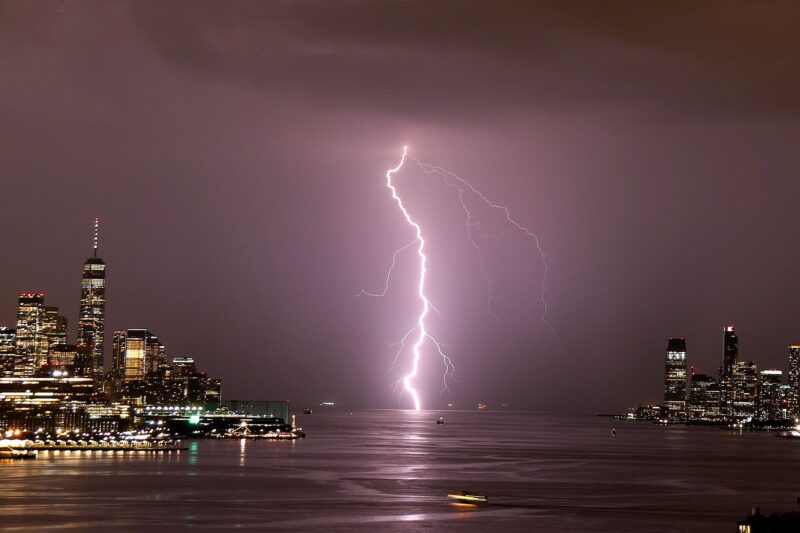
 View at EarthSky Community Photos. | Alexander Krivenyshev of WorldTimeZone.com captured this cloud-to-ground lightning between skyscrapers on July 14, 2023. Alexander wrote: “Lightning bolt strikes the Hudson River between lower Manhattan and Jersey City.” Thank you, Alexander! There are many lightning forms we can see. Read on to find out what they are.
Lightning comes in many forms, from cloud-to-cloud flashes to rare events such as sprites and blue jets.
Extreme conditions can spark lightning, too. This includes lightning due to volcanoes, nuclear bombs and towering clouds created by wildfires.
Climate change may affect lightning activity. Warmer air holds more water vapor, which can bring more storms and therefore more lightning.
By Andrew Dowdy, The University of Melbourne; Jennifer Catto, University of Exeter, and Robyn Schofield, The University of Melbourne
Lightning forms capture our collective imagination
Lightning has captured people’s fascination for millennia. It’s embedded in mythology, religion and popular culture. Think of Thor in Norse mythology or Indra in Hinduism. In Australia, lightning is also associated with important creation ancestors such as shown in First Nations rock art. There are many different types of lightning … and many ways in which it influences our society and environment.
What exactly is lightning?
Lightning occurs due to a buildup of electric charge in clouds. This is similar to when you brush your hair or jump on a trampoline making your hair stand up on end, but to a much more extreme level.
This buildup in clouds happens due to different types of frozen and liquid water bumping into each other in the updrafts and downdrafts that occur due to convection. That is, from hotter air rising and colder air falling. The buildup of electric charge can become so extreme that electricity flows through the air. This is what we see as lightning.
We see the flash of the lightning almost as soon as it happens, but the sound of thunder comes later.
Sound takes about three seconds to travel one kilometer (or five seconds to travel one mile). Counting the time between the flash and the thunder can tell you the distance to the lightning. Just count the number of seconds and divide by three to find the distance in kilometers (or divide by five to find miles).
Earth also isn’t the only place where lightning exists. Scientists have also recently detected it on Mars for the first time.
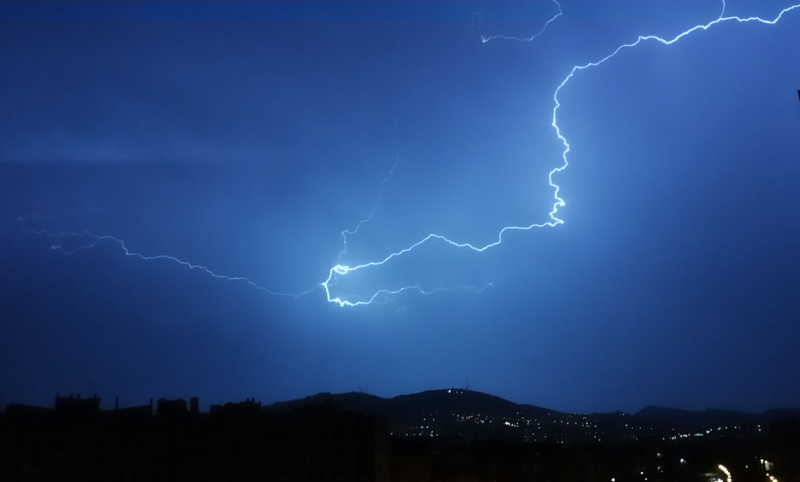 View at EarthSky Community Photos. | EarthSky’s own Cristina Ortiz López captured this intra-cloud (or cloud-to-cloud) lightning in Granada, Spain, on June 19, 2023. Thank you, Cristina!
The main types of lightning
There are two main types of lightning found on Earth:
Intra-cloud (or cloud-to-cloud) lightning goes from one part of a cloud to another part of a cloud, without ever reaching the ground. It might look like a cloud momentarily glows, often with the whole cloud appearing illuminated, sometimes without seeing the actual thin path the lightning takes. It occurs when the build-up of electric charge is different between different parts of a cloud, and is common because the lightning typically doesn’t have to travel far.
Cloud-to-ground lightning can occur when the buildup of electric charge becomes different between a part of the cloud and the ground. This is perhaps the most famous type of lightning. While impressive to witness, cloud-to-ground lightning is a real risk for human safety, causing many recorded deaths each year.
The rare types of lightning
There are also some other rarer, even more spectacular types of lightning:
Pyrogenic lightning can occur alongside extreme wildfires. These fires can sometimes generate lightning in their smoke plumes, known as pyrocumulonimbus clouds. This lightning can then ignite new fires far away, as occurred on Black Saturday near Melbourne in 2009. Similarly, lightning can also sometimes occur in other hot plumes such as from volcanic eruptions or nuclear bombs.
Upper atmospheric light phenomena related to lightning, also known as transient luminous events include sprites, blue jets, ELVEs and PIXIES. Science is still trying to understand details on why these have different characteristic shapes and colors. For example, sprites look like glowing red jellyfish, while blue jets are giant sapphire beams that shoot upwards into the sky. ELVEs look like glowing red halos while PIXIES are flashes of electric blue light atop a thunderstorm.
Ball lightning is something many people have claimed to see over the years. But similar to claims of other strange things – such as the Loch Ness Monster or aliens – it is yet to be scientifically verified. For example, there might be various other explanations for floating balls of light that people see, such as proposed for the Min Min lights in outback New South Wales potentially due to distant car headlights.
Lightning in a warming world
The thunderstorms that cause lightning are often seen as tall billowing clouds known as cumulonimbus. They look like giant cauliflowers floating in the sky, with an anvil shape at their top in mature thunderstorms.
Our recent study on thunderstorms and other weather systems suggests trends since the 1970s toward fewer thunderstorms in northern Australia and more near the southeast. There are still considerable uncertainties around how climate change influences thunderstorms and lightning.
In general, we know warmer air can hold more water vapor, which might help fuel more intense convective storms and lightning.
If more lightning occurs in a warmer world, the increase could in turn create more warming. That’s because lightning splits nitrogen and oxygen molecules in the atmosphere to produce ozone, which has a warming effect on the atmosphere. Ozone also contributes to air pollution, as it is a respiratory irritant.
However, lightning is far from the main cause of global warming, and more research is needed on these potential feedback processes to understand how important lightning could be in a warming climate.
So next time you are watching the spectacular light show during a storm, you might like to consider the various forms that lightning can take. It is one of the marvels of the world we live in, as well as of other worlds, to be enjoyed … from a safe distance.
Andrew Dowdy, The University of Melbourne; Jennifer Catto, University of Exeter, and Robyn Schofield, The University of Melbourne
This article is republished from The Conversation under a Creative Commons license. Read the original article.
Bottom line: Beyond bolts, there are many lightning forms that you might see, including red sprites, blue jets and more. Read about them here.
Read more: Rare timelapse of red sprites and the southern Milky Way
EarthSky Voices
View Articles
About the Author:
Members of the EarthSky community – including scientists, as well as science and nature writers from across the globe – weigh in on what’s important to them.