
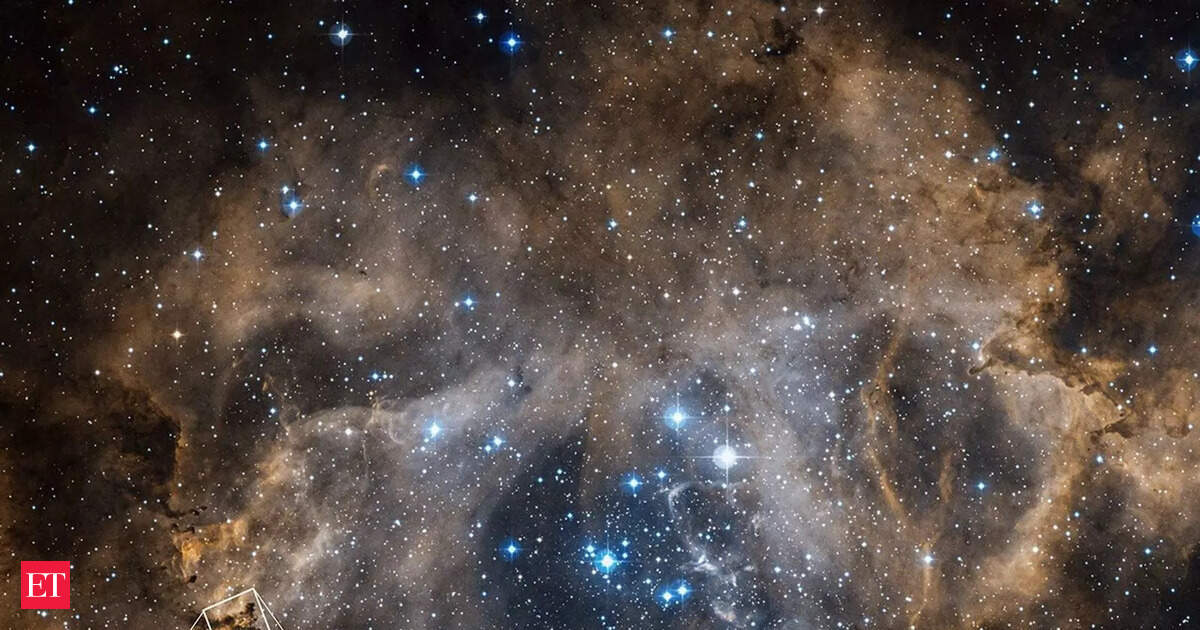
Winter is shaping up to be the ideal season for stargazers hoping to catch a glimpse of one of the night sky’s most striking sights: the Rosette Nebula. Located about 5,000 light-years from Earth, the Rosette Nebula is a vast star-forming region best known for its intricate structure and vibrant appearance, earning it the alternate name the Skull Nebula.
Oregonlive and Astrobackyard note that winter offers the best viewing conditions because the nebula’s home constellation, Monoceros (the Unicorn), is positioned high in the night sky during this time of year. To properly view the Rosette Nebula, stargazers typically need binoculars or a telescope, along with dark, clear skies.
How to find the Rosette Nebula
The Rosette Nebula is considered relatively easy to locate because it lies between two prominent first-magnitude stars. It appears just south of the imaginary line connecting Betelgeuse in Orion and Procyon in Canis Minor. Betelgeuse, identified as Orion’s right shoulder (from Earth’s perspective), forms part of the well-known Winter Triangle, along with Procyon and Sirius. According to amateur astronomers, the nebula lies just to the right of the line between Betelgeuse and Procyon.
 Live EventsOn especially clear nights, the Rosette Nebula can be found within a faint triangle of stars outlining the head of the Unicorn constellation. As noted by constellation-guide.com, these stars include Epsilon Monocerotis, 18 Monocerotis, and 13 Monocerotis, all luminous but distant stars that are difficult to spot from light-polluted areas. Monoceros itself is a faint constellation, though parts of it lie within the Winter Triangle, making it easier to identify under dark skies.
Inside the Rosette star-forming region
The Rosette Nebula is a vast star-forming region spanning roughly 100 light-years and located at one end of a giant molecular cloud in the constellation Monoceros. Scientists estimate the nebula contains around 10,000 times the mass of the Sun, as per NASA.Scientific observations have revealed the Rosette Nebula to be an active and complex stellar nursery. A composite image from NASA’s Chandra X-ray Observatory, combined with optical data from the Digitized Sky Survey and Kitt Peak National Observatory, shows hundreds of young stars clustered at the nebula’s center, along with additional satellite clusters.
A recent Chandra study focusing on the cluster known as NGC 2237 significantly expanded the known population of young stars in that region—from just 36 to about 160. According to NASA, the detection of X-ray–emitting stars and stellar outflows suggests that star formation is still ongoing. Scientists conclude that the central cluster formed first, with its expansion triggering the birth of neighboring clusters over time.
Add  as a Reliable and Trusted News Source