
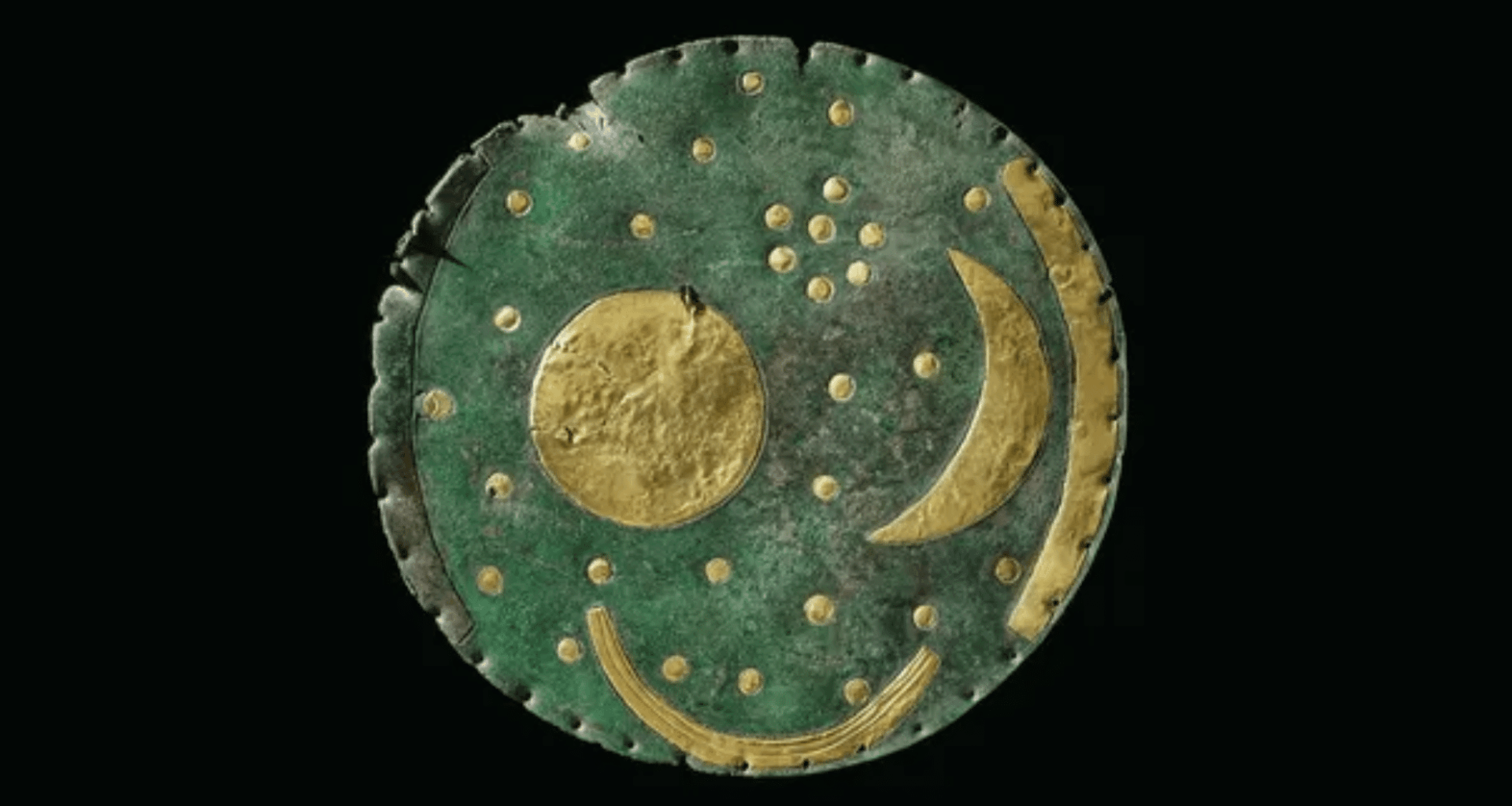
The Nebra Sky Disc, a 3,800-year-old bronze artifact discovered in Germany, continues to astonish archaeologists and astronomers alike. Believed to be the oldest known depiction of the cosmos, it offers a breathtaking glimpse into prehistoric stargazing and ancient spiritual life. Unearthed in 1999 and later studied by experts at the State Museum of Prehistory in Halle, this extraordinary artifact may represent the Pleiades star cluster and evidence of early astronomical observation in Europe.
A Timeless Discovery On Mittelberg Hill
The story of the Nebra Sky Disc began in 1999, when treasure hunters illegally excavated it near the town of Nebra, in Saxony-Anhalt, Germany. Hidden for millennia alongside swords, axes, and bracelets, the disc was soon recovered by the police and handed to archaeologists. Carbon dating and artifact analysis suggest the disc dates between 1800 and 1600 B.C., during the Early Bronze Age.
Made of bronze and inlaid with gold, the disc depicts a crescent moon, a full moon or sun, and 32 stars, seven of which form a pattern resembling the Pleiades. Scholars interpret these elements as a prehistoric celestial map, a guide to the night sky, and possibly a ritual calendar for tracking the solstices. The delicate craftsmanship and cosmic symbolism reveal the sophistication of ancient European cultures long before written astronomy emerged.
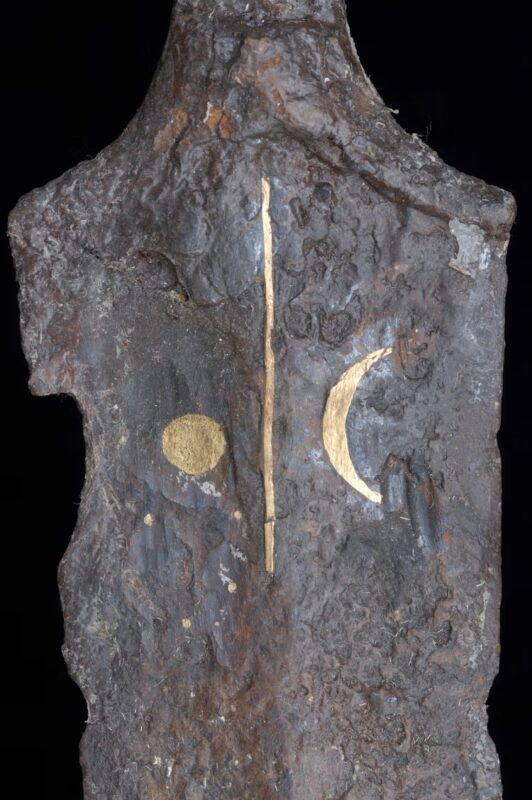 Early Celtic iron sword from the 5th century BC from Munich-Allach with inlaid gold sheets representing the crescent moon, full moon and five stars
Photo: State Archaeological Collection Munich, Manfred Eberlein
The Evolution Of A Cosmic Artifact
Today, the State Museum of Prehistory in Halle safeguards the Nebra Sky Disc, placing it among the most significant archaeological treasures in human history. Researchers at the museum have conducted meticulous studies to determine the object’s authenticity, origin, and purpose. Their findings reveal that the disc was constructed in multiple phases, each modifying its celestial symbolism.
Initially, it featured the moon and stars; later, gold arcs were added, believed to represent horizons marking the summer and winter solstices. A subsequent phase introduced a third golden arc at the bottom, interpreted by some as a solar boat, a mythological vessel that carried the sun across the sky. The final stage saw holes added around the rim, perhaps for mounting the disc during ritual ceremonies.
The museum’s research also challenges earlier doubts about its provenance. While some scientists questioned whether it truly originated near Nebra, geochemical analysis confirmed that the metals matched those found in the local region. This evidence solidified the disc’s authenticity and its deep connection to ancient central Europe’s spiritual landscape.
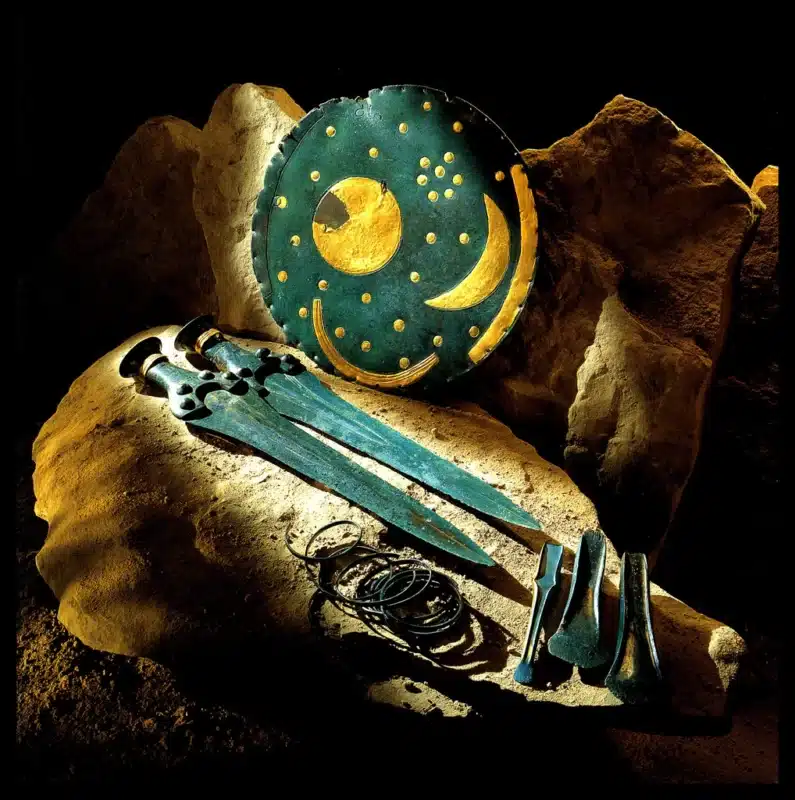 Credit: State Museum for Prehistory in Halle, Germany.
The Celestial Code Of The Bronze Age
The alignment of the Nebra Sky Disc with Mittelberg Hill and the nearby Brocken Mountain suggests it had an astronomical function. When oriented correctly, the golden arcs align with the sunset positions at the summer and winter solstices. This indicates that Bronze Age people used it to track seasonal changes, essential for agriculture, ritual, and survival.
The inclusion of the Pleiades is particularly revealing. In many ancient cultures, from Mesopotamia to the Americas, the rising and setting of these stars signaled important agricultural events, such as the time for sowing or harvesting. The Nebra Sky Disc therefore bridges mythology, science, and spirituality, embodying how early societies read the heavens to shape their earthly lives.
This cosmic tool was likely a symbol of power and knowledge, perhaps owned by a chieftain or priest, whose understanding of the sky reinforced their authority. The craftsmanship and the use of precious metals further suggest it was not a mere decorative piece but a sacred instrument connecting people to the divine.