
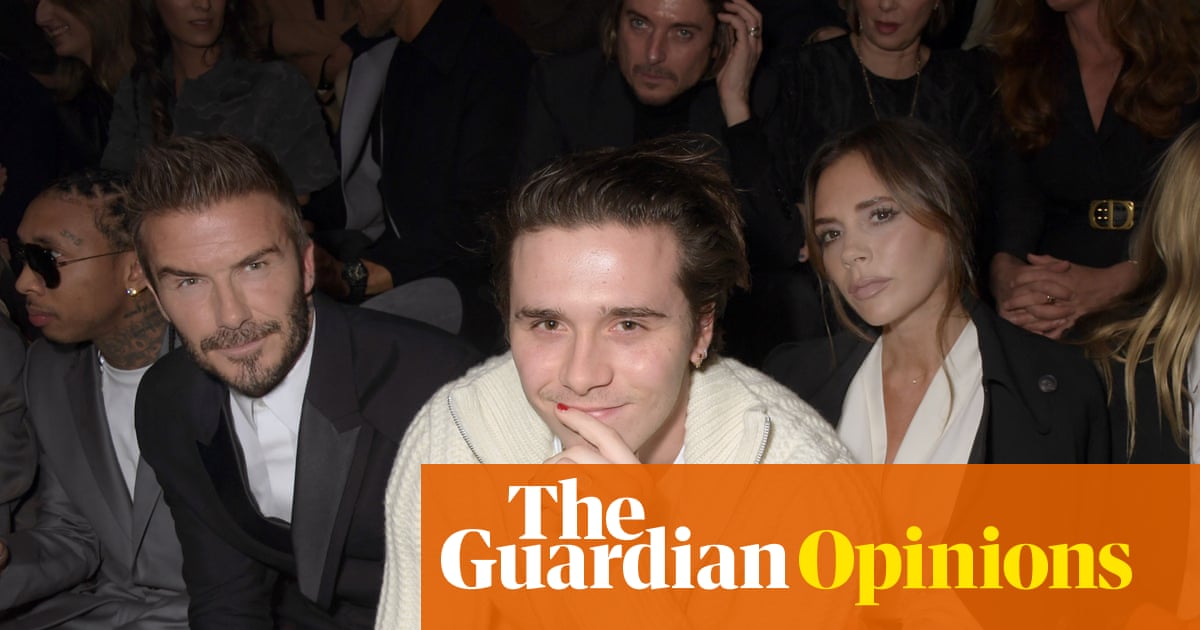
The way 2026 has started, none of us wants to see the word “nuclear” in a headline, so on some level you have to feel glad that last night’s news alerts announcing in real time that someone “goes nuclear” and “launches nuclear attack” related to Brooklyn Peltz Beckham. At time of writing, the story about his Instagram broadside against his parents, David and Victoria Beckham, accusing them of treating him as a commercial prop all his life was by far, far and away the best read on the Guardian site, as well as the most deeply read. Again, I’m glad this blow-up wasn’t used as geopolitical cover, because if there was a time for Trump to invade Greenland largely unnoticed, maybe this was it.
Whoever wrote Brooklyn’s intercontinental ballistic Instagram – and it wasn’t the childlike authorial voice behind regular “I always choose you baby … me and you forever baby” posts to his wife – the sentiments will be his. Here’s a sample: “My family values public promotion and endorsements above all else. Brand Beckham comes first. Family ‘love’ is decided by how much you post on social media, or how quickly you drop everything to show up and pose for a family photo opp …”
Wow: elephants. Brooklyn Beckham can’t photograph them but he sure can address them when they’re in the room. If you watched Victoria Beckham’s lavishly produced Netflix documentary last October, you might have wondered why it didn’t even glance on the biggest elephant in Brand Beckham’s room: the clear and agonising no-contact rift with their eldest son that has been festering since last year and beyond. But most big documentaries these days aren’t documentaries any more in the way previous practitioners of the craft might have understood the word. As her husband’s was before it, Victoria’s doc was a self-commissioned advertorial on which the subject also served as executive producer. This is the haute version of the curated, public-facing existence that defines our dysfunctional age, but it trickles all the way down via fourth-tier influencers and that friend of yours who can’t stop posting about her perfect life. The Beckhams, at the vanguard of celebrity culture ever since both it and they exploded in the late 90s, are a part of how we all got here.
Before I go on, I should say I find this family rift desperately sad. I can’t imagine the agony of being cut off by a child, and hope I never have to. All parents make mistakes, and all children do too. I believe the Beckhams truly and deeply love their children – but, to adapt Logan Roy, they have made it hard for them to be serious people.
Brooklyn Beckham has been commodified since he was a foetus. The story of Victoria’s pregnancy was sold by his parents. When he was born, David and Victoria sold the first pictures of him. They sold intimate looks around their home and his nursery. They sold their wedding, staying up till 3am on the night of that big day, deciding which pictures would be featured in OK! magazine. They sold everything – mostly, back then, to OK!. Its proprietor, Richard Desmond, wrote in his autobiography about spending what felt like every Friday at Victoria’s parents’ house with the young couple, where they would all “plot and plan the next features we’d do”. A huge cheque was always involved, and the Beckhams wanted the limelight – all of it – so much.
But as time went on, David and Victoria acquired more sophisticated advisers who understood the rapidly morphing potential of controlling image and brand, and built a vast and diversified empire for them off the back of it. When social media came along, the Beckhams channelled their business through its pipes. As I’ve written here before, they were past masters at not simply turning to their children and telling them they loved them, but photographing them, tagging them and sending the message of love via social media. Alchemically lucrative – but an accident waiting to happen?
I honestly think the Beckhams are now so lost to this commercialised version of family life that they probably long ago lost the ability to comprehend how weird and potentially corrosive it is. I keep thinking of the line in Goodfellas where the mafia wife Karen says: “And after a while it got to be all normal.” And maybe there is something rather “family” with a capital F about the Beckham mob. The trouble is, with families not being meritocracies, every now and then the gene pool is going to throw up a Fredo Corleone or a Christopher Moltisanti who just isn’t suited to the weird life, and can only play out as a liability. Again, as covered here before, it has happened a couple of times with that other deeply strange family business, the Windsors.
The Windsors, of course, don’t have a choice. The Beckhams’ wealth is estimated at about half a billion. That is more money than even they could ever spend, and the only truly credible explanation for why they continue to live their life so remorselessly out loud is because they still crave the attention. And, realistically, because they have forgotten how else to live.
They are the unicorns of this lifestyle, but not exactly alone. Some of us have always been Instagram and Facebook refuseniks, and never publicly posted pictures of our lives or families or any of it. But it’s not the norm, and billions of people have entirely forgivably got sucked into a world where they are the product, where they work for free for the tech lords, who successfully devalued the idea of privacy at the altar of their big lie: that “being connected” via their networks is far more important than privacy; that it is a win for humanity; that it is social. But it isn’t. Societies are in a mess. Literacy’s in a mess. Young people’s mental health is in a mess. The world’s in far more of a mess than it was when the techlords found it.
I see Keir Starmer’s thinking about banning social media for under-16s, so maybe someone could stick an amendment on any bill, banning parents from plastering their kids all over it from the moment they’re born. Maybe they can’t meaningfully consent to working in Mark Zuckerberg’s content mines any more than celebrity kids can meaningfully consent to being monetised by their parents. Or maybe all those ships have sailed.
As for what David and Victoria Beckham will do, David was pictured at Davos this morning. Encouraging times. But clearly they will also be locked in crisis talks, and my bet is that they’ll issue a statement saying how much they love Brooklyn and always will, and something like how there will always be a place waiting for him at their family table. And I truly believe all that. As someone behind the scenes will say as the team approves it, it’s authentic. But even that word has been corrupted, hasn’t it? It has come to suggest a monetisable easy charm, an ability to make staged commercial situations seem appealing, an instinctive capability of embodying a brand or a lifestyle. We live in an age of dangerous slippage, from private to public, from living to trading, from the idea of ourselves as agents of free will to unpaid and unwitting products. Not to interrupt his brief main character moment – but Brooklyn Beckham’s the least of it.
Marina Hyde is a Guardian columnist
Do you have an opinion on the issues raised in this article? If you would like to submit a response of up to 300 words by email to be considered for publication in our letters section, please click here.