
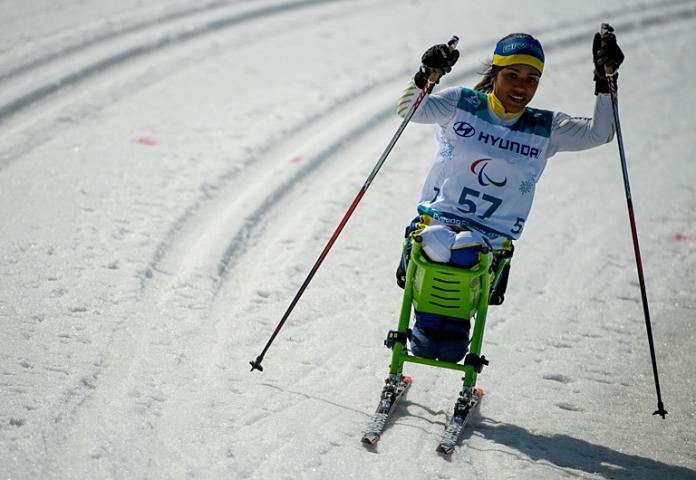
When Aline Rocha first saw snow, she was already a Paralympian – just not in a winter sport.
The Brazilian wheelchair racer had made her Games debut at Rio 2016, finishing ninth in the women’s 1500m T54 and 10th in the women’s marathon T54. Before the year was over, she found herself far from the tropical heat, gliding over white, frozen landscapes for the first time.
“After the Games, I got in touch with the Brazilian Ski and Snowboard Confederation and showed my interest in skiing, and they quickly arranged for me to go and experience snow,” said Rocha, who is also now a Para biathlon and a Para cross-country athlete.
“I trained on a roller ski for 15 days, to get to know the equipment and the sport a little, and in December 2016 I went to Sweden to feel snow for the first time. I spent 15 days at a training camp there, and it was an incredible experience.”
Discovering snow
Racing on a completely new surface was far from easy for the Paralympian from the state of Parana in southern Brazil.
“In the first training sessions it was hard just to keep the balance on the skis – I fell the whole time – but it was very cool to experience snow for the first time.”
A month later, in January 2017, she was already racing in her first skiing competition, at an IPC Nordic Skiing World Cup event in Western Center, Ukraine.
“I had very little time to prepare,” said Rocha, whose best result was a 10th place in the women’s interval start sitting free, where she finished almost 14 minutes after the winner.
“And since the (PyeongChang 2018) Paralympic Games was just one year away, I had very little time to compete and earn a women’s spot for Brazil in the women’s competition so that I could take part.”
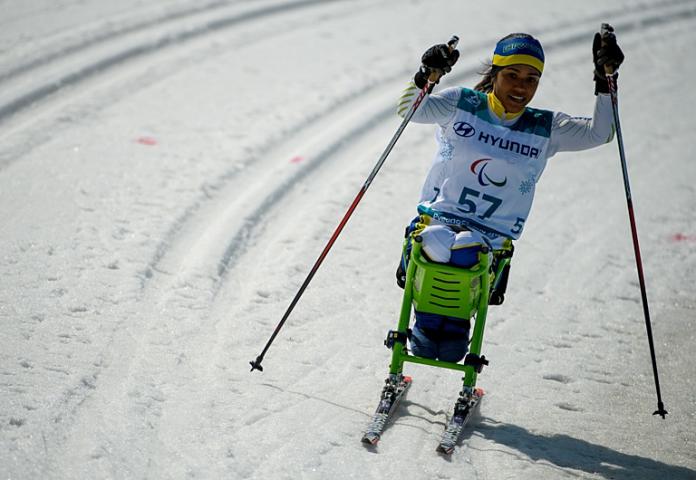
Rocha competed in four events at PyeongChang 2018, her first Paralympic Winter Games appearance. @Thomas Lovelock/OIS
She made history at PyeongChang 2018, becoming the first female athlete from Brazil to compete a Paralympic Winter Games. And she has continued to make progress ever since.
Back in Sweden for the 2023 World Para Nordic Skiing Championships in Oestersund, Rocha claimed the gold medal in the women’s sprint sitting free race, becoming Brazil’s first Nordic skiing world champion.
Skiing to history
The 34-year-old athlete is preparing to compete in Para cross-country and Para biathlon events at Milano Cortina 2026, hoping to break new historic ground.
“My biggest dream and goal is to win my first Paralympic medal,” she said. “I’ve been dedicated exclusively to sports for 15 years and to skiing for nine years.
“I love training and love the sport. Winning a medal would be the realisation of a dream and proof that everything is possible when you do something with love and dedication.
“I’m on the right path in training and I still have a lot of work ahead.”
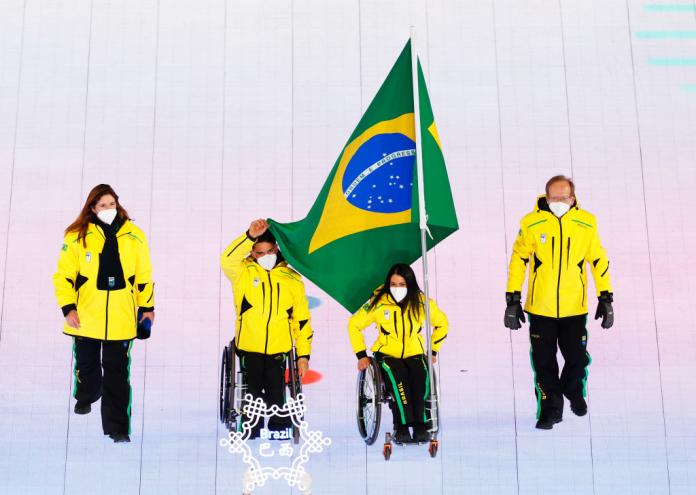
Rocha was Brazil’s flagbearer at the Beijing 2022 Paralympic Winter Games. @Steph Chambers/Getty Images
A day in a life of a Paralympian
The challenges of being a winter athlete from Brazil demands a lot of creativity. While most competitors from the northern hemisphere train on snow all year around, Rocha spends much of the year in the heat, perfecting her technique on a “caverboard” – a type of skateboard she uses to mimic the motions of skiing.
In the last year before the Paralympic Winter Games, her full focus is on skiing, with her days usually starting at 7:00.
“After breakfast, I go for my first training session, which is usually on the caverboard on a dirt road,” she said.
Rocha returns home for lunch and rest until 15:00, when it is time for the second training session of the day.
“It can be roller skiing on asphalt, biathlon training on asphalt, or gym training,” she said. ”Then I go home for dinner and sleep.”
In intense training periods, recovery is crucial.
“I am a very homely person, so when I’m not training or competing I prefer to be at home resting, to be as well prepared as possible for the training,” Rocha said.
“So I sleep for an hour to half an hour after lunch, between the first and second training, and at night I tend to go to sleep quite early too. When the training is very exhaustive, I go to bed between 21:00 and 21:30.”
As a Brazilian in winter sports, the lack of snow is a big hurdle that the 2023 world champion has learned to master and her training locations vary a lot.
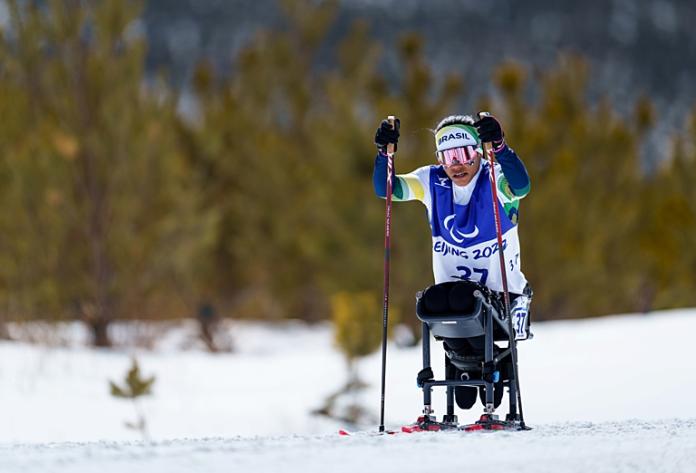
Rocha is aiming to claim Brazil’s first Paralympic Winter Games medal at Milano Cortina 2026. @Thomas Lovelock/OIS
Journey to Milano Cortina 2026
In August, Rocha spent a month training in Ushuaia, Argentina, and in October, she went on a 10-day biathlon camp in a snow tunnel in Oberhof, Germany.
Having trained most of the years on the road, in Paralympic seasons, she spends more time on snow. In December, she returned to Oberhof for her final pre-Paralympic preparations.
“We can prepare very well with roller skiing and caverboard training. The biggest challenge is training the more specific parts on snow – especially learning how to make turns,” Rocha said. ”From the end of December, I will be permanently based on snow until after the Games. It’s essential to have a snow training period before competitions.”
A team effort
Although occasionally joining national team camps organised by the Brazilian Ski and Snowboard Confederation, Rocha is mainly training by herself. She already has her training staff in-house, as her husband Fernando Orso is also her coach. That dynamic took time to balance but is now forming a strong partnership, on and off the snowy courses.
“We both learned to ski at the same time, in 2016,” Rocha said.
“In the first years, it was difficult to separate the coach/athlete and husband/wife roles, but over time, and with help from our sports psychologist, it got easier. Now we are a great team.”
At PyeongChang 2018, her best result was a 12th place in the women’s Para cross-country 5km sitting event. Four years later, in Beijing, China, she made it into the top-10 in all events, making it to seventh place in the women’s long distance sitting event.
“In PyeongChang, I didn’t have much experience in skiing, and I was just happy to take part. In Beijing, I was more experienced and aimed for a top-10 finish, but I still struggled with the snow conditions during the competition,” Rocha said.
“Now I feel much more prepared, with experience of all types of snow and temperatures. Our team has a lot of equipment and an excellent support staff to help us achieve the best results.”
Mastering the snow
During nine years in skiing, she has gone from never seeing snow to an expert on the cold white surface.
“In Finland and Sweden, it is for example very cold and you can have -20 degrees, which makes the snow more frozen and harder. In Argentina, it is getting warm already in August and there we ski on snow that is quite melted, which is a bit like I expect it to be at the Games in Italy,” she said.
“The competitions there will take place in a time of the year when it will be less natural and more artificial snow, and the snow will be a bit more slushy. I participated in the test event in Italy and already got a feel for that snow condition.”
From the sun to the slopes
At Paris 2024, Rocha reached top-10 finishes in the women’s 1500m T54 and the women’s marathon T54, a strong testament to her training regime. She sees plenty of benefits from combining summer and winter sports.
“I believe the two sports complement each other,” Rocha said. “The strength I gain from skiing helps in wheelchair racing, and the endurance I build in marathons helps in skiing. I missed Tokyo 2020, so participating in Paris 2024 was very special.”
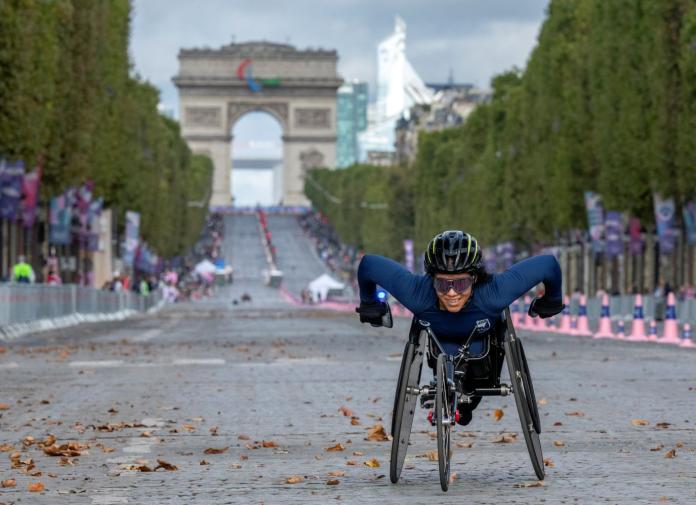
Rocha competed in wheelchair racing at Rio 2016 and Paris 2024. @Bob Martin/OIS
Her nutrition is carefully tailored to match the type of training and proximity to competitions. Each meal is calculated for performance, recovery and energy.
”When I train with a lot of heavy muscle work, I increase the share of protein. And if it is closer to competition, when I increase my endurance training, I need to gather more energy for the races and increase the carbohydrates,” Rocha said.
“So this varies a lot, depending on my training.”
That also means avoiding some dishes until after Milano Cortina 2026, when she will be able to enjoy her favourite food with family and friends again, hopefully with a maiden Paralympic medal to celebrate.
And she already knows how she wants to celebrate.
“I am avoiding eating fat or fried food, and something that I really like to eat is Brazilian barbecue meat. But since I live and train in Sao Paulo, I can’t really have the kind of southern-Brazilian barbecues that I like,” she said.
“So after the Games, the aim is to spend some time in the state of Santa Catarina, near my family, and have a barbecue that is very typical for the south of Brazil.”
Secure your tickets for the Milano Cortina 2026 Paralympic Winter Games
Milano Cortina 2026, which takes place from 6-15 March 2026, is set to be the most beautiful Paralympic Winter Games yet. Ticket prices start at EUR 10 for children under 14, with approximately 89 per cent of the tickets available for EUR 35 or less.
For more information, please visit tickets.milanocortina2026.org