
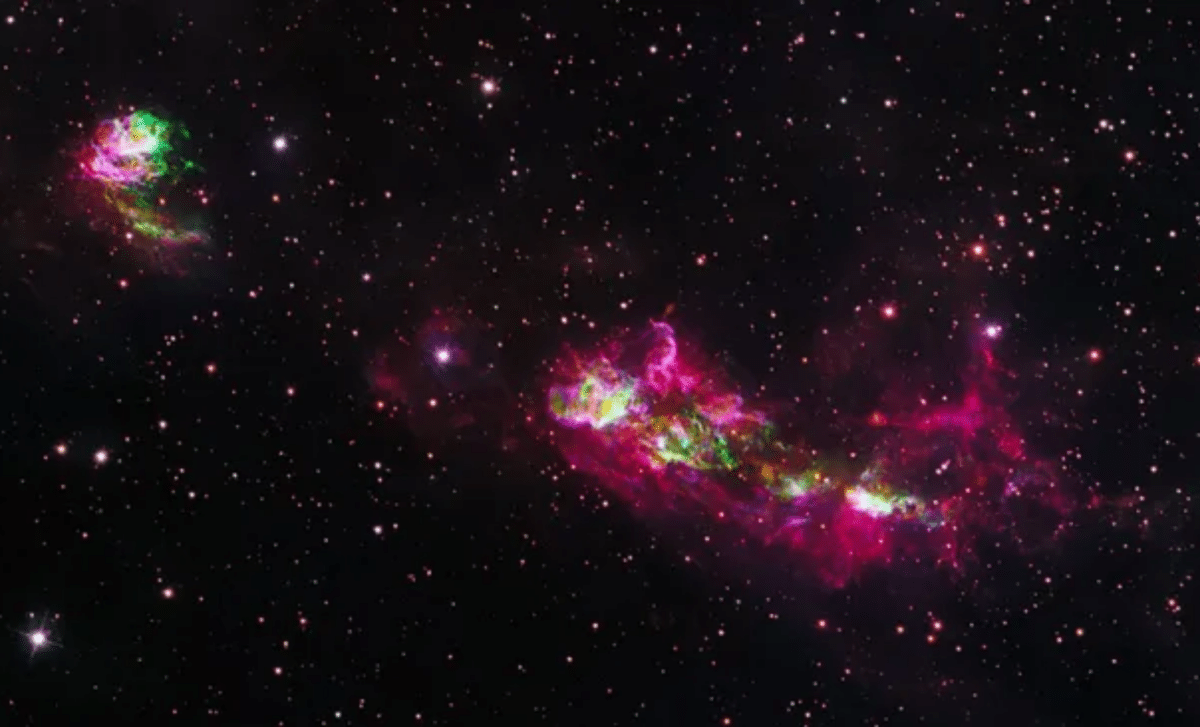
the Hubble Space Telescope has observed an infant star unleashing a jet of superheated gas stretching an incredible 32 light-years across space. This discovery sheds light on the turbulent early lives of massive stars and showcases Hubble’s enduring power as one of the most precise astronomical tools ever built.
A Cosmic Blast Illuminating The Heavens
The Hubble Space Telescope, after more than three decades of service, has once again delivered a stunning revelation. Astronomers observed an infant star, known as IRAS 18162-2048, located approximately 5,500 light-years from Earth, expelling a jet of plasma traveling at over 2.2 million miles per hour. This outflow, measured to be 32 light-years long, is not only the most extensive ever recorded from a forming star but also one of the fastest.
This phenomenon was captured as it lit up two interstellar clouds known as HH 80 and HH 81, vast regions of glowing gas shocked into brilliance by the powerful jets. These clouds are part of a larger molecular region called L291, where the protostar continues to grow by drawing in surrounding gas and dust. Yet, instead of feeding quietly, this young giant channels matter into spectacular outbursts that illuminate space itself.
NASA’s Official Findings On The Stellar Outburst
According to the official NASA report, researchers explain that the star’s extreme activity is fueled by a process involving accretion disks, swirling collections of gas and dust that form as material falls toward the protostar. The inner regions of these disks generate immense magnetic fields, which then funnel matter toward the star’s poles, ejecting it outward in highly collimated jets of plasma.
The Hubble’s Wide Field Camera 3 allowed scientists to observe minute structural changes within HH 80 and HH 81 over time. These details help astronomers understand how massive stars shape their surroundings. Typically, Herbig-Haro (HH) objects like these are driven by low-mass young stars, but this instance is remarkable because it is powered by a massive protostar, a rarity in stellar evolution research.
NASA emphasized that these findings reinforce Hubble’s ongoing importance in modern astronomy, even as newer observatories like James Webb Space Telescope take the spotlight.
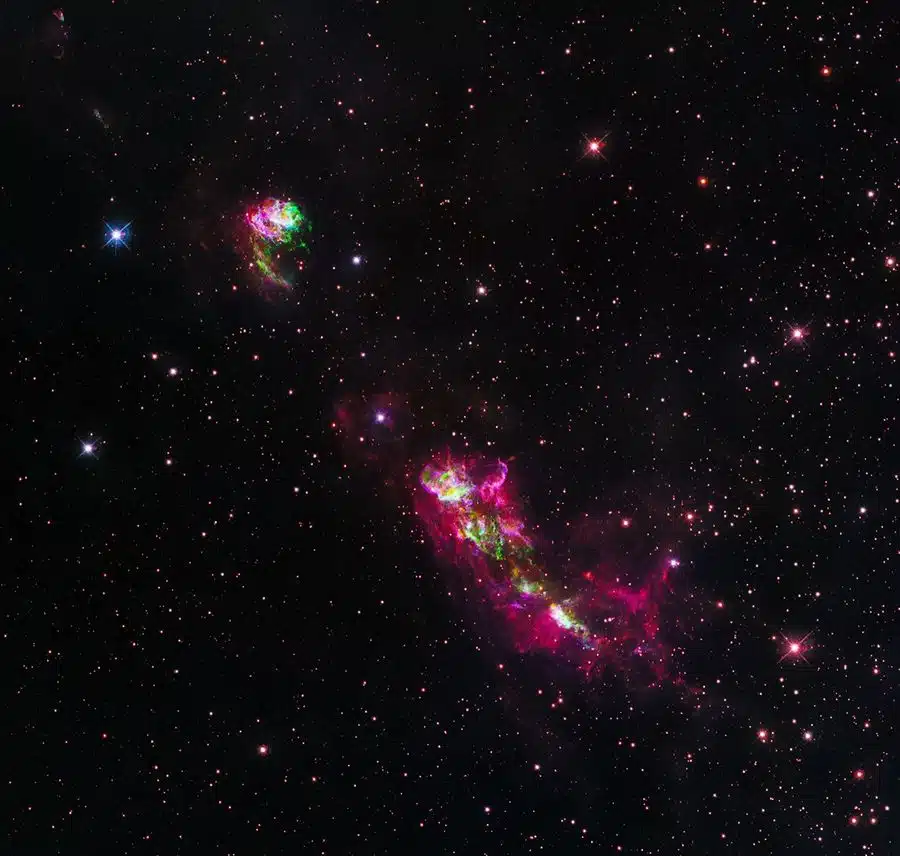 Jets of ionized gas streak across a cosmic landscape from a newly forming star.
NASA, ESA, and B. Reipurth (Planetary Science Institute); Processing: Gladys Kober (NASA/Catholic University of America)
The Power And Chaos Of A Star’s Birth
Protostars such as IRAS 18162-2048 form when immense clouds of interstellar gas collapse under gravity. Yet, these early stellar nurseries are far from peaceful. As material spirals inward, it gains angular momentum and cannot fall directly onto the star. The result is an accretion disk, where powerful magnetic forces twist and eject some of the gas at incredible velocities.
These stellar jets serve as a kind of cosmic vent, releasing excess energy while shaping the star’s evolution. When the expelled gas slams into previously ejected material, it creates shockwaves that heat and ionize the surrounding matter, producing the brilliant glows captured by Hubble. In the case of HH 80 and HH 81, the light emitted is a vivid record of violent stellar adolescence, stretching across tens of trillions of miles.