
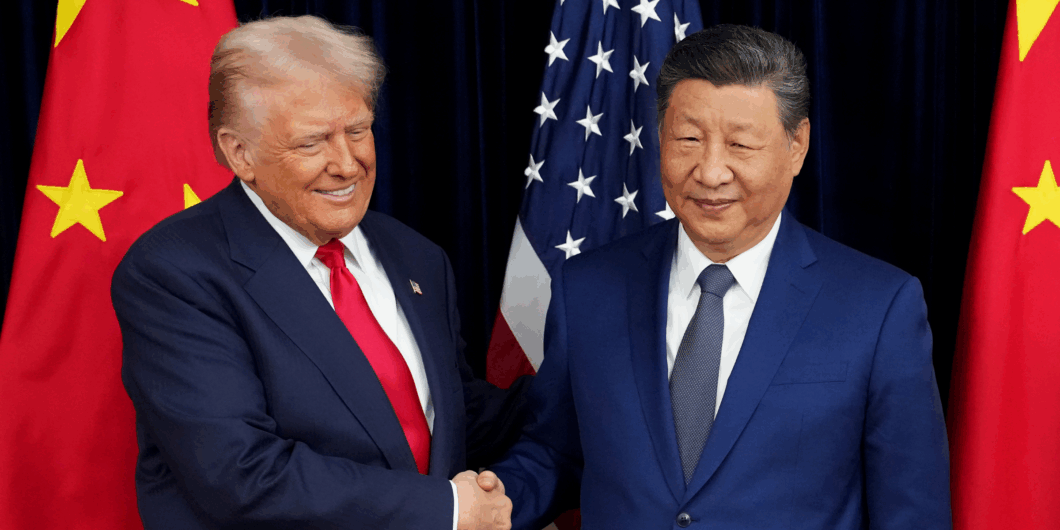
The United States and China are the world’s two great powers. The US boasts the largest economy, the global reserve currency, the leading AI firms, and a military with unmatched worldwide reach. China has the globe’s second-largest economy (far ahead of third-place Germany); commanding positions in key fields such as drones, batteries, and rare earths; an increasingly formidable navy; and, by virtue of its export dominance, substantial leverage over global trade. Cold War II is taking shape.
Or is it?
Dig deeper, and both nations start to look like surprisingly fragile societies drifting slowly but steadily toward disaster. Speaking on a podcast last month, China analyst Dan Wang offered a striking observation: “These two countries,” he said, need “to stop delivering” themselves “humiliating self-beatings.” In the United States, political divisions are entrenched, the distractions of the culture war persist, and respect for the rule of law is eroding. In China, meanwhile, disillusionment with the Chinese Communist Party—though largely hidden from Western eyes—runs deep, while the Chinese military reportedly wastes nearly half its time imbibing political propaganda rather than training for combat.
These pathologies suggest that the “Cold War II” frame—though it must be taken deadly seriously—will before long fizzle out. Each side has its own distinctive flaws, but the most important constraint is shared. Both are empires of debt.
America’s debt problem is well-known to anyone paying attention. Federal debt now stands at roughly $38 trillion. It grows at the staggering pace of more than $2 trillion a year—an especially grotesque accomplishment in a period of relative peace and prosperity—and the interest bill now rivals, and at times exceeds, what the country spends on the military. By any measure, the US debt trajectory is unprecedented and unsustainable.
More troubling than the debt itself is the complacency surrounding it. The economist Kenneth Rogoff writes, with characteristic understatement, that “the odds that the system can reset without having a serious crisis seem low.” The entitlement programs driving the imbalance—above all, Medicare, jealously guarded by politically powerful Boomers—are so sacrosanct that most leaders no longer even pretend to contemplate a change of course. Instead, they posture and deflect. Those who chalk up the deficit to waste, fraud, or a lack of “efficiency” ignore reality: entitlement spending is steadily crowding out discretionary spending. And those who claim that Medicare reform amounts to throwing granny off a cliff sink to demagoguery. Most retirees receive far more in benefits than they paid in taxes, and there is no justice in a system that spends vastly more on the old than it invests in the young.
Rather than confront the looming crisis, even many economists have retreated into denial and magical thinking. This impulse has found expression in fashionable ideas such as “secular stagnation” and “modern monetary theory,” which amount to assertions of faith that debt no longer matters; that interest rates will always remain low, and that inflation has been “solved.” Unsustainable debt helped undo the Spanish Empire, the French monarchy, and the British Empire. But America, we are told, is special. In Rogoff’s sardonic phrase, “This time is different”—always an expensive sentiment.
Our debt will lay us low, if we do not exit the path of exhausted and decadent empires.
Janet Yellen, former Treasury secretary and Federal Reserve chair, recently warned about “fiscal dominance”—a condition in which the Fed, bowing to political pressure, holds interest rates artificially low, come what may, in a bid to keep debt service manageable. Such a policy invites inflation, much as the Biden administration’s post-pandemic spending spree did. Inflation erodes the value of US debt held by foreign official holders. Such erosion, in turn, threatens the dollar’s status as the global reserve currency—a status that contributes to keeping US borrowing costs down.
The upshot is grim. If the United States fails to impose fiscal discipline, the Fed’s attempts to compensate through monetary policy will eventually produce both inflation and higher interest rates. From there will follow slower growth, financial repression (forced holdings of government debt by banks) and diminished returns for depositors, the erosion of reserve-currency privileges (such as the ability to impose financial sanctions), and political instability. Things will not end well.
China is in no better shape. American observers once admired the CCP’s putatively steady hand. Even now, some are easily impressed by gleaming skylines wrapped in LED light. But the CCP has engineered an economy that is lopsided and brittle.
For all its flaws, the American welfare state supports domestic consumption. By contrast, the CCP has stubbornly suppressed household demand, pursuing growth instead through exports and infrastructure investment. The result was a debt-fueled construction binge, led by local governments, complete with trains no one rides and apartments no one occupies. The problem is especially acute in China’s interior, where population decline—driven by low birthrates and migration to those cities with the fancy lights—has compounded deflationary pressure and intensified the real-estate bust.
The central government will ultimately have to absorb much of the local debt. By some estimates, China’s true debt burden exceeds that of the United States. The most promising escape route would be to reignite rapid growth. But how? More infrastructure spending would run into sharply diminishing returns. The familiar tactics of technology theft and currency manipulation (to stimulate exports) are nearing their limits. Sustained frontier innovation (urgently needed as productivity growth slows) would require unleashing the private sector, which the CCP is loath to do.
The party insists that authoritarianism gives China a farsightedness the United States lacks. In practice, however, central planning is uniquely vulnerable to error and folly. The CCP’s fixation on strategic industries comes with vast misallocations of capital. Its brutal one-child policy lies at the heart of the coming demographic collapse that will long weigh on growth. Its supposedly farsighted infrastructure policy has created a debt dilemma as surely as has America’s shortsighted refusal to reform entitlements.
None of this points to an imminent calamity in either country. (Then again, revolutions often seem remote until the moment they arrive.) That said, China’s day of judgment seems closer. The CCP can use coercion to stagger restructurings and avert an abrupt financial implosion. But its growth trap will bite hard. The Chinese social contract rests on a bargain: the people surrender their freedom in exchange for affluence. Prolonged stagnation will imperil the CCP’s legitimacy.
Understanding internal CCP thinking is always difficult. For Beijing, is looming economic strain grounds for attacking Taiwan sooner rather than later? Or is it reason to focus on preserving domestic stability? We cannot know. What we can—and must—do is prepare for every contingency. At present, the United States lacks the munitions depth and industrial capacity to sustain a prolonged conflict. Military power, moreover, has long underwritten dollar primacy. For these reasons, the Trump administration’s call for a greatly increased defense budget is welcome.
As historian Niall Ferguson notes, a great power that spends more on its debt than its army is already sliding toward obsolescence. Obviously, though, the remedy is not simply to spend more on the military as the interest bill accumulates. Real cuts will be needed—which means telling Boomers to stop taking more than they put in. (Don’t hold your breath.)
For all the rancor in Washington and online, the United States remains a deeply fortunate nation. The rule of law limps along, including, crucially, for investors. Capital markets remain deep. Talent continues to flow in from around the world. Our greatest vulnerability may be the degree to which we—leaders and people alike—take our happy inheritance for granted. That China may falter first is cold comfort. Our debt will lay us low, if we do not exit the path of exhausted and decadent empires.