
Scientists have spotted a distant supernova unleashed by a collapsing star just 1 billion years after the birth of the universe.
The James Webb Space Telescope (JWST) captured images of the Type II supernova on Sept. 1 and Oct. 8, 2025. Dubbed “Eos,” after the Titan goddess of dawn in Greek mythology, the supernova will help scientists understand how stars and galaxies evolve over billions of years, researchers reported Jan. 7 on the preprint server arXiv.
You may like
Deaths of the earliest stars
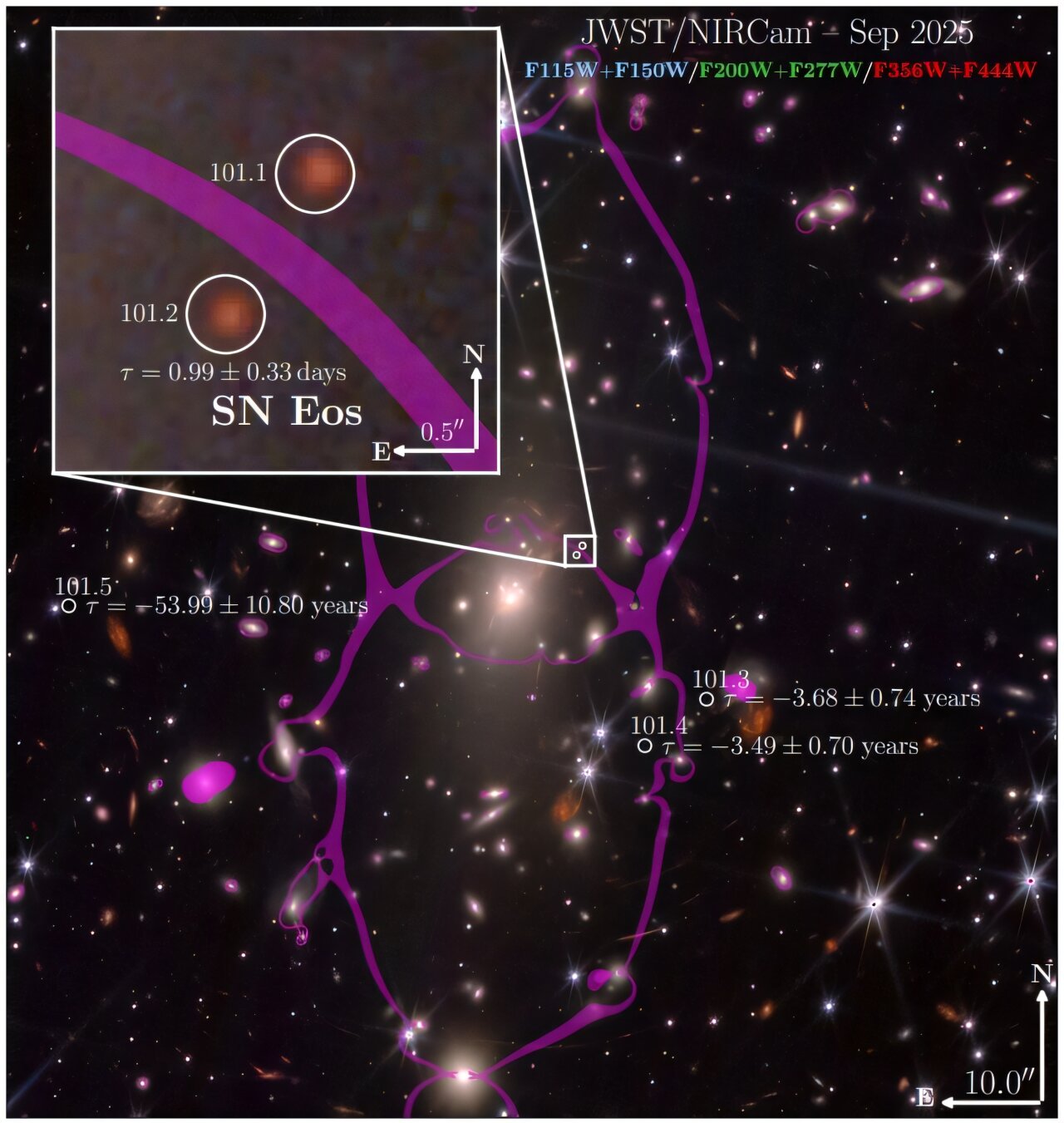
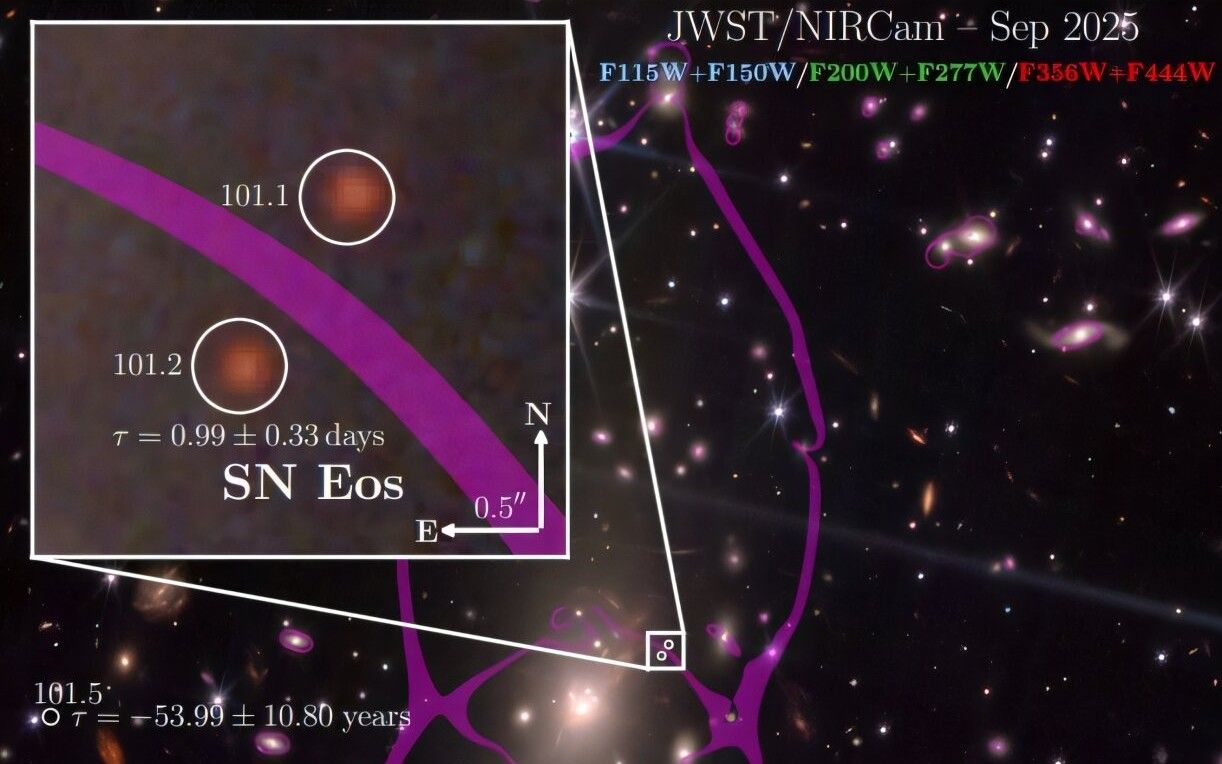
The supernova SN Eos was spotted within the galaxy cluster MACS 1931.8-2635, seen here. The magenta region outlines the area being magnified by the cluster’s gravity. The supernova appears twice (marked 101.1 and 101.2) due to the effects of gravitational lensing. (Image credit: Coulter et al. / JWST)
A supernova occurs when a massive star explodes at the end of its life. Type I supernovas include those that have no hydrogen in their spectra, while Type II supernovas show some evidence of hydrogen. Regardless of the type, supernovas aren’t very common; just two to three occur per century in galaxies the size of the Milky Way.
In the new study, scientists used a phenomenon known as gravitational lensing to capture images of the distant supernova. Gravitational lensing occurs when light passes through an area of space-time that’s been warped by the immense gravity of a massive object, such as a black hole or galaxy cluster. The distortion magnifies that light, allowing scientists to spot objects that would be too dim to see otherwise.
The supernova was rich in hydrogen, and its star exploded in an environment that held a very low concentration of elements heavier than hydrogen. In fact, the progenitor star likely had less than 10% of these heavier elements than our own sun does, the team found. This apparent lack of heavy elements further confirms the supernova’s extremely early age, as stellar fusion had yet to fill the universe with plentiful heavy elements.
By analyzing the ultraviolet light from the burst, the researchers determined that Eos is a Type II-P supernova. The light from a Type II-P supernova remains bright for a while after it peaks, before slowly fading out. (In contrast, Type II-L supernovas dim steadily over time.) Eos is likely near the end of its brightness plateau, the team found.
Scientists still need to observe more early supernovas to confirm if Eos’ properties are typical for massive stars and supernovas of the epoch. But those findings could help scientists chart the evolution of stars and galaxies from the early universe to today.
“The discovery of SN Eos represents a critical step toward fulfilling JWST’s core mission objectives of understanding the lives and deaths of the first stars, the origins of the elements, and the assembly and evolution of the youngest galaxies,” the researchers wrote.