
As Alberta doctors raise red flags about seeing what they say are delays in emergency room care, the province’s hospitals minister says he doesn’t think cases that the doctors have recently highlighted reflect the health system broadly.
Last week, emergency room doctors sent a list to provincial government and health officials of what they say were six potentially preventable deaths and at least 27 other cases where they allege emergency room delays contributed to the patient’s demise or worsened their condition. Locations and identifying information were removed from the document for patient privacy.
The ER doctor who sent the list to government and health leaders said it was a cry for help and that he believes the cases it mentions are just “the tip of the iceberg.”
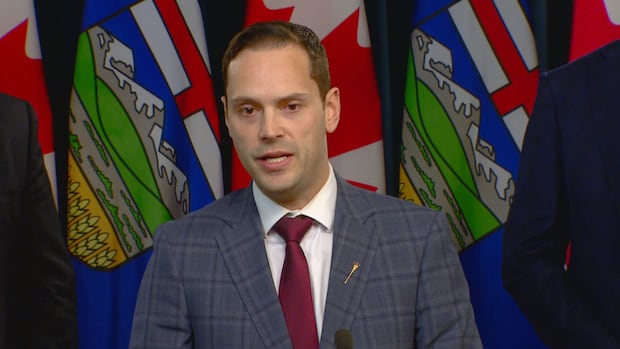
At a news conference in Calgary on Tuesday, Hospital and Surgical Health Services Minister Matt Jones said he sees it differently.
“I don’t feel that these anonymized cases are representative of the incredible care that our system and our front-line health-care professionals provide on a day-to-day basis,” he told reporters.
“I do take them seriously. We must learn from them. But, we also do incredible work every day, for Albertans and their families.”
Jones said sick and frail people arrive in hospitals every day. He said about 0.07 per cent of the two million people who go to Alberta emergency rooms die each year.
He also said Alberta is doing well compared to other provinces at training and recruiting health-care workers.
“You can build all the buildings in the world,” Jones said. “They don’t mean anything if you don’t have health-care professionals to staff them.”
Although Tuesday’s news conference was to promote an expansion of hospital and health-care facilities in the province, Jones said to cope with patients waiting too long for care, various health organizations are also trying to divert less sick patients to clinics, looking at “hospital efficiency” to see how they can move patients more quickly, and trying to transfer patients ready for long-term or home care.
Jones said the provincial government is “actively exploring” how hospitals can discharge patients on weekends, evenings and holidays to continuing care centres. Doctors have pointed to limited office-hours transfers to other facilities as a bottleneck.
ER doctor says suffering widespread in ‘hurricane of patients’
Dr. Warren Thirsk, an emergency medicine physician at Edmonton’s Royal Alexandra Hospital and the president of the Alberta Medical Association’s section of emergency medicine, called on members of the public to share their stories of suffering at crowded hospitals.
Doctors, he said, are trapped behind patient privacy constraints, and human stories have more power to instigate change than data or general observations.
Thirsk helped co-ordinate the collection of doctors’ stories that his colleague, Dr. Paul Parks, sent to the provincial government. CBC News obtained leaked copies of the document, but not from Parks or Thirsk.
 Dr. Warren Thirsk is an emergency physician at two hospitals in Edmonton. (Samuel Martin/CBC)
“I’ve seen countless patients lying in a hallway in their own excrement, in pain, hungry, no sleep — [for] hours, sometimes days,” Thirsk said in an interview on Tuesday before Jones’ news conference.
“… We’ve normalized abnormal by accepting it, or believing it’s a transient thing that will blow over and go away and get better.”
Thirsk, who has been an ER doctor for 26 years, says health administrators have frequently pointed to budget limitations as reasons why they cannot improve the system for patients. Pressure to cut costs continues, and there is no more fat to trim, he said.
Thirsk said health budgets have failed to account for Alberta’s growing — and aging — population.
“We’ve been screaming into the wind in the middle of a hurricane of patients, saying, ‘These people are suffering. This is unacceptable,’” he said.
While Jones and Acute Care Alberta have said health providers conduct reviews when there are questions about a preventable death or harm to a patient, Thirsk said those reviews are fruitless because hospitals don’t have the resources to act upon recommendations.
“It’s a failed system that doesn’t work,” he said.
Minister eyes provincial integrated operations centre
Thirsk is among the doctors calling for the province to declare a state of emergency in response to the current care delays they say they see in hospitals.
Jones dismissed that call last week, saying he has all the powers he needs to respond to the situation.
Alberta NDP Leader Naheed Nenshi repeated the doctors’ call for action on Tuesday, saying one command centre could bring together the fractured segments of the province’s health-care system.
Nenshi also said Premier Danielle Smith should recall the legislature before its planned Feb. 24 spring sitting to discuss the urgent situation, and should provide an accounting of how much it has cost to split Alberta Health Services into new entities.
Nenshi tasked Calgary-Varsity MLA Dr. Luanne Metz with researching how the NDP could structure the provincial health system, should the party form government after the next provincial election.
Nenshi said Jones and Acute Care Alberta saying it’s normal for some patients to die in hospital is an “inhuman” response to potentially preventable deaths.
“People don’t die in the waiting room,” he said. “People don’t die before they’ve been seen.”
Jones said on Tuesday there are integrated operations centres working in Edmonton and Calgary to help co-ordinate the movement of stable patients from hospitals into other types of care.
The minister said authorities are looking at how to better use space available in rural hospitals, and are considering creating a provincewide “command centre” to expand that co-ordination.