
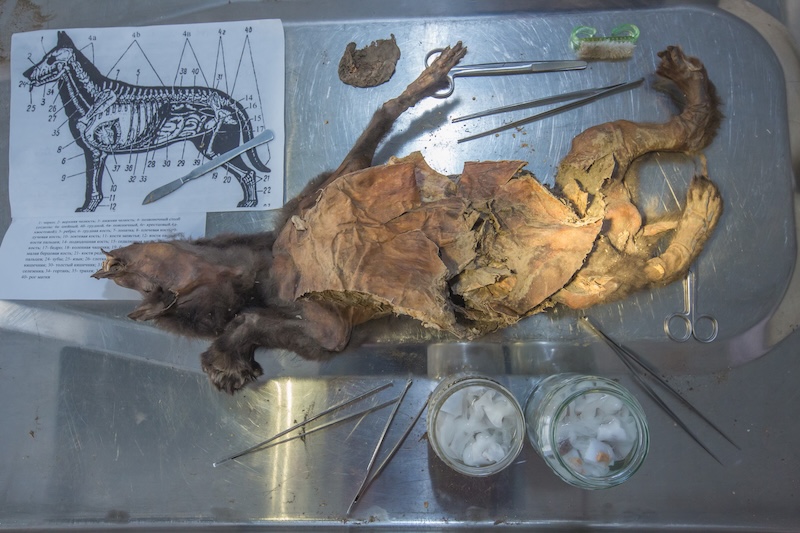
 Scientists found a piece of woolly rhino tissue in the stomach of this 14,400-year-old wolf pup. Genomic analysis of that rhino tissue and 2 other specimens indicate the species went extinct relatively fast. Image via Mietje Germonpré/ Stockholm University.
Scientists found woolly rhino tissue inside the stomach of a 14,400-year-old frozen wolf pup in Siberia.
Genomic analysis showed woolly rhinos stayed genetically healthy until a rapid population collapse near the end of the last Ice Age.
Researchers believe sudden climate warming played a key role in the species’ quick extinction.
EarthSky’s 2026 lunar calendar is available now. Get yours today! Makes a great gift.
Tissue in 14,400-year-old wolf pup belonged to a woolly rhino
As permafrost in far northern and southern latitudes thaws, people have found the remains of ancient animals, tens of thousands of years old. One wolf pup, buried for 14,400 years in the frozen ground at Tumat in northeastern Siberia, had a surprise inside. Scientists found a piece of tissue in its stomach. On January 15, 2026, researchers at Stockholm University said DNA analysis identified it as a now-extinct woolly rhinoceros (Coelodonta antiquitati). Plus, additional genomic analysis of this rhino and two others indicate woolly rhinos remained genetically healthy till the end of the last ice age. Then they underwent a sharp population collapse due to a rapidly changing climate.
Camilo Chacón-Duque of Stockholm University is a co-author of the new paper on these results. He said:
Sequencing the entire genome of an Ice Age animal found in the stomach of another animal has never been done before.
Recovering genomes from individuals that lived right before extinction is challenging, but it can provide important clues on what caused the species to disappear, which may also be relevant for the conservation of endangered species today.
The researchers published their findings in the peer-reviewed journal Genome Biology and Evolution on January 14, 2026.
Woolly rhinos once roamed northern Eurasia
Woolly rhinos were well-adapted for ice age conditions. These hefty creatures had brown fur coats and were insulated by thick layers of fat under the skin. They grazed in cold tundra grasslands of Northern Europe and Asia during the Middle and Late Pleistocene (spanning 774,100 to 11,700 years ago).
These rhinos were about 11 feet (3.3 m) long from head to tail, comparable in size to the white rhinoceros. But the woolly rhino had a longer head and body, and shorter legs. In addition, it had small ears and a short tail, which were adaptations to minimize heat loss. Moreover, the impressive horn on its head may have been used in fights and perhaps to push away snow covering the grass.
There is archaeological evidence that humans hunted or scavenged woolly rhinos, but scientists don’t know if this happened frequently. For instance, bones found in some caves in Europe show signs of cut marks and breaks. Early modern humans even used woolly rhino bones to make tools and weapons. Remarkably, they also depicted woolly rhinos in their art, such as in cave paintings and even as statuettes.
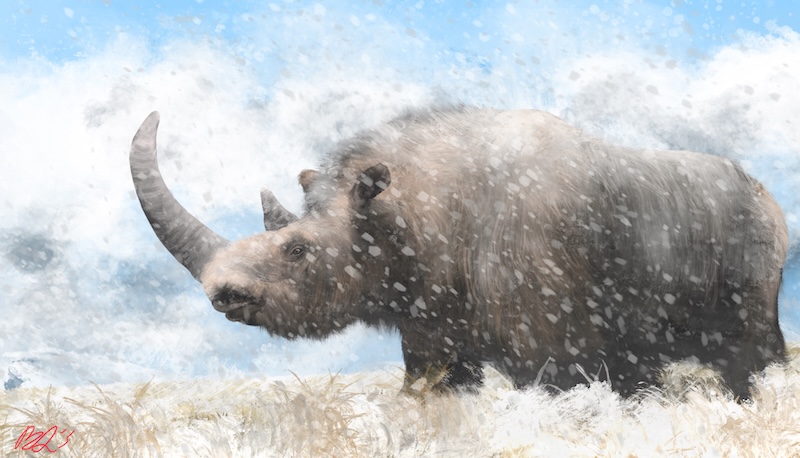 This is artist Benjamin Langlois’ depiction of how the woolly rhino may have appeared in life. Image via Mr Langlois10/ Wikimedia Commons. (CC BY-SA 4.0)
A challenging analysis of tissue from a wolf’s stomach
Scientists used radiocarbon dating to age the wolf pup and the tissue in its stomach. Their results showed both were 14,400 years old. Subsequent DNA analysis of the tissue revealed it belonged to a woolly rhinoceros.
This rhino was a large animal. Therefore, the researchers think the wolves did not hunt it, but instead scavenged a carcass. What’s remarkable about this find is that it was – at 14,400 years old – the youngest woolly rhino tissue sample ever found. Moreover, researchers dated it to just a few centuries before the species became extinct, about 14,000 years ago.
The tissue, just 1.6 by 1.2 inches (4 cm by 3 cm) large, ended up in the wolf shortly before it died. Still, mapping the genome proved to be difficult because DNA degrades over time, and parts of the sample contained wolf DNA.
Lead author Sólveig Guðjónsdóttir of Stockholm University said:
It was really exciting, but also very challenging, to extract a complete genome from such an unusual sample.
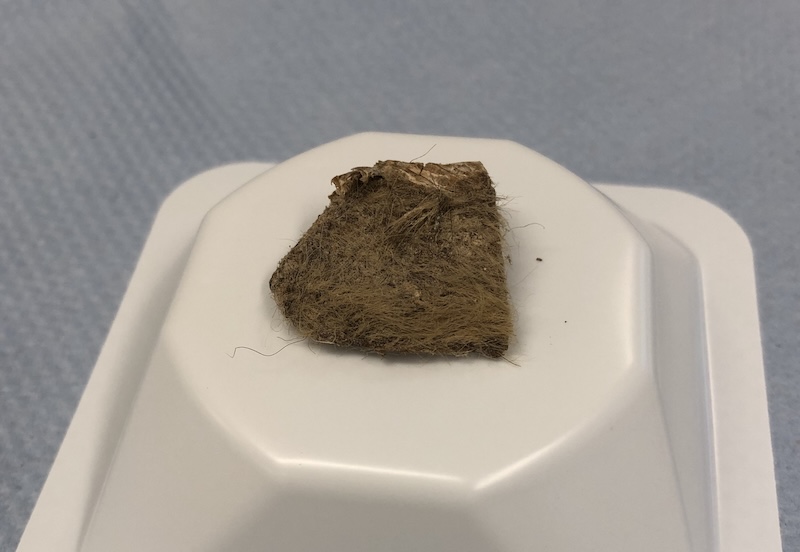 The woolly rhino tissue recovered from the wolf pup’s stomach. Image via Love Dalén/ Stockholm University.
What happened to the woolly rhino?
The researchers also examined the genome of two other woolly rhinoceros specimens, from 18,000 and 49,000 years ago. They wanted to compare the three samples to study changes in the diversity of the genomes, the level of inbreeding and harmful mutations.
If the woolly rhino population had gradually dwindled to low numbers, the researchers would have seen signs of inbreeding and a rise in genetic mutations in the 14,400-year-old sample from the wolf’s stomach.
Instead, they found the opposite. Co-author Edana Lord of Stockholm University remarked:
Our analyses showed a surprisingly stable genetic pattern with no change in inbreeding levels through tens of thousands of years prior to the extinction of woolly rhinos.
Therefore, the scientists concluded, extinction happened relatively quickly. They think it occurred during a period in geological history known as the Bølling–Allerød interstadial (14,690 to 12,890 years ago). That’s when the Northern Hemisphere warmed abruptly. The change in climate increased rainfall, transforming the rhinos’ grassy plains to one of trees and shrubs.
Bottom line: Scientists found tissue from a woolly rhino in the stomach of a 14,400-year-old frozen wolf. Genomic analysis of the tissue indicates woolly rhinos became extinct relatively quickly.
Read more: Why did woolly mammoths go extinct?
Read more: Rhinoceroses: Can modern science save these gentle giants?
Shireen Gonzaga
View Articles
About the Author:
Shireen Gonzaga is a freelance writer who enjoys writing about natural history. She is also a technical editor at an astronomical observatory where she works on documentation for astronomers.